“It is a movie that is so bad it is good, a delightful mess of sexual fantasy and sci-fi camp that somehow manages to be entertaining despite its flaws.”
Roger Ebert
Chicago Sun-Times
 Italy
"See Barbarella do her thing!"
User Score
88600 votes
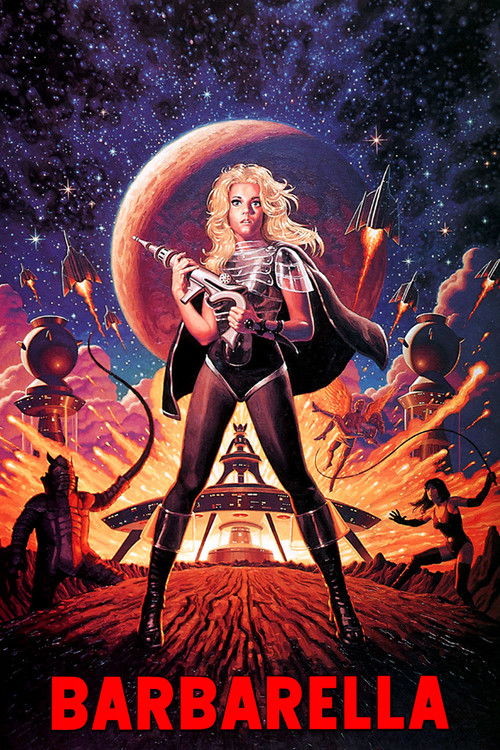
Released in October 1968, Barbarella stands as a unique artifact of late 1960s cinema where science fiction collided with high fashion and surreal comedy. Directed by Roger Vadim, the film adapts Jean-Claude Forest's French comic strip into a visual spectacle that prioritizes style and whimsy over traditional narrative logic. Jane Fonda stars as the titular character, an intergalactic agent whose primary weapon is her innocence rather than violence.
The production marked a significant moment for Vadim, who was married to Fonda at the time. The film features costumes designed by Paco Rabanne, which became instantly iconic for their use of plastic and metal links. Despite initial mixed reviews regarding its plot simplicity, the movie has endured as a cult classic known for its psychedelic aesthetic and bold approach to sexuality.
Rent
Availability and pricing can change. Confirm on the provider's site before purchasing.
In the year 40,000, Earth exists as a utopia under the benevolent rule of the President. This peace faces an existential threat from Durand-Durand, a mad scientist residing on the rebel planet Pygar. He has constructed the Excessive Machine, a device capable of generating infinite energy but also possessing the power to destroy the entire planet if activated. Unable to stop the scientist himself, the President recruits Barbarella, a highly skilled agent known for her optimism and lack of fear.
Barbarella's journey begins with a catastrophic space travel accident that strands her on a desolate world. There she meets Pygar, a winged being who was once human before undergoing a transformation due to a failed experiment. Pygar becomes her guide through the treacherous landscape, leading them toward the City of the Sun. Upon arrival, they are captured by forces loyal to Durand-Durand, initiating a series of encounters with bizarre torture devices designed to extract pleasure until death.
The film introduces a cast of eccentric characters including the sadistic Captain Moon and the enigmatic Mark Hand. Barbarella finds herself subjected to elaborate contraptions like the Love Machine, yet her naivety often causes these devices to malfunction or backfire against their creators. Her mission evolves from a simple assassination attempt into a deeper exploration of power dynamics and the nature of destruction. She forms unexpected alliances with captives and antagonists alike while racing against time to prevent the activation of the Excessive Machine.
As the narrative builds, the story highlights the contrast between cold technological logic and human emotion. Barbarella must confront her own vulnerabilities while navigating a world where morality has been outpaced by innovation. The tension escalates through various challenges that push the boundaries of acceptable content in science fiction cinema of the era. The climax approaches within the heart of Durand-Durand's fortress, leaving the fate of Earth hanging in the balance.
Barbarella (1968) Original Trailer
Barbarella - 50th Anniversary Trailer
Barbarella - Behind the Scenes
Critical Consensus
While unevenly paced and deliberately cheesy, Barbarella stands as a landmark of 1960s sci-fi camp. It combines Jane Fonda's sex appeal with surreal visual effects and a whimsical tone that prefigured modern genre-blending films. Though criticized for its shallow plot, the film is celebrated for its bold aesthetic and cultural impact.
“It is a movie that is so bad it is good, a delightful mess of sexual fantasy and sci-fi camp that somehow manages to be entertaining despite its flaws.”
Roger Ebert
Chicago Sun-Times
“A visually stunning, albeit narratively thin, spectacle that showcases Jane Fonda's charisma and the era's fascination with the exotic.”
Variety Staff
Variety
“Vadim's direction creates a dreamlike atmosphere that is both seductive and absurd, making Barbarella a cult classic that transcends its era.”
Peter Bradshaw
The Guardian
“The film's greatest strength lies in its production design and costumes, which create a unique visual language that remains influential today.”
Todd McCarthy
Hollywood Reporter
Jane Fonda
Barbarella
John Phillip Law
Pygar
Anita Pallenberg
The Great Tyrant
Marcel Marceau
Professor Ping
Claude Dauphin
President of Earth
Milo O'Shea
Durand-Durand
Véronique Vendell
Captain Moon
Serge Marquand
Captain Sun
David Hemmings
Dildano
Ugo Tognazzi
Mark Hand
Director
Roger Vadim
Writers
Jean-Claude Forest, Roger Vadim, Claude Brulé, Terry Southern, Tudor Gates
Composers
Bob Crewe, Charles Fox
Cinematographer
Claude Renoir
Producer
Dino De Laurentiis
Hugo Awards (1969)
Best Dramatic Presentation: Nominated
Join the community
fans discussing