“Bay's direction is so frantic and loud that it becomes exhausting, and the script is so full of clichés that it feels like a parody of itself.”
Roger Ebert
Chicago Sun-Times
 United States
"One last drill to save us all."
User Score
520000 votes
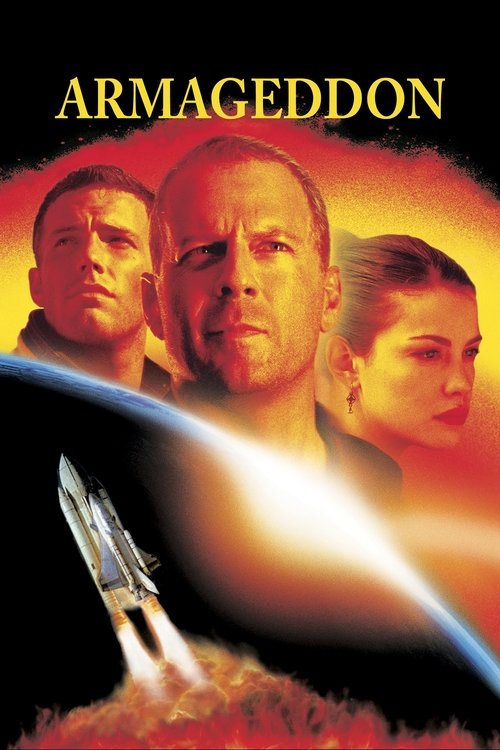
A massive asteroid hurtling toward Earth forces NASA to abandon standard diplomacy in favor of a desperate, high-stakes mission. The agency recruits Harry Stamper, a rough-around-the-edges oil driller, to lead a team of rugged workers into the void. Their goal is simple yet impossible: drill deep into the rock and plant a nuclear device to split the planet-eater before impact. Director Michael Bay brings his signature explosive style to this 1998 sci-fi adventure, blending human drama with spectacular space visuals.
Bruce Willis anchors the film as the stubborn leader, while Billy Bob Thornton plays the pragmatic NASA official who must trust these blue-collar heroes. Ben Affleck adds tension as the young mechanic competing for the affection of Stamper's daughter, Grace, played by Liv Tyler. With a budget of $140 million and a global box office haul exceeding $553 million, the movie became a defining blockbuster of its era. Critics gave it a modest rating of 6.8 out of 10, but audiences embraced the relentless pace and emotional core.
Availability and pricing can change. Confirm on the provider's site before purchasing.
In July 1998, astronomers at NASA Kennedy Space Center spot a celestial object moving on a collision course with Earth. They name it Doomsday, a rock roughly the size of Texas that will strike in exactly eighteen days. Initial attempts to deflect the asteroid using nuclear missiles fail when the explosion shatters the rock into smaller fragments that still threaten to hit the planet. Panic spreads globally as governments scramble for solutions. NASA Director Dan Truman faces immense political pressure from the White House and decides to recruit a team of deep-core oil drillers led by Harry Stamper, a charismatic but estranged Texas oilman known for his expertise in drilling through extreme conditions.
Harry Stamper runs a successful drilling company but struggles with personal relationships, particularly regarding his daughter Grace. She is currently engaged to A.J. Frost, a NASA astronomer, though her heart belongs to Harry. Harry initially refuses the mission, prioritizing his company's safety and his daughter's upcoming wedding. However, after learning that the only way to stop the asteroid is to drill deep into its core and plant a nuclear payload, a task requiring the specific expertise of his crew, Harry agrees, provided he can take his entire team.
The team travels to Russia to board a decommissioned Soviet space station. They undergo rigorous training with NASA astronaut Grigoriy Solovyev and learn to operate in zero gravity. The training montage highlights the camaraderie among the men and the growing tension between A.J. and Harry over Grace. Once launched into space aboard the Soyuz capsule, the team docks with the aging Mir space station, which serves as their base of operations. They must navigate the hostile environment of the asteroid, dealing with extreme temperatures, low oxygen levels, and the psychological strain of being stranded in the void.
As they descend onto the surface, the drill bit encounters unexpected resistance, and the team begins to suffer casualties due to equipment failures and the harsh conditions. The narrative focuses heavily on the brotherhood of the drillers, their loyalty to one another, and the emotional weight of potentially never returning home. Harry struggles with the decision to leave Grace behind, while A.J. fights to prove himself worthy of her love despite the impending doom. As the mission progresses, the clock ticks down. The team discovers that the asteroid is not just a rock but a hollow shell containing a massive energy source, complicating the drilling process. They face a critical failure when the drill gets stuck, forcing them to make desperate sacrifices to free it. The central conflict intensifies as the team realizes that the original plan to split the asteroid might not be enough; they may need to go deeper than anticipated to ensure the nuclear charge detonates effectively. With time running out and the world watching, the drillers must push their physical and mental limits to complete the impossible task. The story builds toward a climactic moment where the fate of humanity rests entirely on the shoulders of these rough-around-the-edges workers, who must decide whether to sacrifice themselves for the greater good or attempt a last-ditch escape.
Armageddon ≣ 1998 ≣ Trailer #2
Armageddon ≣ 1998 ≣ Trailer #1
Criterion Trailer 40: Armageddon
Critical Consensus
Critics widely acknowledged the film's technical prowess and Michael Bay's signature visual style, praising the explosive action sequences and the star-studded cast. However, many felt the script was overly melodramatic, filled with corny one-liners, and relied too heavily on tropes common to 1990s disaster films. While audiences enjoyed the spectacle, reviewers often found the emotional beats unconvincing and the plot predictable.
“Bay's direction is so frantic and loud that it becomes exhausting, and the script is so full of clichés that it feels like a parody of itself.”
Roger Ebert
Chicago Sun-Times
“The movie is a triumph of special effects over storytelling, delivering a spectacle that is undeniably thrilling but emotionally hollow.”
Janet Maslin
The New York Times
“Armageddon is a roller coaster ride that never stops, but it lacks the soul and intelligence to make the journey truly memorable.”
Peter Travers
Rolling Stone
Bruce Willis
Harry S. Stamper
Billy Bob Thornton
Dan Truman
Ben Affleck
A.J. Frost
Liv Tyler
Grace Stamper
Will Patton
Chick
Steve Buscemi
Rockhound
William Fichtner
Willie Sharp
Owen Wilson
Oscar
Michael Clarke Duncan
Bear
Peter Stormare
Lev Andropov
Ken Hudson Campbell
Max
Alec Baldwin
President Harris
Director
Michael Bay
Writers
Jonathan Hensleigh, J.J. Abrams, Tony Gilroy, Robert Roy Pool, Shane Salerno
Composer
Trevor Rabin
Cinematographer
John Schwartzman
Producers
Michael Bay, Gale Anne Hurd, Jerry Bruckheimer
Join the community
fans discussing