 United States


“‘American Graffiti’ is not only a great movie but a brilliant work of historical fiction; no sociological treatise could duplicate the movie's success.”
Roger Ebert
RogerEbert.com
Part of a Collection
American Graffiti Collection
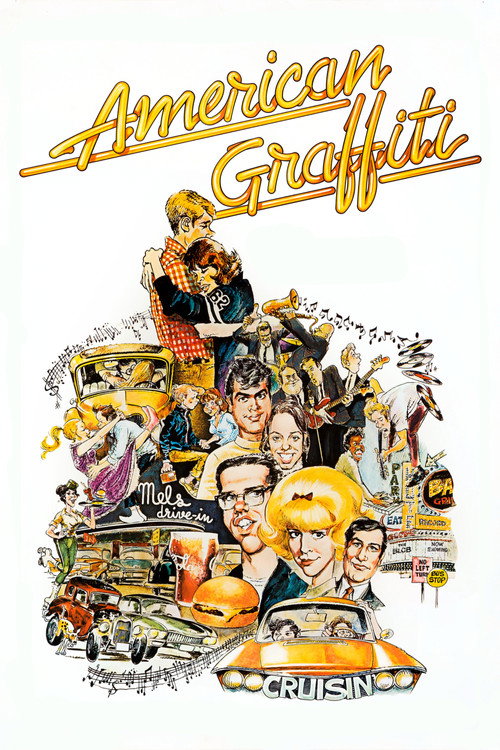
George Lucas's 1973 film American Graffiti captures the fleeting magic of a single summer night in 1962. The story follows a group of recent high school graduates on their last evening together before heading off to college. Cruising the streets of Modesto, California, they navigate the bittersweet territory between adolescence and adulthood, soundtracked by the era's rock and roll hits.
Directed by Lucas and produced by Francis Ford Coppola's company, the movie features a cast of then-emerging stars. Richard Dreyfuss plays Curt Henderson, a thoughtful student contemplating his future, while Ron Howard is Steve Bolander, his more confident friend. John Milner, the cool drag racer, is portrayed by Paul Le Mat, and Charles Martin Smith embodies the endearingly awkward Terry 'The Toad' Fields. The ensemble also includes Cindy Williams and Candy Clark as the young women in their lives.
Shot on a modest budget of $777,000, American Graffiti became a massive commercial success, grossing $140 million at the box office. This comedy-drama, steeped in nostalgia, resonated with audiences and critics alike, earning a rating of 7.039 out of 10 based on over 1,600 votes. It remains a beloved snapshot of a specific time and place, a fond farewell to youth.
Availability and pricing can change. Confirm on the provider's site before purchasing.
The final summer night of 1962 unfolds in Modesto, California, as a group of recent high school graduates prepares to scatter for college and the uncertain future. The air buzzes with the sound of rock and roll, the rumble of souped-up cars, and the nervous energy of youth on the brink of change.
Curt Henderson, played by Richard Dreyfuss, is the central figure contemplating a scholarship to an East Coast university. He's torn between the security of his relationship with Laurie (Cindy Williams) and the magnetic pull of the unknown, symbolized by a mysterious blonde he glimpses driving a white Thunderbird. His friend Steve Bolander (Ron Howard), who is already heading to the local community college with Laurie, tries to offer advice but is grappling with his own anxieties about commitment and growing up.
John Milner (Paul Le Mat), the proud owner of a vintage '32 Ford Deuce coupe, embodies a resistance to the inevitable march of time. He spends the evening cruising the main drag, reliving past glories and engaging in a simmering rivalry with Bob Falfa (Harrison Ford), a slick newcomer with a souped-up '55 Chevy. Terry "The Toad" Fields (Charles Martin Smith), an insecure and often overlooked member of the group, borrows Milner's prized car for the night, hoping to impress a girl and perhaps boost his own confidence.
Throughout the night, the characters encounter a series of vignettes that highlight their hopes, fears, and relationships. They cruise past diners, engage in street races, and listen to the booming voice of radio DJ Wolfman Jack, whose broadcasts provide a nostalgic soundtrack and a constant presence. Curt's search for the blonde in the T-bird becomes a quest for an idealized vision of the future, while Steve and Laurie navigate the complexities of their relationship, their differing plans creating friction. Terry's misadventures with Milner's car lead to both comical mishaps and moments of unexpected self-discovery.
The film captures the specific culture of early 1960s youth, from the cars and the music to the anxieties about leaving home and facing adult responsibilities. It's a portrait of a generation at a crossroads, clinging to the last vestiges of carefree adolescence before the realities of adulthood and historical events begin to shape their lives irrevocably.
American Graffiti ≣ 1973 ≣ Trailer
American Graffiti Trailer
Critical Consensus
A nostalgic and poignant look at youth, American Graffiti masterfully captures the bittersweet transition from adolescence to adulthood through its memorable characters and iconic soundtrack. George Lucas's film is a near-perfect slice of Americana.
“‘American Graffiti’ is not only a great movie but a brilliant work of historical fiction; no sociological treatise could duplicate the movie's success.”
Roger Ebert
RogerEbert.com
“It’s a brilliant film about a specific time and place, and about the universal experience of growing up.”
Variety
Variety
“George Lucas’s nostalgic look back at the early 60s is a near-perfect slice of Americana.”
The Hollywood Reporter
The Hollywood Reporter
“It’s the kind of film that makes you feel good about the past and a little sad about the future.”
The New York Times
The New York Times
Richard Dreyfuss
Curt Henderson
Ron Howard
Steve Bolander
Paul Le Mat
John Milner
Charles Martin Smith
Terry "The Toad" Fields
Cindy Williams
Laurie Henderson
Candy Clark
Debbie Dunham
Mackenzie Phillips
Carol
Wolfman Jack
XERB Disc Jockey
Bo Hopkins
Joe Young
Manuel Padilla Jr.
Carlos
Beau Gentry
Ants
Harrison Ford
Bob Falfa
Director
George Lucas
Writers
George Lucas, Gloria Katz, Willard Huyck
Cinematographers
Jan D'Alquen, Ron Eveslage
Producers
Francis Ford Coppola, Gary Kurtz
Academy Awards (1974)
Best Picture: Nominated
Academy Awards (1974)
Best Director: Nominated
Academy Awards (1974)
Best Supporting Actress: Nominated
Academy Awards (1974)
Best Original Screenplay: Nominated
Golden Globe Awards (1974)
Best Motion Picture – Musical or Comedy: Won
Golden Globe Awards (1974)
Best Director: Won
Golden Globe Awards (1974)
Best Actor – Motion Picture Musical or Comedy: Nominated
Golden Globe Awards (1974)
Best Supporting Actress – Motion Picture: Nominated
Golden Globe Awards (1974)
Best Original Score: Nominated
BAFTA Awards (1974)
Best Actor: Nominated
BAFTA Awards (1974)
Best Supporting Actor: Nominated
BAFTA Awards (1974)
Best Screenplay: Nominated
Join the community
fans discussing