 United States
“The movie is a good one, and its violence is not gratuitous but grows out of the situation. It is a portrait of a city at war with itself.”
Roger Ebert
Chicago Sun-Times
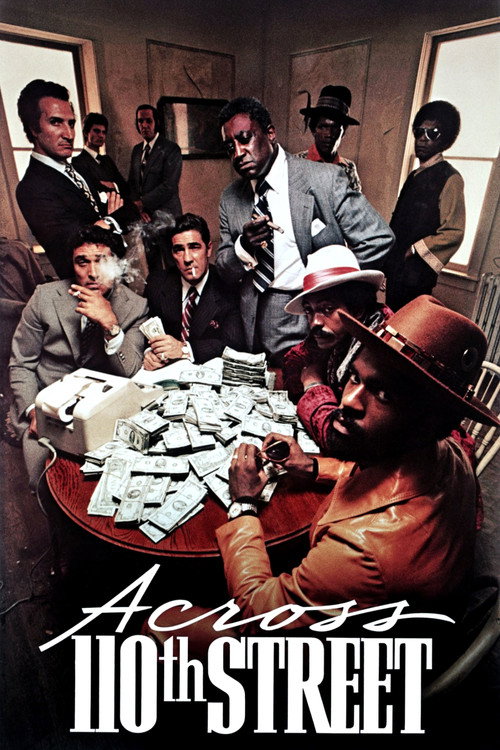
In 1972, Barry Shear directed a gritty crime thriller that pulls no punches. Across 110th Street drops viewers into a Harlem heist gone violently wrong. Three small-time crooks snatch $300,000 from the Italian mob, killing several mafiosi and two cops in the process. The fallout ignites a war between the Mafia, the police, and the desperate thieves. Anthony Quinn plays Capt. Frank Mattelli, a tough, old-school NYPD detective, while Yaphet Kotto stars as Lt. William Pope, a Black officer navigating the racial tensions of the era. Their uneasy partnership anchors the film as they race to find the culprits before the mob's enforcers do. The cast also includes Anthony Franciosa as Nick D'Salvio, a ruthless mob lieutenant, and Paul Benjamin, Richard Ward, and Antonio Fargas among the ensemble. Shot on location in New York City, the film captures the raw, decaying streets of early 1970s Harlem. It blends action, drama, and social commentary, sitting squarely within the blaxploitation wave but with a more serious, documentary-like tone. Produced by Film Guarantors and released through United Artists, the movie didn't set box office records but earned respect for its unflinching portrayal of racial and criminal divides. J.J. Johnson's jazz-infused score adds a layer of cool tension. With a 6.7/10 rating on IMDb from over 140 votes, it remains a cult favorite among crime cinema enthusiasts, praised for its authenticity and the chemistry between Quinn and Kotto.
Availability and pricing can change. Confirm on the provider's site before purchasing.
Across 110th Street opens in the decaying, racially charged landscape of early 1970s Harlem, where the titular street serves as the unofficial dividing line between the Black neighborhood and the white-dominated world of Manhattan below it. The film begins with a violent, meticulously planned heist that goes catastrophically wrong. Three small-time Black criminals, Johnny, Joe Logart, and a third accomplice, have been tipped off about a large sum of Mafia money being collected in a Harlem apartment. They storm the location, but the operation spirals into a bloodbath when the mobsters resist. The robbers kill three Italian mob soldiers and, in the chaos, two uniformed NYPD officers who respond to the scene. They escape with approximately $300,000 in cash, but the carnage they leave behind sets off a chain reaction that will consume everyone involved.
The robbery immediately creates three separate, competing investigations. The NYPD assigns the case to Captain Frank Mattelli (Anthony Quinn), a grizzled, old-school Italian-American detective who has spent decades on the force and harbors deeply prejudiced attitudes toward the Black community he patrols. Mattelli is a relic of a bygone era, blunt, brutal, and convinced that his methods, however unorthodox, are the only way to get results. He is reluctantly paired with Lieutenant William Pope (Yaphet Kotto), a young, college-educated Black officer who is equally frustrated with the department's institutional racism and Mattelli's outdated tactics. Their partnership is tense and adversarial from the start, with each man viewing the other as an obstacle rather than an ally.
Meanwhile, the Italian Mafia, furious at the audacity of the heist and the loss of their men and money, dispatches Nick D'Salvio (Anthony Franciosa), a ruthless, ambitious mob lieutenant, to track down the thieves and recover the cash. D'Salvio is determined to prove himself to his superiors and will stop at nothing to get results. He begins methodically working his way through Harlem's criminal underworld, using violence and intimidation to extract information. His presence in the neighborhood further inflames racial tensions, as the white mobsters encroach on Black turf and threaten the established power structure.
On the other side of the investigation, the three robbers are desperately trying to lay low and divide their stolen fortune. They are connected to Doc Johnson (Richard Ward), a respected and powerful Harlem crime boss who runs his operations with a degree of order and community respect. Doc Johnson is furious when he learns that the heist has brought heat down on his territory and that the police and the Mafia are both tearing apart his neighborhood looking for the culprits. He pressures the robbers to give themselves up or return the money, but they are determined to keep their score.
As Mattelli and Pope pursue their investigation, they clash over methodology and racial perspectives. Pope is acutely aware that he is being judged by both his white superiors and the Black community, and he struggles to navigate the double bind of being a Black cop in a neighborhood that distrusts the police. Mattelli, for his part, sees Pope as an inexperienced idealist who doesn't understand the realities of the street. Despite their animosity, they are forced to work together, and their investigation leads them through Harlem's bars, tenements, and back alleys, uncovering a web of corruption, betrayal, and desperation.
Meanwhile, D'Salvio's brutal hunt for the robbers escalates. He kidnaps and tortures associates of Doc Johnson, killing anyone who might have information about the heist. The violence threatens to spark an all-out race war between the Italian mob and Harlem's Black criminal organizations. The three robbers, now separated and paranoid, begin to turn on each other as the pressure mounts. Each man must decide whether to run, hide, or fight as the net closes in from all sides.
The film's central conflict is not merely a police procedural or a heist thriller; it is a portrait of a city tearing itself apart along racial and economic lines. The title itself is symbolic, 110th Street is the boundary between two worlds, and the film explores what happens when those worlds collide. The narrative weaves together the perspectives of the police, the mob, and the criminals, showing how each is trapped by the systems of race, class, and violence that define their existence.
Across 110th Street (1972) Original Trailer [FHD]
Critical Consensus
A gritty, unflinching crime drama that transcends blaxploitation with documentary-like realism and sharp social commentary. Authentic Harlem locations, tense racial dynamics, and strong performances from Quinn and Kotto make it a standout, though its nihilistic tone may overwhelm some viewers.
“The movie is a good one, and its violence is not gratuitous but grows out of the situation. It is a portrait of a city at war with itself.”
Roger Ebert
Chicago Sun-Times
“A tough, angry, and remarkably effective crime film that uses its Harlem locations with a documentary-like precision.”
Vincent Canby
The New York Times
“Anthony Quinn and Yaphet Kotto give forceful performances in this uncompromising look at racial tensions within the NYPD and the criminal underworld.”
Variety Staff
Variety
“Barry Shear's direction is taut and unrelenting, capturing the desperation of Harlem with a realism that few Hollywood films of the era dared to attempt.”
The Hollywood Reporter Staff
The Hollywood Reporter
“Across 110th Street offers much more than a terrific Bobby Womack jam, it's a blistering, mournful portrait of a community trapped between two corrupt systems.”
Bennett Campbell Ferguson
Willamette Week
Anthony Quinn
Capt. Frank Mattelli
Yaphet Kotto
Lt. William Pope
Anthony Franciosa
Nick D'Salvio
Paul Benjamin
Jim Harris
Richard Ward
Doc Johnson
Antonio Fargas
Henry J. Jackson
Gilbert Lewis
Shevvy
Norma Donaldson
Gloria Roberts
Gloria Hendry
Laurelene
Marlene Warfield
Mrs. Jackson
Nat Polen
Lt. Reilly
Tim O'Connor
Lt. Hartnett
Ed Bernard
Johnny
Director
Barry Shear
Writers
Luther Davis, Wally Ferris
Composer
J.J. Johnson
Cinematographer
Jack Priestley
Producers
Fouad Said, Ralph B. Serpe
Join the community
fans discussing