 France
“A film of such moral complexity and emotional depth that it feels like a revelation. It is a masterpiece of modern cinema.”
A.O. Scott
The New York Times
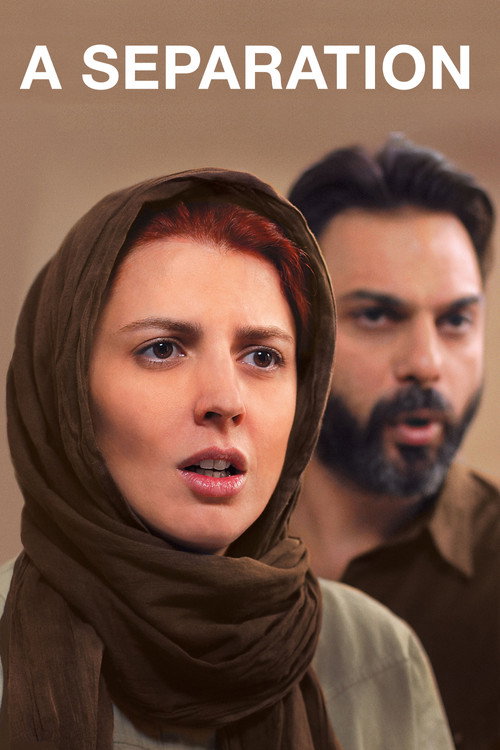
In Tehran, a married couple stands at a crossroads. Simin (Leila Hatami) wants to leave Iran, seeking a better future for their daughter Termeh (Sarina Farhadi). Nader (Payman Maadi) refuses to go, insisting on staying to care for his father, who is losing his grip on reality to Alzheimer's disease. This domestic standoff, written and directed by Asghar Farhadi, cracks open into a story about pride, class, and the quiet lies we tell ourselves.
The film, shot by Mahmoud Kalari with a handheld intimacy that pulls you into every argument, unfolds almost like a thriller, though its genre is pure drama. Made on a modest budget of $5 million, it went on to earn over $24 million worldwide and won the Academy Award for Best Foreign Language Film, a rare feat for an Iranian production. The cast, including Sareh Bayat as a struggling maid and Shahab Hosseini as her volatile husband, delivers performances that feel painfully real.
Stream
Availability and pricing can change. Confirm on the provider's site before purchasing.
Set in the bustling, sun-drenched streets of Tehran, A Separation opens on a domestic crisis that threatens to dismantle a middle-class Iranian family. Nader, a dedicated bank employee and caring son, finds himself locked in a silent war with his wife, Simin. The conflict is not born of infidelity or sudden estrangement, but of fundamental incompatibility regarding their future. Simin has grown weary of life under Iran's restrictive political climate and seeks to emigrate to Canada, hoping to secure a better educational and social environment for their 11-year-old daughter, Termeh. She views staying in Iran as a sentence of stagnation and fear. Nader, however, refuses to leave. His decision is rooted in an unshakeable sense of duty; he must remain to care for his elderly father, who suffers from advanced Alzheimer's disease and requires constant supervision due to his tendency to wander and become disoriented.
The film establishes its central tension through a series of heated arguments where both spouses are portrayed as morally complex rather than purely villainous. Simin is depicted as ambitious, frustrated, and perhaps a bit self-centered, yet her desire for safety and opportunity is entirely rational. Nader is shown as stubborn, proud, and deeply principled, yet his rigidity blinds him to the suffocating reality of his family's situation. Their daughter, Termeh, becomes the tragic casualty of this standoff. Caught between two parents who cannot agree on the most basic facts of their lives, she is forced to make impossible choices, often lying to one parent to protect the other, a burden that weighs heavily on her young shoulders.
Unable to reach a compromise, Simin files for divorce. Under Iranian law, a woman cannot simply walk away from a marriage without specific grounds, and if she leaves the country without her husband's consent, she forfeits custody of the child. Desperate to maintain her bond with her father while also escaping the country, Termeh is left in a limbo state. To resolve the immediate crisis of caring for Nader's father while Simin prepares to leave, Nader hires Razieh, a pious, working-class woman from a rural background. Razieh is desperate for money to support her pregnant sister-in-law and her own family, making her willing to accept the grueling job of caring for the bedridden man.
The dynamic shifts when the hired help becomes entangled in the couple's unraveling marriage. Razieh is inexperienced and struggles with the physical demands of the job and the unpredictable behavior of Nader's father. A pivotal incident occurs involving the father's wandering and a subsequent accident, which triggers a chain reaction of legal and moral complications. As the story unfolds, it transforms from a domestic drama into a tense, thriller-like exploration of class disparity, religious hypocrisy, and the elusive nature of truth. Every character is forced to confront their own moral compromises. Nader's search for justice leads him into the judicial system, where he faces a counter-accusation from Razieh's volatile husband, Hojjat.
The narrative weaves through police stations, courtrooms, and living rooms, peeling back layers of deception. The audience watches as small lies snowball into catastrophic misunderstandings. The film masterfully avoids taking sides, presenting each character's perspective with empathy. We see the desperation of the poor, the arrogance of the privileged, the confusion of the sick, and the pain of the child. The tension builds relentlessly as the characters navigate a society where personal honor and religious piety often clash with economic survival and emotional need. The story culminates in a series of confrontations that test the limits of human endurance, leaving the audience questioning who is truly right and who is truly wrong, all while the fate of the family hangs in the balance.
A Separation | Official Trailer HD (2011)
Critical Consensus
A masterclass in moral ambiguity and human complexity, Asghar Farhadi crafts a gripping narrative that transcends cultural boundaries. The film explores universal themes of family, responsibility, and truth with precision and empathy. Its refusal to provide easy answers forces the audience to engage deeply with every character's perspective, resulting in a powerful and emotionally resonant experience.
“A film of such moral complexity and emotional depth that it feels like a revelation. It is a masterpiece of modern cinema.”
A.O. Scott
The New York Times
“Farhadi has created a film that is as suspenseful as any thriller and as moving as any drama. It is a triumph of storytelling.”
Peter Travers
Rolling Stone
“A riveting, intricately plotted drama that never loses sight of its human core. The performances are uniformly excellent.”
Todd McCarthy
The Hollywood Reporter
“Farhadi's script is a marvel of construction, building tension slowly and surely until the final, devastating blow.”
David Denby
The New Yorker
“A film that demands to be seen and discussed. It is a profound exploration of the human heart and the consequences of our choices.”
Mark Kermode
The Guardian
Leila Hatami
Simin
Payman Maadi
Nader
Sareh Bayat
Razieh
Sarina Farhadi
Termeh
Shahab Hosseini
Hojjat
Kimia Hosseini
Somayyeh
Ali-Asghar Shahbazi
Nader's Father
Babak Karimi
Interrogator
Merila Zarei
Miss Ghahraii
Shirin Yazdanbakhsh
Simin's Mother
Director
Asghar Farhadi
Writer
Asghar Farhadi
Composer
Sattar Oraki
Cinematographer
Mahmoud Kalari
Producer
Asghar Farhadi
Academy Awards (2012)
Best Foreign Language Film: Won
Academy Awards (2012)
Best Original Screenplay: Nominated
Golden Globe Awards (2012)
Best Foreign Language Film: Won
Berlin International Film Festival (2011)
Golden Bear: Won
Berlin International Film Festival (2011)
Silver Bear for Best Actor: Won
Berlin International Film Festival (2011)
Silver Bear for Best Actress: Won
BAFTA Awards (2012)
Best Film Not in the English Language: Won
César Awards (2012)
Best Foreign Film: Won
European Film Awards (2011)
Best Film: Won
European Film Awards (2011)
Best Director: Won
Join the community
fans discussing