“Redford has made a film that is both a love letter to the past and a meditation on the passage of time. It is a masterpiece of visual storytelling.”
Roger Ebert
Chicago Sun-Times
 United States
"Nothing perfect lasts forever. Except in our memories."
User Score
118000 votes
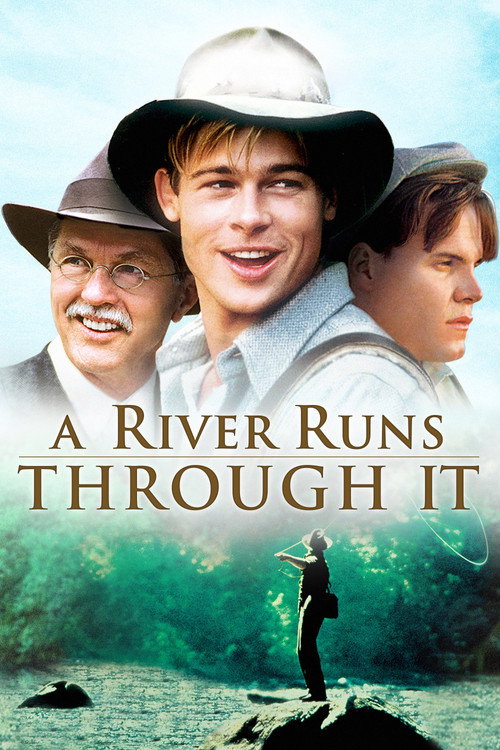
Robert Redford directed this semi-autobiographical drama adapted from Norman Maclean's 1976 novella. The story unfolds in 1920s Montana where fly fishing serves as a spiritual language for the Maclean family. Reverend John Maclean teaches his sons that casting a line is an act of faith, yet the river also mirrors the turbulent currents of their personal lives.
Craig Sheffer portrays Norman, the disciplined older brother who leaves for university, while Brad Pitt plays Paul, the younger sibling whose rebellious nature clashes with the town's strict moral code. The film captures the passage of time through seasons on the Big Blackfoot River and explores how two brothers navigate diverging paths without losing their bond.
Availability and pricing can change. Confirm on the provider's site before purchasing.
The narrative begins with Norman Maclean returning to his hometown in Montana as a middle-aged professor and journalist. He reflects on his youth alongside his brother Paul under the guidance of their father, a Presbyterian minister who demands perfection in both prayer and fishing. The boys learn to cast their lines not just as a sport but as a discipline that requires patience and precision. Their mother remains a steady presence in the background while the father insists on rigorous training methods that push the children to master the art of the cast.
Norman eventually departs for the University of Chicago to study literature and later becomes a teacher, finding solace in books and academic order. Paul stays behind in Montana where he struggles with the rigid expectations of his community. His charismatic personality draws him into the company of local gamblers, particularly the Burns family. Jessie Burns becomes his romantic interest and introduces him to card games that quickly spiral out of control. Despite the Reverend's stern disapproval of gambling as a sin, he continues to fish with Paul hoping to steer him toward redemption.
The tension escalates as Paul's addiction deepens. He spends nights at card tables drinking heavily and losing money he does not have. The father watches helplessly as his son drifts further away from the path of virtue. Montage sequences show the changing seasons and the aging faces of the family members. The conflict centers on whether anyone can save a soul once it has been consumed by its own demons. The film balances breathtaking shots of the river with intimate scenes of family dinners and quiet arguments. As the years pass, the brothers grow apart yet remain connected by the shared memory of the water they loved together. The story builds toward a tragic turning point where the consequences of Paul's choices become undeniable.
Throughout the runtime the film avoids melodrama in favor of understated emotion. Characters speak sparingly and much of the communication happens through gestures or silence. The cinematography emphasizes the natural beauty of the landscape which contrasts sharply with the internal turmoil of the characters. Viewers witness the slow erosion of hope as Paul's behavior becomes increasingly erratic. The father tries every method he knows to reach his son but finds himself powerless against the pull of addiction. The narrative focuses on the inevitability of loss and the difficulty of accepting imperfection in those we love most.
Official Trailer
Re-Release Trailer
Critical Consensus
The film stands as a visually stunning adaptation that captures the beauty of nature and the complexity of family dynamics. Robert Redford's direction balances intimate character studies with sweeping landscapes. While some critics found the pacing slow the poetic storytelling and Brad Pitt's breakthrough performance elevate it to a timeless classic.
“Redford has made a film that is both a love letter to the past and a meditation on the passage of time. It is a masterpiece of visual storytelling.”
Roger Ebert
Chicago Sun-Times
“A beautiful melancholy film that captures the essence of a bygone era. The performances are subtle and the cinematography is breathtaking.”
Janet Maslin
The New York Times
“Brad Pitt delivers a career-defining performance as the troubled Paul. The film is a haunting reminder of the fragility of life.”
Peter Travers
Rolling Stone
Craig Sheffer
Norman Maclean
Brad Pitt
Paul Maclean
Tom Skerritt
Reverend Maclean
Brenda Blethyn
Mrs. Maclean
Emily Lloyd
Jessie Burns
Director
Robert Redford
Writers
Richard Friedenberg, Norman Maclean
Composer
Mark Isham
Cinematographer
Philippe Rousselot
Producers
Robert Redford, Patrick Markey, Amalia Mato
Academy Awards (1993)
Best Cinematography: Nominated
Golden Globe Awards (1993)
Best Original Score: Nominated
BAFTA Awards (1993)
Best Cinematography: Nominated
National Board of Review (1992)
Best Film of the Year: Won
Directors Guild of America (1993)
Outstanding Directorial Achievement in Motion Pictures: Nominated
Join the community
fans discussing