 France
“A masterpiece of tension and spirituality.”
Roger Ebert
Chicago Sun-Times
Set in Lyon during the Nazi occupation of World War II, this film follows Fontaine, a French Resistance fighter imprisoned at Fort Montluc. Robert Bresson directs François Leterrier as a man who must rely on patience and faith rather than action to survive his confinement. The narrative strips away Hollywood melodrama to focus on the minute details of an escape plan that seems impossible against overwhelming odds.
The story unfolds through methodical preparation as Fontaine observes his captors and forms a bond with fellow prisoner Jost. Together they devise a way out using simple tools found within the cell. Their struggle is not just physical but spiritual, highlighting themes of grace and the randomness of survival in a world controlled by fear.
Availability and pricing can change. Confirm on the provider's site before purchasing.
Fontaine arrives at Fort Montluc, a detention center run by the German Abwehr under the command of Klaus Barbie. He is placed in a cell with other prisoners, including Jost, a fellow resistance member who becomes essential to his survival, and Blanchet, whose grim fate serves as a constant reminder of the stakes involved. The environment is defined by constant surveillance, dehumanizing routines, and the ever-present threat of execution. Unlike typical prison break films that rely on large groups or action sequences, this narrative focuses intensely on the solitary struggle of one man against an oppressive system.
The central conflict is intellectual and spiritual as much as it is physical. Fontaine must maintain his sanity while meticulously planning an escape that appears futile given the heavy security, the presence of dogs, and the watchful eyes of guards. He observes the habits of his captors, noting the sounds of footsteps, the timing of guard changes, and the layout of the facility. He forms a bond with Jost, and together they devise a plan to tunnel out of their cell and navigate the prison grounds. The narrative highlights the importance of faith and luck, themes Bresson weaves into the fabric of the film. Fontaine frequently encounters moments of chance, such as finding a tool left behind by a guard or receiving a small item from a sympathetic outsider, which he interprets as signs of divine intervention.
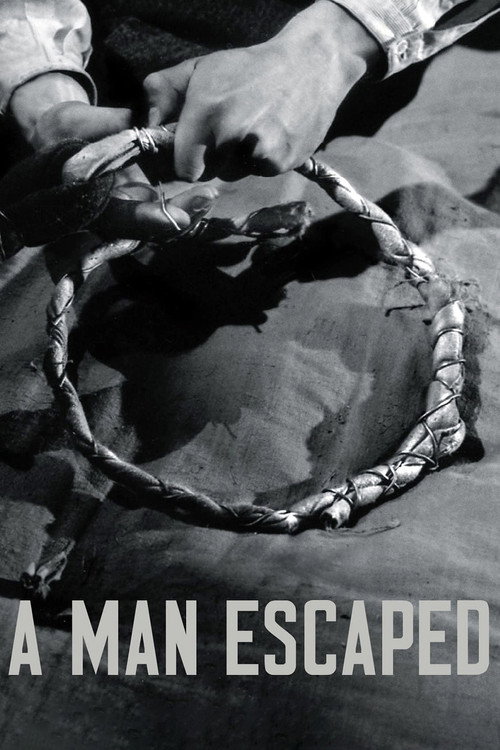
As the weeks pass, the tension mounts. The film captures the monotony of prison life punctuated by sudden bursts of anxiety and the crushing weight of uncertainty. Fontaine’s relationship with Jost deepens, yet the film maintains a distance, refusing to sentimentalize their friendship. Instead, it portrays their interactions as necessary for survival, grounded in shared purpose rather than emotional outbursts. The plot thickens as they begin to execute their plan, using simple tools like a spoon to loosen stones and a rope made from bed sheets to descend walls. Each step is fraught with danger; a single mistake could mean death or a transfer to a more secure location where escape would be futile.
The middle section of the film is a study in patience and precision. Fontaine and Jost work in silence, communicating through subtle gestures and coded language to avoid detection. They face internal struggles as well, with Fontaine grappling with doubts about their chances of success and the moral implications of leaving others behind. The film also touches on the broader context of the war, showing glimpses of the outside world through the eyes of the prisoners, reinforcing the urgency of their mission. As the date of their planned escape approaches, the atmosphere becomes increasingly suffocating, with every sound amplified and every shadow seeming ominous.
Bresson’s direction ensures that the audience feels the claustrophobia and the relentless pressure of time. The camera remains steady, often focusing on hands, feet, or objects, emphasizing the physicality of the task at hand. There are no dramatic musical swells or orchestral scores to manipulate emotions; instead, the sound design relies on ambient noises, the clinking of keys, the rustling of fabric, the distant bark of a dog, to create an immersive experience. The story builds toward a climax that is both inevitable and uncertain, leaving the viewer in suspense as Fontaine and Jost prepare to make their final move. The film refuses to offer easy answers or guaranteed triumph, instead presenting escape as a fragile, precarious act of will that hinges on countless variables beyond human control.
A Man Escaped - Original Trailer
Critical Consensus
A masterpiece of restraint and precision, A Man Escaped redefines the prison drama genre through its austere style and profound exploration of faith and survival. Bresson’s direction transforms a simple escape story into a spiritual journey, captivating audiences with its unflinching realism and emotional depth.
François Leterrier
Fontaine
Charles Le Clainche
Jost
Maurice Beerblock
Blanchet
Roland Monod
Priest of Leiris
Jacques Ertaud
Orsini
Director
Robert Bresson
Writers
Robert Bresson, André Devigny
Cinematographer
Léonce-Henri Burel
Producers
Alain Poiré, Jean Thuillier
Cannes Film Festival (1957)
Best Director: Won
BAFTA Awards (1957)
Best Film from any Source: Nominated
National Board of Review (1957)
Top Ten Films: Won
New York Film Critics Circle Awards (1957)
Best Foreign Language Film: Won
Join the community
fans discussing