“DaCosta brings a chilling precision to the cult dynamics, making 'The Bone Temple' a terrifying exploration of how easily fear can morph into dogma.”
Peter Debruge
Variety
Part of the 28 Days Later series
Series community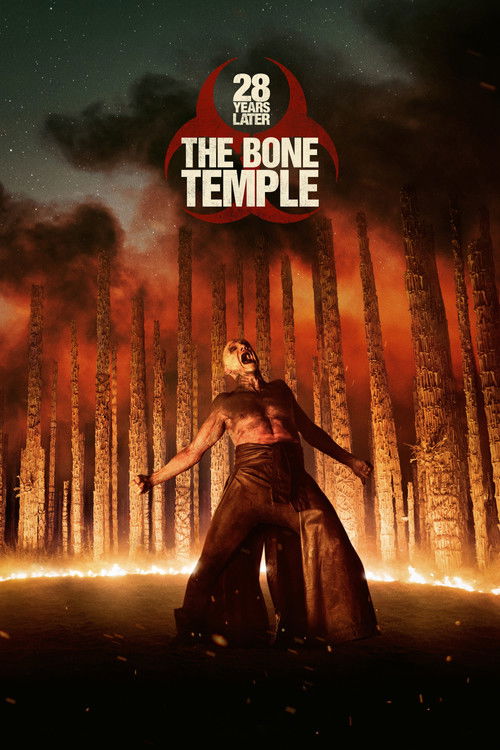
 United States
"Fear is the new faith."
User Score
1751 votes
Part of a Collection
28 Days/Weeks/Years Later Collection
Nia DaCosta steps into the director's chair for this third chapter, steering the franchise away from mindless rage toward a chilling exploration of organized fanaticism. Set twenty-eight years after the events of 28 Weeks Later, the film finds civilization fractured but not entirely gone. The story splits between Dr. Kelson, an aging scientist guarding the remnants of old knowledge, and Spike, a young survivor trapped in a nightmare orchestrated by a ruthless cult leader.
The narrative shifts focus from biological horror to psychological dread as the infected virus evolves into a tool for social control. Filmed on location in Northumberland, the movie uses the rugged English landscape to create a backdrop of stark beauty and decay. With a budget of $63 million, the production aims to deliver a visceral experience that blends action with deep thematic questions about faith and survival.
Availability and pricing can change. Confirm on the provider's site before purchasing.
In the ruins of England, Dr. Kelson spends his days cataloging the dead past while searching for any sign that the Rage virus might still hold answers. He lives in isolation until a strange signal leads him to evidence suggesting the pathogen has mutated into something far more dangerous than simple aggression. His research points toward a hidden facility where biology and belief have merged into a terrifying new reality.
Meanwhile, Spike wanders the desolate countryside trying to stay alive. He stumbles upon a group led by Sir Jimmy Crystal, a man who commands absolute loyalty through fear and ritual. Crystal runs 'The Bone Temple,' a sect that has risen from the ashes of society. Unlike the shambling infected of previous films, these followers are sharp, organized, and driven by a twisted devotion to a deity rooted in ancient English soil.
Spike is captured and forced into the cult's hierarchy, where he witnesses brutal rituals designed to break the human spirit. Crystal believes the virus was never meant to destroy humanity but to evolve it. He sees himself as a prophet leading the next stage of human survival. As Spike struggles to maintain his sanity, he realizes the cult's power comes from a hive-mind connection fueled by the mutated strain.
Kelson races against time to expose the truth behind the temple. He discovers that the cult's 'faith' is actually a biological weapon that turns followers into super-soldiers. The two storylines converge as Kelson infiltrates the fortified complex built around an ancient stone structure. The tension builds as Spike must choose between submitting to the cult's ideology or finding a way to escape before he becomes part of their twisted legacy. The boundaries between the infected, the cultists, and the survivors blur, creating a high-stakes confrontation that tests the limits of human endurance.
The film showcases DaCosta's signature visual style, emphasizing the stark beauty of the decaying English landscape. Hildur Guðnadóttir's score adds a haunting layer to the atmosphere, blending orchestral swells with ambient electronic textures. The story explores themes of desperation and the fragility of morality in a lawless world, culminating in a sequence that challenges the audience's understanding of what it means to be human in a post-apocalyptic setting.
International Trailer
New Trailer
Official Trailer
Critical Consensus
Early reviews praise Nia DaCosta for injecting fresh energy into the franchise, blending visceral horror with deep thematic exploration of faith and fanaticism. Critics highlight the standout performances of Ralph Fiennes and Jack O'Connell, noting the film's successful transition from zombie tropes to a more cerebral, cult-based horror narrative. The cinematography and Hildur Guðnadóttir's haunting score are frequently cited as major strengths.
“DaCosta brings a chilling precision to the cult dynamics, making 'The Bone Temple' a terrifying exploration of how easily fear can morph into dogma.”
Peter Debruge
Variety
“A bold reinvention of the franchise that trades mindless zombies for something far more sinister: human belief turned into a weapon.”
David Ehrlich
IndieWire
“Fiennes delivers a career-defining performance as a man haunted by his past, anchoring a film that is as much a character study as it is a horror thriller.”
Owen Gleiberman
Variety
“The film's atmosphere is suffocating in the best way possible, creating a sense of dread that lingers long after the credits roll.”
Richard Roeper
Chicago Sun-Times
Ralph Fiennes
Dr. Kelson
Alfie Williams
Spike
Jack O'Connell
Sir Jimmy Crystal
Erin Kellyman
Jimmy Ink
Chi Lewis-Parry
Samson
Director
Nia DaCosta
Writer
Alex Garland
Composer
Hildur Guðnadóttir
Cinematographer
Sean Bobbitt
Producers
Alex Garland, Danny Boyle, Andrew Macdonald, Bernard Bellew, Peter Rice
Saturn Awards (2026)
Best Horror Film: Nominated
Saturn Awards (2026)
Best Director: Nominated
BAFTA Awards (2026)
Outstanding British Film: Nominated
Critics' Choice Movie Awards (2026)
Best Sci-Fi/Horror Movie: Nominated
Join the community
fans discussing