 United States
“A film about baseball that isn't really about baseball, but about the war between intuition and statistics, and about a man who tries to think his way past the limitations of his budget.”
Roger Ebert
RogerEbert.com
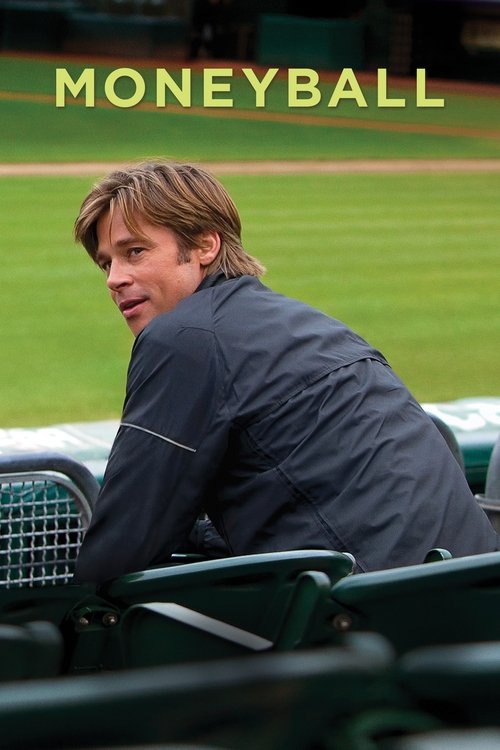
In 2002, the Oakland Athletics had a problem. Their three best players had just been bought up by richer teams, and their general manager, Billy Beane, was stuck with a $41 million payroll against the Yankees' $125 million. Conventional wisdom said there was no way to compete. So Beane decided to ignore conventional wisdom entirely.
This film, directed by Bennett Miller and written by Steven Zaillian and Aaron Sorkin, follows Beane as he teams up with Peter Brand, a Yale economics grad who believes that baseball's old scouting methods are obsolete. Together, they build a team from castoffs and misfits, players with high on-base percentages but low market value. The old guard, including manager Art Howe, fights them at every turn. But as the A's start winning, the system proves itself.
Brad Pitt gives one of his best performances as Beane, a man haunted by his own failed playing career and driven to prove that data can beat money. Jonah Hill, in a career-changing dramatic role, plays Brand with quiet intensity. Philip Seymour Hoffman brings gruff resistance as Howe. The film cost $50 million to make and grossed over $110 million worldwide, earning six Academy Award nominations including Best Picture.
Availability and pricing can change. Confirm on the provider's site before purchasing.
The 2001 season ends in disappointment for the Oakland Athletics. They lose the American League Division Series to the New York Yankees, and then watch their stars, Jason Giambi, Johnny Damon, Jason Isringhausen, leave for bigger contracts. Billy Beane, the general manager, visits Cleveland to discuss a trade and meets Peter Brand, a young Yale graduate working in the Indians' front office. Brand shows Beane a new way to evaluate players: using sabermetrics, focusing on overlooked stats like on-base percentage rather than traditional scouting reports.
Beane hires Brand as his assistant GM. Together they identify undervalued players: Scott Hatteberg, a catcher whose arm is shot but who gets on base; David Justice, an aging veteran; Chad Bradford, a submarine-style pitcher no one wants. The A's scouting staff, led by Grady Fuson, is hostile. They see players' physical flaws and ignore the numbers. Manager Art Howe refuses to play the new acquisitions, preferring his own lineup. Beane forces his hand by trading away Howe's preferred players, leaving him no choice.
The season starts badly. The A's lose game after game. Beane, unable to watch, paces in the gym while the team plays. He is haunted by his own past, once a can't-miss prospect who never fulfilled his potential. His daughter Casey lives with him part-time, and she sees his obsession. The media mocks the A's approach. But slowly, the wins start coming.
In August, the A's begin an incredible run. They win 20 games in a row, tying the American League record. The streak silences critics and validates Beane's system. But the film does not end in triumph. The A's enter the playoffs, and the season ends with another early exit. Beane is offered a record $12.5 million contract to run the Boston Red Sox, a team with deep pockets that wants to implement his methods. He must decide: take the money and resources, or stay in Oakland with his daughter and unfinished business.
Official Trailer
Australian Trailer
Critical Consensus
Moneyball is a sharp, intelligent sports drama that transcends its genre by focusing on strategy and innovation rather than on-field action. Brad Pitt delivers one of his best performances, and Aaron Sorkin's crackling dialogue elevates the material into a compelling meditation on risk, data, and the human cost of progress.
“A film about baseball that isn't really about baseball, but about the war between intuition and statistics, and about a man who tries to think his way past the limitations of his budget.”
Roger Ebert
RogerEbert.com
“Mr. Pitt gives one of the best performances of his career, capturing Beane's intelligence, his frustration and his stubborn, almost mystical faith in the power of numbers.”
A.O. Scott
The New York Times
“Moneyball is a home run. Brad Pitt has never been better, and Jonah Hill is a revelation. Bennett Miller directs with a sure hand, and the script by Steven Zaillian and Aaron Sorkin is a beauty.”
Peter Travers
Rolling Stone
“A smart, invigorating and thoroughly engaging look at how a new way of thinking transformed baseball, with Brad Pitt delivering one of his finest performances.”
Todd McCarthy
The Hollywood Reporter
“It's a film about baseball for people who don't like baseball, and about statistics for people who don't like statistics. Brad Pitt is magnetic, and the film has real emotional heft.”
Peter Bradshaw
The Guardian
Brad Pitt
Billy Beane
Jonah Hill
Peter Brand
Philip Seymour Hoffman
Art Howe
Robin Wright
Sharon
Chris Pratt
Scott Hatteberg
Stephen Bishop
David Justice
Reed Diamond
Mark Shapiro
Brent Jennings
Ron Washington
Ken Medlock
Grady Fuson
Tammy Blanchard
Elizabeth Hatteberg
Jack McGee
John Poloni
Vyto Ruginis
Pittaro
Kerris Dorsey
Casey Beane
Director
Bennett Miller
Writers
Steven Zaillian, Aaron Sorkin, Stan Chervin
Composer
Mychael Danna
Cinematographer
Wally Pfister
Producers
Michael De Luca, Rachael Horovitz, Brad Pitt
Academy Awards (2012)
Best Picture: Nominated
Academy Awards (2012)
Best Actor: Nominated
Academy Awards (2012)
Best Supporting Actor: Nominated
Academy Awards (2012)
Best Adapted Screenplay: Nominated
Academy Awards (2012)
Best Sound Mixing: Nominated
Academy Awards (2012)
Best Film Editing: Nominated
Writers Guild of America (2012)
Best Adapted Screenplay: Won
National Board of Review (2011)
Best Actor: Won
National Board of Review (2011)
Best Adapted Screenplay: Won
Join the community
fans discussing