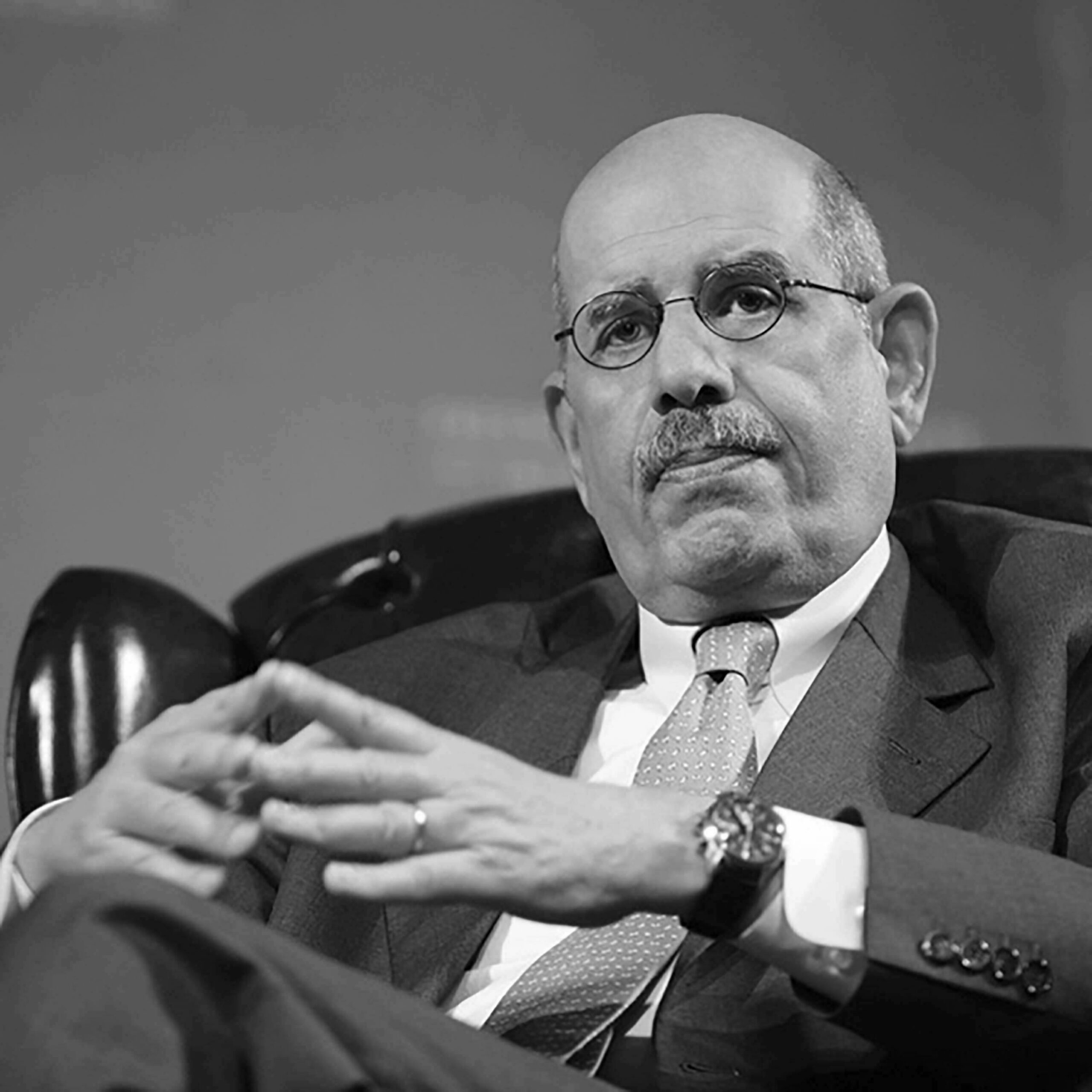
Mohamed ElBaradei
 Egypt
Also known as: Mohamed Mustafa ElBaradei, Mohamed El Baradei, Mohamed M. ElBaradei, Mohamed Mostafa ElBaradei
Birthday
June 17, 1942
Birth Sign
Gemini
Birthplace
Cairo, Egypt
Age
84 years old
About
Mohamed Mostafa ElBaradei is an Egyptian lawyer, diplomat, and politician who served as the Director General of the International Atomic Energy Agency from 1997 to 2009. He is best known for his leadership in nuclear non-proliferation efforts, which earned him the Nobel Peace Prize in 2005 alongside the IAEA. His tenure included high-stakes inspections in Iraq prior to the 2003 invasion and navigating complex diplomatic standoffs regarding Iran and North Korea.
Following his departure from the IAEA, ElBaradei returned to Egypt to become a central figure in the reform movement that led to the 2011 revolution. He briefly served as the country's interim Vice President in 2013 before resigning in protest of state violence. Today, he remains an active voice on international governance, human rights, and the rule of law.
Early Life & Background
Mohamed Mostafa ElBaradei was born on June 17, 1942, in Cairo, Egypt, into a family where legal service and human rights were deeply valued. His father, Mostafa ElBaradei, was a prominent lawyer and the former President of the Egyptian Bar Association, setting a standard of public service that influenced Mohamed's early life. Growing up in this environment, he developed a strong interest in law and justice from a young age.
ElBaradei pursued his higher education at Cairo University, earning a Bachelor of Laws degree in 1962. Seeking further specialization, he moved to the United States to attend New York University School of Law, where he completed his doctorate in international law in 1974. These academic foundations prepared him for a career that would bridge national politics and global diplomacy.
In 1964, he joined the Egyptian Diplomatic Service, beginning a long journey through international relations. His early postings included serving in Egypt's Permanent Missions to the United Nations in both New York and Geneva. During the 1970s and 1980s, he held various legal and diplomatic roles, eventually becoming a senior legal adviser at the IAEA. This period allowed him to master the intricacies of international law and nuclear policy before rising to lead the agency itself.
Career Growth
ElBaradei's rise to prominence began when he was appointed Director General of the International Atomic Energy Agency in December 1997. He was re-elected to the position in 2001 and again in 2005, serving a twelve-year term that defined his legacy. During this time, he oversaw critical inspection missions in Iraq leading up to the 2003 invasion, reporting to the UN Security Council that no evidence of weapons of mass destruction existed, a judgment later vindicated by the failure to find such arms.
The apex of his diplomatic career arrived in October 2005 when he and the IAEA were jointly awarded the Nobel Peace Prize. The committee recognized their efforts to prevent nuclear energy from being used for military purposes and to ensure its safe, peaceful application. This award cemented his reputation as a global advocate for disarmament and transparency.
After leaving the IAEA in November 2009, ElBaradei returned to Egypt and founded the National Association for Change. He played a pivotal role in the 2011 Egyptian revolution that ousted Hosni Mubarak. In 2013, he accepted the position of interim Vice President but resigned shortly after to protest the violent crackdown on protesters at the Rabaa massacre. Since then, he has continued his work as a commissioner of the Global Commission on Drug Policy and a member of the Mo Ibrahim Foundation Prize Committee.
Career Timeline
Public Image & Style
Mohamed ElBaradei projects an image of intellectual integrity and moral courage. As a diplomat, he is known for his calm demeanor and unwavering commitment to facts, even when they contradict powerful political narratives. His style is formal and understated, reflecting his background as a jurist rather than a showman. Media portrayals often highlight his role as a conscience in international affairs, particularly during times of crisis where he refused to compromise on principles of peace and verification.
Fame & Fandom (iFAMOUS Rankings)
The iFANN Global Fame Rankings confirm his enduring influence, placing him as the 64th most famous person in Egypt, a position holding steady from the previous cycle. His origin story further cements his status, marking him as the 58th most famous person from Egypt within the same stable ranking period. These figures reflect a legacy that tracks global attention across media coverage, search activity, and consumption signals worldwide, proving that his impact transcends mere news cycles.
Unlike the electric, ritual-driven communities surrounding pop stars or athletes, Mohamed ElBaradei's supporters form a distinct coalition of political loyalists and global citizens united by shared values rather than fandom culture. There is no coined name for his base, no equivalent to 'Swifties' or 'Armies', because his appeal rests on serious advocacy for peace, democracy, and human rights rather than celebrity worship. His followers mobilized around constitutional reform and anti-war movements, particularly during the Egyptian revolution, treating his return to Cairo as a pivotal historical moment rather than a concert appearance. This audience engages through rallies and petitions, not fan-funded campaigns or birthday billboards, reflecting a relationship built on ideological alignment with the diplomat who consistently chose dialogue over confrontation.
Interesting Facts and Legends
Mohamed ElBaradei is a lifelong opera enthusiast, a passion he has often cited as a counterbalance to the high-pressure world of international diplomacy. His return to Cairo in 2011, captured in iconic photographs walking through the airport during the height of the revolution, transformed him from an international official into a domestic political symbol. In 2026, he drew direct parallels between the pre-war intelligence failures in Iraq and new tensions involving Iran, describing the push toward conflict as 'Iraq Redux' and labeling the supporting evidence as bogus. These moments reinforce his identity as a truth-teller who consistently prioritizes diplomacy over confrontation.
Notable Quotes
“The push toward war is 'Iraq Redux' and the supporting evidence is bogus.”
“We must prevent nuclear energy from being used for military purposes.”
Family & Personal Life
ElBaradei married Aida El-Kachef, a former teacher he met in New York, in 1969. The couple has two children: a daughter named Laila and a son named Mostafa. They also have several grandchildren. Throughout his decades-long career in the public eye, ElBaradei has kept his family life deliberately private, with his wife rarely appearing in public settings. Their long-standing marriage has remained a stable foundation amidst his turbulent professional life.
Notable Connections
Relationships & Dating History
Mohamed ElBaradei's romantic history is defined by a single, enduring partnership. He married Aida El-Kachef, a former teacher, in 1969 after meeting her in New York. The couple has maintained a private life throughout his rise to global prominence, with El-Kachef rarely appearing in the public eye. They have two children together, Laila and Mostafa. There are no documented reports of prior relationships, engagements, or divorces. As of 2026, ElBaradei remains married to Aida El-Kachef, celebrating decades of shared life and public service.
- MarriedAida El-Kachef1969 - presentCurrentMet in New York; married since 1969; two children together.
Salary, Net Worth In 2026
$5 Million
iFANN Editorial Team estimate
Mohamed ElBaradei's financial standing reflects his career as a public servant and international diplomat rather than a commercial celebrity. Research by the iFANN Editorial Team puts his fortune at around $5 million as of 2026, derived primarily from his salary as Director General of the IAEA, his pension, and income from speaking engagements and board memberships. Unlike many high-profile figures, he does not rely on commercial endorsements or entertainment ventures. His Nobel Peace Prize money was shared with the IAEA, and his wealth accumulation has been modest compared to the vast resources managed during his tenure at the agency. The estate's trajectory remains stable, supported by his ongoing advisory roles and intellectual contributions to global policy.
Awards Won (3)
Mohamed ElBaradei has received numerous prestigious awards for his work in international law and peace. Most notably, he was awarded the Nobel Peace Prize in 2005 jointly with the IAEA. He also received the Four Freedoms Award and the Nile Medal, Egypt's highest state honour. Additionally, he holds honorary degrees from universities worldwide and has been recognized for his contributions to human rights and democratic reform.
2005 · Peace
International Atomic Energy Agency
2006 · Human Rights
Global Commission on Drug Policy
Known For
Nobel Peace Prize
2005 · Laureate
Director General of the IAEA
1997-2009 · Diplomat
Interim Vice President of Egypt
2013 · Politician
Keywords
Sources
Quick Facts
- Profession
- politician, diplomat, jurist
- Born
- June 17, 1942
- Birthplace
- Cairo, Egypt
- Gender
- Male
- Birth Sign
- Gemini
Personal Details
- Full Name
- Mohamed Mostafa ElBaradei
- Spouse
- Aida El-Kachef
- Children
- Laila, Mostafa
- Education
- Cairo University (LLB), New York University School of Law (SJD)
Frequently Asked Questions
Is Mohamed ElBaradei still alive?
Why did Mohamed ElBaradei win the Nobel Peace Prize?
What did Mohamed ElBaradei say about Iraq's weapons of mass destruction?
Was Mohamed ElBaradei ever vice president of Egypt?
How old is Mohamed ElBaradei and where was he born?
Social Media
Similar People
Join the community
fans discussing