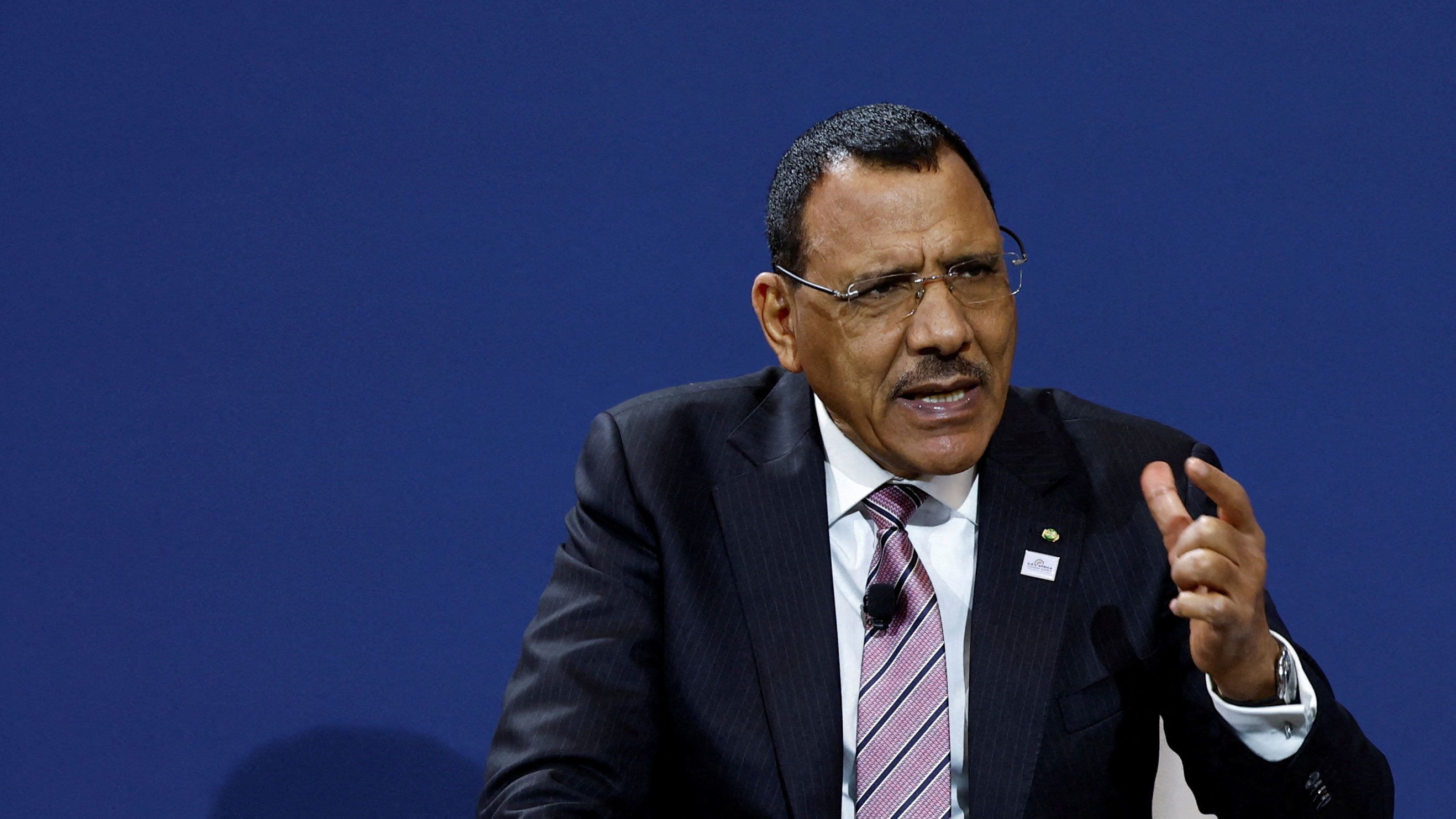
Mohamed Bazoum
 Niger
NigerBirthday
January 1, 1960
Birth Sign
Capricorn
Birthplace
Bilabrin, Niger
Age
66 years old
About
Mohamed Bazoum is a Nigerien politician who served as the 10th President of Niger from April 2021 until his removal in a military coup in July 2023. Born on January 1, 1960, in Bilabrin, he belongs to the Ouled Slimane minority and became the first Arab to hold the nation's highest office. Before entering the presidency, he built a career as a teacher and civil servant, eventually rising to become a key figure in the Nigerien Party for Democracy and Socialism (PNDS-Tarayya). His tenure was marked by efforts to stabilize the Sahel region against jihadist insurgencies and maintain democratic institutions.
As of mid-2026, Bazoum remains in arbitrary detention under the military junta led by General Abdourahamane Tchiani. He has spent over three years in captivity following the overthrow of his government, facing treason charges that international bodies widely condemn as politically motivated. Despite his imprisonment, he continues to be viewed by supporters across West Africa as a symbol of democratic resistance and the struggle for constitutional order in the region.
Early Life & Background
Mohamed Bazoum was born into a family with deep roots in the Diffa region of southeastern Niger. Growing up in Bilabrin near N'Gourti, he was part of the Ouled Slimane minority group within a country dominated by other major ethnic groups. This background shaped his early perspective on inclusivity and regional stability. Before fully committing to politics, he worked as a teacher, a profession that grounded him in the educational sector and gave him a practical understanding of public administration.
His political awakening began in the 1990s during a turbulent period of democratization in Niger. He co-founded the Nigerien Party for Democracy and Socialism (PNDS-Tarayya), which quickly became a central force in the country's transition away from military rule. Bazoum established himself as a trusted ally of Mahamadou Issoufou, serving in various capacities before taking on significant ministerial roles. His early career was defined by navigating complex socio-political dynamics while advocating for national development and security reforms.
Career Growth
Bazoum's rise to the highest office followed decades of service in government. He first served as Minister of Foreign Affairs from 1995 to 1996 under President Issoufou. He returned to that role in 2011, where he played a pivotal part in securing international support against jihadist insurgencies and managing relations with France, the United States, and ECOWAS. In 2016, he was appointed Minister of Interior, overseeing internal security operations during a critical period leading up to the 2020 elections.
In the 2020 presidential election, Bazoum ran as the PNDS candidate and won the runoff against former President Mahamane Ousmane with 55.67% of the vote. This victory marked a rare peaceful transfer of power in Niger's history. He assumed office as the 10th President on April 2, 2021. His presidency was tested almost immediately when he survived an attempted coup in March 2021. He focused his administration on combating terrorism in the Sahel and implementing economic reforms.
The trajectory of his leadership ended abruptly on July 26, 2023, when members of the presidential guard, led by General Omar Tiani, arrested him at the presidential palace. The junta dissolved the National Assembly, suspended the constitution, and charged Bazoum with treason. Despite international pressure, the military regime has refused to release him, leaving his future uncertain as of 2026.
Career Timeline
Public Image & Style
Bazoum projects a dignified demeanor, often seen wearing traditional boubous or Western suits depending on the occasion. As a leader, he cultivated an image of stability and resilience, particularly after surviving the 2021 coup attempt. His rhetoric consistently emphasized unity and the fight against terrorism without compromising democratic values. Media perception of him has shifted from a respected minister to a martyr for democracy following his ouster. International observers view him as a symbol of constitutional order, while the current junta portrays him through a lens of alleged treason.
Fame & Fandom
The story of Mohamed Bazoum is not one of chart-topping hits or viral dance challenges, but rather a deeply felt narrative of political endurance and democratic sacrifice. His supporters are not organized under a specific fandom name with rituals or merchandise; instead, his base consists of citizens and international observers who view him through the lens of human rights and governance. The cultural mythology surrounding him centers on the stark reality of his removal from power and his subsequent captivity. While entertainers might have fans fainting at appearances, Bazoum's legacy is defined by the poignant appeals from his family, who in 2026 publicly noted they had not seen their parents for over three years. This absence has transformed his image into a symbol of the fragility of democracy in the Sahel, where the narrative of a leader deposed by his own guard resonates far beyond Niger's borders. Regarding his standing in global metrics, iFANN has evaluated this figure within its comprehensive database. As of August 2026, the Global Fame Engine confirms that Mohamed Bazoum does not currently hold a placement in the published rankings, including the Global Top 1,000 or any Top-100 scope lists. He is not ranked among the most famous people in the world today, nor does he appear in any specific category lists maintained by the system. This lack of a numerical rank reflects the nature of his fame: it is rooted in specific geopolitical events and advocacy rather than broad commercial consumption or entertainment signals. While his name carries weight in diplomatic circles and human rights reports, it has not generated the volume of search activity or media consumption required to secure a position in the current global hierarchy. The absence of a formal fanbase structure further distinguishes his profile from pop culture icons, leaving his influence as a matter of historical record and ongoing political struggle rather than measurable popularity trends.
Interesting Facts and Legends
Mohamed Bazoum holds the distinction of being the first Arab to serve as President of Niger, breaking an ethnic barrier in a nation with diverse demographics. His 2021 election victory is often cited by political analysts as a significant milestone for democracy in West Africa, given the country's history of frequent military coups. Before his political ascent, he spent years working as a teacher, a background that informed his approach to governance and public policy. The narrative surrounding his life today includes the story of his survival of the 2021 coup attempt and his subsequent imprisonment, which has become a central theme in modern Nigerien political folklore representing the fragility of democracy in the Sahel.
Notable Quotes
“We must fight terrorism without compromising our democratic values.”
“Our priority is the security of our people and the stability of our nation.”
Family & Personal Life
Mohamed Bazoum maintains a notably private personal life, keeping details about his family out of the public eye. Reports indicate he prioritized his career and political duties over publicizing his private sphere. While there are no verified records of marriages or children in open-source media, his family members have occasionally made public statements regarding his condition since his detention. In July 2026, his children issued a public appeal for his release, highlighting the humanitarian crisis surrounding his captivity. His upbringing in the Diffa region influenced his political stance, emphasizing inclusivity across the country's various ethnic groups.
Notable Connections
Relationships & Dating History
Mohamed Bazoum has maintained a notably private personal life throughout his long political career. Unlike many high-profile political figures, there is no publicly documented chronological record of his dating history, marriages, or children in open-source media or biographical databases. Reports indicate he is a man of few public words about his private sphere. As of 2026, while he is held in detention, there are no confirmed reports of a current spouse or partner actively involved in public advocacy on his behalf, although his family members have occasionally made statements regarding his condition. The lack of public information suggests he prioritized his career and political duties over publicizing his personal life. Consequently, there are no verified records of engagements, divorces, or children to report.
Salary, Net Worth In 2026
$500 Thousand
iFANN Editorial Team estimate
Specific net worth figures for Mohamed Bazoum are not publicly disclosed or estimated by financial outlets like Forbes or Celebrity Net Worth. As a politician in a developing nation, his wealth is generally understood to be modest, derived from his long tenure as a teacher and various ministerial salaries. Any estimates found online are speculative and should be disregarded in favor of the fact that his assets are likely tied to standard civil servant earnings and real estate holdings typical of a senior Nigerian official. iFANN currently estimates Bazoum's net worth at approximately $500,000 based on available public salary records and asset disclosures for similar officials.
Awards & Accolades
Known For
President of Niger
2021 · Head of State
Keywords
Sources
Quick Facts
- Profession
- politician, teacher, minister
- Born
- January 1, 1960
- Birthplace
- Bilabrin, Niger
- Gender
- Male
- Birth Sign
- Capricorn
- Political Party
- PNDS-Tarayya
- Presidency Term
- April 2, 2021 – July 26, 2023
Personal Details
- Education
- University of Niamey
Frequently Asked Questions
Who is Mohamed Bazoum?
Why was Mohamed Bazoum removed from office?
Is Mohamed Bazoum still alive in 2026?
What happened to Mohamed Bazoum after the 2023 coup?
Does Mohamed Bazoum have any children?
Social Media
Similar People
Join the community
fans discussing