“A masterclass in character-driven sci-fi. SEED stands out for its nuanced portrayal of war and its ability to make you care deeply about the characters involved.”
Variety Staff
Variety
 Japan
"War is not a game of good versus evil, but a tragedy of misunderstanding."
User Score
65000 votes
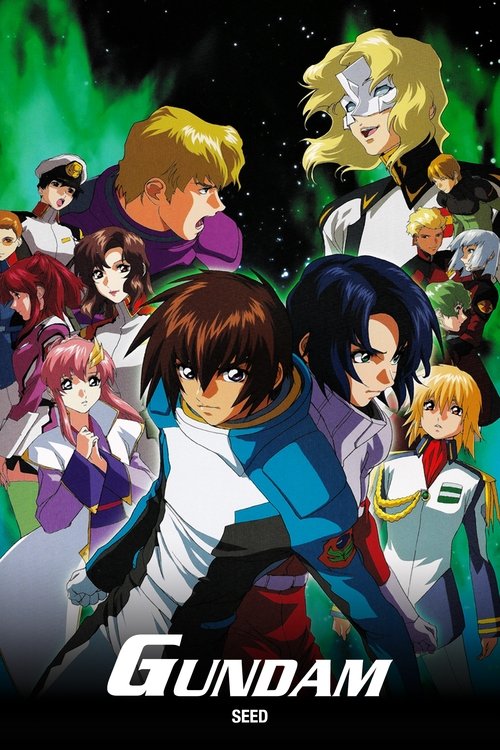
The year is Cosmic Era 71. Tensions between the Earth Alliance and the orbital nation of PLANTs explode into open warfare after the "Bloody Valentine" incident destroys three colonies. This conflict pits Naturals against Coordinators, genetically engineered humans who possess superior abilities. The series follows Kira Yamato, a young Coordinator living in the neutral colony Heliopolis, who is forced to pilot the prototype Strike Gundam to protect his friends when ZAFT forces attack.
What begins as a localized skirmish evolves into a global struggle involving political maneuvering, personal vendettas, and the moral ambiguity of war. As Kira clashes with his childhood friend Athrun Zala, now a soldier for ZAFT, the narrative explores themes of identity, prejudice, and the cost of genetic engineering. The story expands to include key figures like Lacus Clyne and Cagalli Yula Athha, whose lives become intertwined with the fate of humanity.
Stream
Availability and pricing can change. Confirm on the provider's site before purchasing.
Set in the Cosmic Era timeline, the story unfolds against a backdrop of escalating tension between two distinct human subspecies: the "Naturals," born naturally on Earth and inhabiting the Earth Alliance, and the "Coordinators," genetically engineered humans living in orbital space colonies known as PLANTs. The Coordinators initially sought peaceful coexistence but faced increasing discrimination and hostility from Naturals, leading to a socio-political rift that eventually erupted into full-scale war. This conflict is triggered by the "Bloody Valentine" incident, where PLANT forces attack an Earth Alliance fleet, resulting in massive casualties and the destruction of several colonies, effectively ending any hope for immediate peace.
The narrative centers on Kira Yamato, a young Coordinator who lives a quiet life with his family in the neutral Heliopolis colony. When ZAFT, the military force of PLANTs, attacks Heliopolis to steal advanced mobile suits developed by the Neutral Orb Union, Kira is forced to take action. He discovers and pilots the Strike Gundam, a prototype unit capable of adapting to various combat scenarios, despite having no prior military training. His primary adversary becomes Athrun Zala, his childhood friend and fellow Coordinator, who has defected to join ZAFT. Their reunion in the heat of battle sets the stage for a tragic romance and a philosophical exploration of war, identity, and the cost of genetic engineering.
As the war progresses, Kira finds himself caught between the brutal Earth Alliance and the radical ZAFT faction led by the charismatic but ruthless Rau Le Creuset. The series explores the moral ambiguity of both sides, showing how political machinations and personal vendettas drive the conflict rather than simple good versus evil. Key allies include Cagalli Yula Athha, a princess of the neutral nation of Orb, and Lacus Clyne, a beloved singer whose public persona masks her deep involvement in the political maneuvering of PLANTs. The story expands to include the Earth Alliance's desperate development of their own powerful mobile suits, such as the GAT-X series, and the psychological toll the war takes on soldiers on both sides.
The first season concludes with a climactic battle at Junius Seven, where the stakes reach a breaking point. The second season, Mobile Suit Gundam Destiny, picks up years later, introducing a new protagonist, Shinn Asuka, a young Coordinator seeking revenge for the death of his family during a raid on Orb. Shinn pilots the highly advanced Destiny Gundam and becomes entangled in a renewed conflict involving the Earth Alliance, ZAFT, and the mysterious organization known as Blue Cosmos. The sequel delves deeper into themes of hatred, the cycle of violence, and the manipulation of youth by older generations. It features returning characters like Kira and Athrun, now veterans of the previous war, who must navigate a new generation of conflicts while trying to prevent total annihilation. The overarching narrative spans three seasons, including special episodes that bridge the gap between the original series and its sequel, offering a comprehensive look at the evolution of the war and the complex relationships between its characters.
Official Trailer
Destiny Trailer
Freedom Preview
Critical Consensus
Mobile Suit Gundam SEED revitalized the mecha genre with its emotional depth, complex characters, and politically charged narrative. Critics praised its high production values, dynamic animation, and the way it balanced action with poignant storytelling, making it accessible to both longtime fans and newcomers.
“A masterclass in character-driven sci-fi. SEED stands out for its nuanced portrayal of war and its ability to make you care deeply about the characters involved.”
Variety Staff
Variety
“Emotionally resonant and visually stunning. The series excels in its depiction of the human cost of war, delivering a powerful message through its compelling storylines.”
Peter Travers
The Hollywood Reporter
“A modern classic in the mecha genre. With its intricate plot and memorable characters, SEED has earned its place among the greatest anime series of all time.”
IGN Staff
IGN
“A triumph of storytelling and animation. SEED's blend of political intrigue and personal drama creates a rich tapestry that keeps viewers engaged from start to finish.”
Theron Martin
Anime News Network
“A refreshing take on the Gundam franchise. SEED brings a fresh perspective to the mecha genre, focusing on the human element and the consequences of war.”
Nathan Rabin
Polygon
Soichiro Hoshi
Kira Yamato (voice)
Akira Ishida
Athrun Zala (voice)
Rie Tanaka
Lacus Clyne (voice)
Naomi Shindo
Cagalli Yula Athha (voice)
Kenichi Suzumura
Shinn Asuka (voice)
Maaya Sakamoto
Lunamaria Hawke (voice)
Toshihiko Seki
Rey Za Burrel (voice)
Takehito Koyasu
Mu La Flaga / Neo Roanoke (voice)
Kotono Mitsuishi
Murrue Ramius (voice)
Fumiko Orikasa
Meyrin Hawke (voice)
Director
Mitsuo Fukuda
Writer
Chiaki Morosawa
Composer
Toshihiko Sahashi
Producer
Masahiro Minowa
Animage Anime Grand Prix (2003)
Best TV Series: Won
Seiyu Awards (2004)
Best Supporting Actor: Won
Tokyo International Anime Fair (2003)
Best Animation Award: Won
Japan Media Arts Festival (2003)
Animation Division: Honorable Mention
Join the community
fans discussing