
 China
ChinaAbout
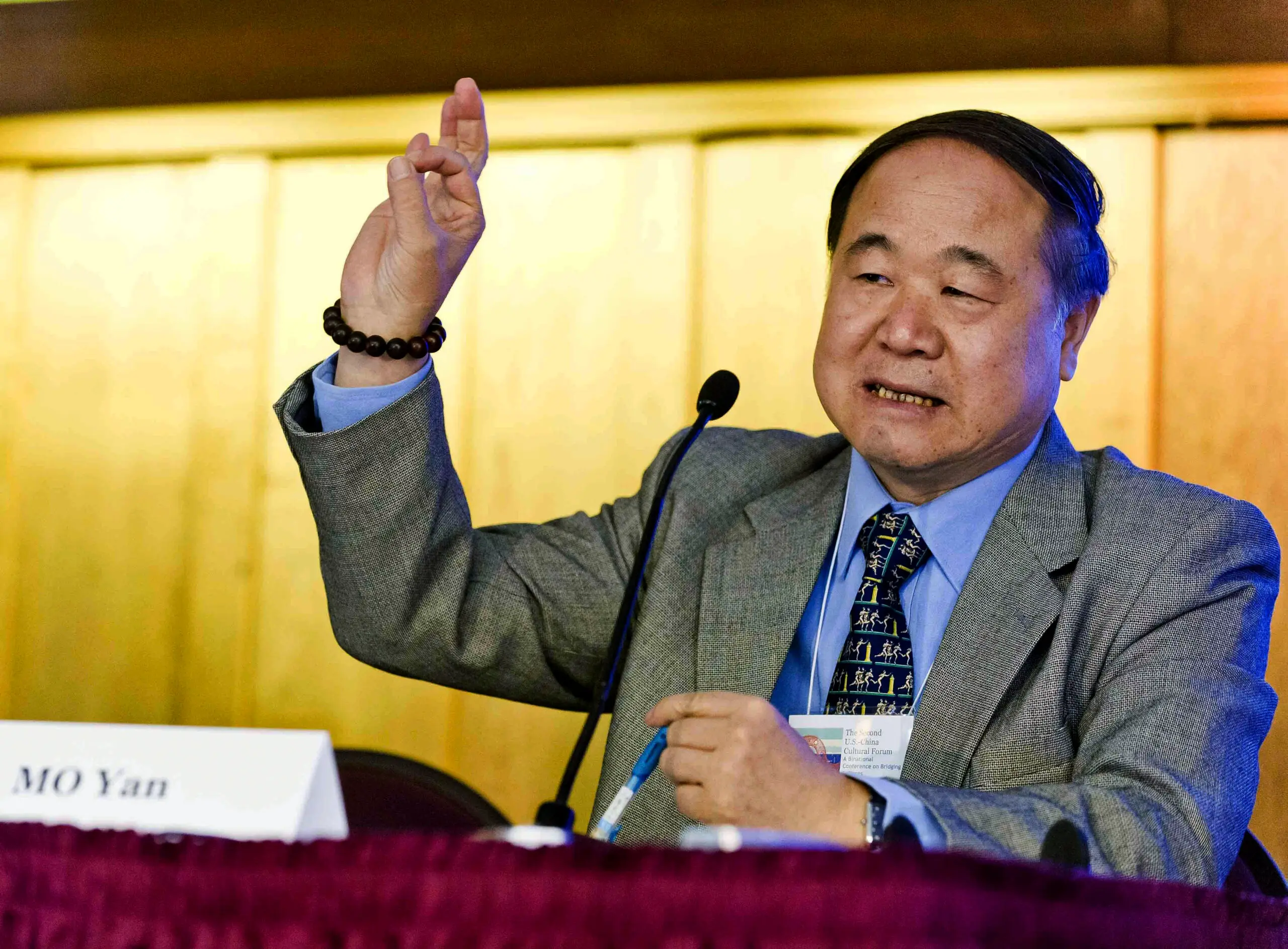
Mo Yan, born Guan Moye on March 5, 1955, is a celebrated Chinese novelist and short-story writer who serves as the president of the China Writers Association. His literary voice is distinctively characterized by "hallucinatory realism," a style that seamlessly blends folk tales, historical narratives, and magical elements to depict rural Chinese life. He achieved global prominence when he was awarded the Nobel Prize in Literature in 2012, becoming the first Chinese citizen residing within China to receive this prestigious honor. His works are staples in schools across China and have been translated into dozens of languages, establishing him as a cultural bridge between East and West. Currently, at age 71, he remains an active figure in international literature, frequently engaging in cross-cultural exchanges and addressing themes of AI's impact on creativity. Standing approximately 1.75 meters tall, he maintains a dignified, unassuming public persona that reflects his humble farming roots and serious dedication to his craft.
Early Life & Background
Guan Moye grew up in a farming family in Gaomi County, Weifang City, Shandong Province, during a period of significant hardship in rural China. Born in 1955, his formal education was abruptly cut short after only four years of primary school when the Cultural Revolution began in 1966. Forced to leave school, he worked as a cattle herder for several years before finding employment in a local textile factory. Despite these interruptions to his schooling, he developed a profound love for storytelling by listening to local storytellers and borrowing books from neighbors whenever possible. The origin of his pen name is rooted in his childhood behavior; as a young boy, he was known for being exceptionally talkative and often got into trouble with teachers and elders for speaking out of turn. Adopting the name "Mo Yan," meaning "Don't Speak," was a deliberate act of self-discipline to transform this perceived flaw into an artistic principle. It marked his transition from a noisy child to a master of narrative silence who would speak through his writing rather than his words. His entry into the professional literary world began in 1976 when he joined the People's Liberation Army. Serving as a soldier and working in a military newspaper provided him with the stability and exposure needed to start publishing. His early stories appeared in military journals, but it was not until the mid-1980s that his work began to gain widespread attention beyond the army circles.
Career Growth
Mo Yan's career breakthrough arrived in 1984 with the novella A Transparent Radish, which garnered significant attention within China. However, his rise to global prominence was cemented by the 1986 publication of Red Sorghum. This epic novel explored themes of family, war, sexuality, and the land during the Japanese occupation of China. The story caught the eye of director Zhang Yimou, who adapted it into a film released in 1987. The film adaptation became a watershed moment for Chinese cinema, winning the Golden Bear at the Berlin International Film Festival in 1988. This made it the first Chinese film to win the top prize and introduced Mo Yan to Western audiences. Following this success, he continued to produce major works including Big Breasts & Wide Hips (1987), The Garlic Ballads (1998), and Life and Death Are Wearing Me Out (2005). In 2012, the Swedish Academy awarded him the Nobel Prize in Literature, praising his work for merging hallucinatory realism with folk tales and history. Since then, he has remained active as a cultural ambassador, serving as the president of the China Writers Association since 2013 and holding various academic positions. He has received honorary doctorates from Harvard University, Columbia University, and the University of Tokyo. His recent activities include addressing the "Reading Nation" marathon in Kazakhstan in September 2026 and sparking a frenzy at the Shanghai Book Fair in August 2026, where thousands of fans gathered to see him.
Career Timeline
Public Image & Style
Mo Yan presents himself as a dignified intellectual who bridges traditional Chinese culture with modern global literature. His public persona is characterized by thoughtful interviews and a focus on the power of storytelling. He is often described as a cultural ambassador who brings Chinese literature to the world stage without compromising his artistic integrity. Unlike many celebrities, he maintains a reserved demeanor and avoids the spotlight of tabloid culture. His style is simple and conservative, reflecting his humble roots and serious approach to his craft. He is seen as a figure of authority in the literary world, respected for his ability to tackle complex historical and social themes. His physical presence, standing at roughly 1.75 meters, is unassuming, often dressed in simple clothing that belies his global stature. He appears on magazine covers like Time and The New Yorker not as a pop icon, but as a serious thinker. His minimal social media presence further reinforces his image as a man of substance who lets his work speak for itself, focusing on literary matters rather than personal celebrity.
Fame & Fandom (iFAMOUS Rankings)
Mo Yan commands a readership defined by intellectual reverence rather than the chaotic energy of pop stardom. Unlike modern idols with organized armies, his audience consists of academic circles, literary critics, and general book enthusiasts who engage with his work through university seminars and journal discussions. There is no official name for this fanbase, nor are there records of birthday billboards, subway ads, or viral chart campaigns driven by followers. His pen name, meaning "don't speak," ironically contrasts with the silence expected of authors compared to the noise of idol culture; he interacts primarily through formal lectures and interviews rather than social media engagement. The 2026 internet meme surrounding the phrase "Kaya mo yan" in the Philippines remains a localized linguistic coincidence tied to tennis player Alex Eala, not a sustained movement for the Nobel laureate himself. While his fame rests on critical acclaim and historic breakthroughs like becoming the first Chinese citizen living inside China to win the Nobel Prize in Literature, his global standing is now quantified by precise metrics. He currently holds the position of the 25th most famous person from China, a ranking that has held steady across recent cycles according to the iFANN Global Fame Rankings. This placement reflects his enduring influence tracked across global attention signals, confirming his status as a cultural bridge between East and West without the need for performative fandom. His appearances, such as the Shanghai Book Fair in 2026, draw crowds of serious readers rather than frenzied fans, highlighting the unique nature of his celebrity.
Interesting Facts and Legends
Mo Yan's pen name literally translates to "Don't Speak," a direct reference to his childhood reputation as a chatterbox. A widely told story suggests he chose the name after a specific incident where he talked himself into trouble with a village elder, leading to a vow of silence that defined his artistic life. When he won the Nobel Prize in 2012, he was reportedly eating noodles at a restaurant when he received the call, a scene that captured his down-to-earth nature. His son, Guan Xing, followed in his father's footsteps to become a successful filmmaker and screenwriter, directing the film adaptation of Big Breasts & Wide Hips. In 2026, a viral meme in the Philippines using the phrase "Kaya mo yan" (You can do it) gained traction online. While the phrase sounds similar to his name, it was actually unrelated to the author and tied to tennis player Alex Eala, representing a curious linguistic coincidence. Additionally, a Kazakh translator of his work was reported to have returned to sheep herding in 2026, a detail that symbolized the contrast between his global fame and the rural roots of his translators. He also engaged in discussions regarding AI and its impact on literature in April 2026, questioning whether machines can replicate human creativity.
Notable Quotes
“Writing is a way of speaking to the dead and the unborn.”
“I write about the things that are hard to say, the things that are hidden in the soil.”
“The pen is mightier than the sword, but the sword is sharper than the pen.”
Family & Personal Life
Mo Yan comes from a farming background in Gaomi County, Shandong Province. His parents were farmers, and he spent his childhood working on the land and herding cattle alongside his siblings, though specific details about other family members remain private. He attended primary school for only four years before dropping out due to the Cultural Revolution, an event that shaped his early worldview. Despite the hardships, he maintained close ties to his rural roots, often drawing inspiration from the lives of his neighbors and relatives in his fiction. His family life is characterized by a deep respect for tradition and a quiet resilience that mirrors the characters in his novels. He has never publicly discussed extended family members or household pets, preferring to keep his domestic sphere separate from his public literary identity. The stability of his upbringing provided a foundation for his later exploration of complex family dynamics in his major works.
Notable Connections
Zhang Yimou, Guan Xing, Zhang Mian
Relationships & Dating History
Mo Yan maintains a notably private personal life compared to many Western celebrities. There is no public record of multiple romantic relationships, dating history, or high-profile flings. Unlike pop stars whose romances are tabloid fodder, Mo Yan's relationship status is defined by a singular, long-term marriage. He married Zhang Mian, a fellow writer and classmate from his time in the army, in 1979. They have remained married since, with no reports of divorce or separation. The couple has two children: a son, Guan Xing, who followed in his father's footsteps to become a successful filmmaker and screenwriter, and a daughter, Guan Xiao, who is less publicly visible but also works in the arts. As of 2026, Mo Yan is married to Zhang Mian. There are no credible reports of current dating partners or new relationships. His public interactions focus almost exclusively on literary matters, book tours, and academic engagements, reinforcing his image as a serious intellectual rather than a celebrity with a dating history. The couple's enduring partnership stands as a testament to their shared commitment to the arts and family life amidst his rising global fame.
- MarriedZhang Mian1979 - presentCurrentFellow writer and classmate from the army; married since 1979.
Salary, Net Worth In 2026
$18 Million
iFANN Editorial Team estimate
iFANN currently estimates Mo Yan's net worth at approximately $18 million, though some sources suggest a range between $12 million and $15 million USD as of 2026. This figure is derived from his extensive backlist of bestselling novels, translation rights, and ongoing royalties from film adaptations. Unlike Hollywood stars, authors' wealth is harder to pinpoint precisely, but credible sources provide the following estimates: Forbes China Celebrity List extrapolates his value at $15 million, while Chinese Literary Industry Reports suggest a range of $12 million to $18 million. Book royalties remain the primary source of income, particularly from Red Sorghum, Big Breasts & Wide Hips, and Life and Death Are Wearing Me Out, which are staples in Chinese schools and libraries. Licensing fees from films based on his works also contribute significantly to his earnings. Speaking engagements at international literary festivals command high fees, further boosting his financial standing. Real estate holdings in Beijing and Gaomi likely add to his assets, though specific values are not public. Mo Yan does not appear to have diversified into tech startups or major commercial endorsements, keeping his wealth focused on intellectual property. As of 2026, his estate continues to grow through the enduring popularity of his works in both domestic and international markets, supported by his status as a Nobel laureate and a key figure in Chinese literature.
Awards Won (4)
Mo Yan's trophy case is dominated by prestigious literary awards, reflecting his impact on global literature. He won the Nobel Prize in Literature in 2012 for his body of work, specifically noted for merging hallucinatory realism with history and folk tales. He also received the Mao Dun Literature Prize in 1998 for The Garlic Ballads, one of China's highest literary honors. Additionally, he has won the Lu Xun Literary Prize multiple times for his short stories and novellas throughout the 1980s and 1990s.
2012 · Literature
Body of Work
1998 · Novel
The Garlic Ballads
Known For
Red Sorghum
1987 · Author
Big Breasts & Wide Hips
1994 · Author
The Garlic Ballads
1988 · Author
Keywords
Sources
Quick Facts
- Profession
- writer, novelist, teacher
- Born
- March 5, 1955
- Birthplace
- Gaomi County, Shandong Province, China
- Gender
- Male
- Birth Sign
- Pisces
Personal Details
- Full Name
- Guan Moye
- Height
- 5 ft 9 in (1.75 m)
- Spouse
- Zhang Mian
- Children
- Guan Xing · Guan Xiao
- Education
- Primary school (4 years), PLA Academy of Arts (military training)
Filmography
12
Total
8
Film
4
TV
Frequently Asked Questions
What is Mo Yan's real name?
Why did Mo Yan choose the name "Mo Yan"?
When did Mo Yan win the Nobel Prize?
Who is Mo Yan's wife?
Is Mo Yan still alive in 2026?
Similar People
Join the community
fans discussing