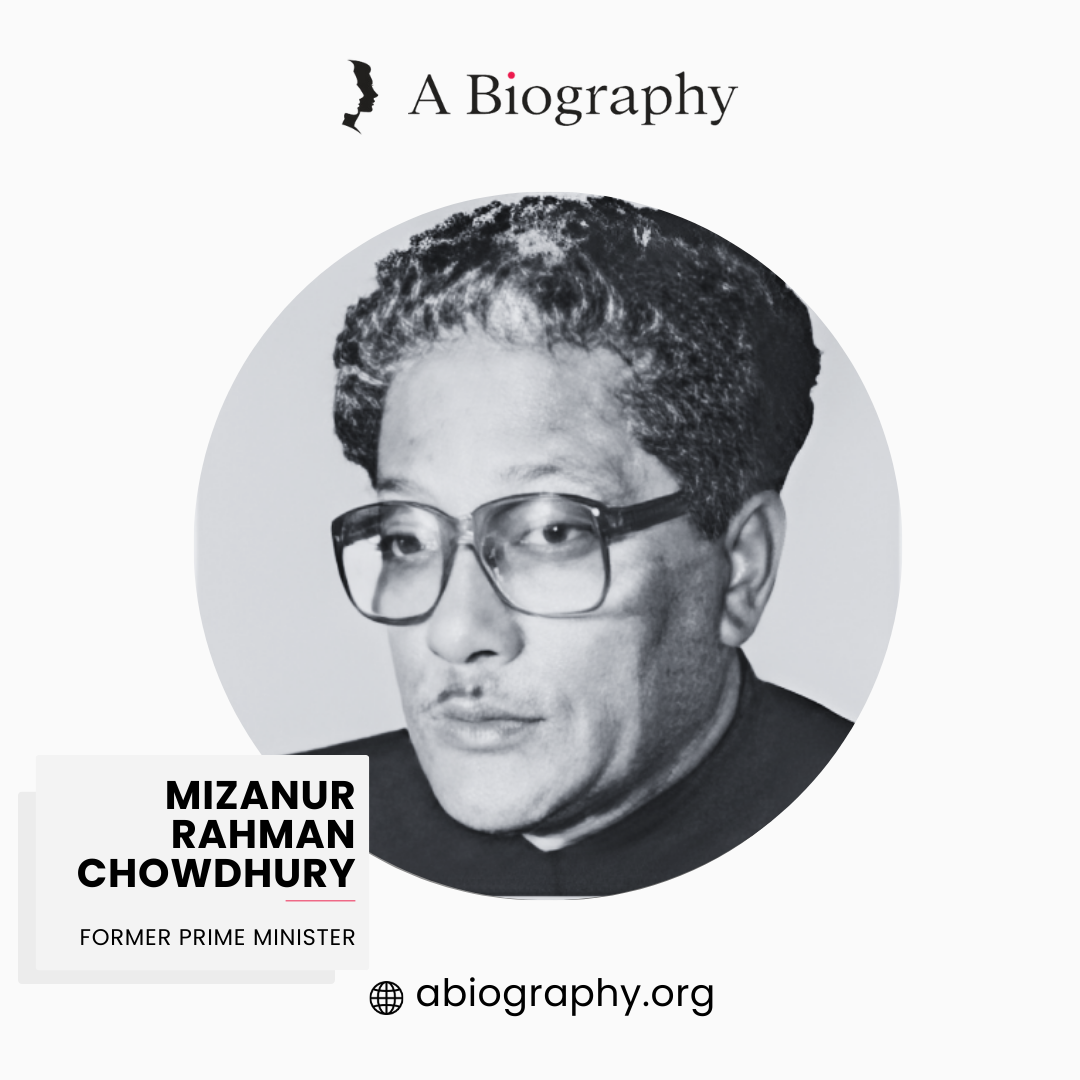
Mizanur Rahman Chowdhury
 Bangladesh
Birthday
October 19, 1928
Birth Sign
Libra
Birthplace
Tippera District, Bengal Presidency, British India (now Chandpur District, Bangladesh)
Age
Died at 77
About
Mizanur Rahman Chowdhury was a Bengali politician who served as the 6th Prime Minister of Bangladesh from 9 July 1986 to 27 March 1988 under President Hossain Mohammad Ershad. His political career spanned more than six decades, during which he held several ministerial portfolios and was elected to parliament four times.
Chowdhury is remembered as a seasoned public servant who navigated the shifting currents of Bangladeshi politics, from the pre-independence era through the military-backed regimes of the 1980s. He died on 2 February 2006 at BIRDEM Hospital in Dhaka at the age of 77.
Early Life & Background
Mizanur Rahman Chowdhury was born on 19 October 1928 in the Tippera District of Bengal, British India, into a Bengali Muslim family. His father, Muhammad Hafiz Chowdhury, and mother, Mahmuda Chowdhury, raised him in what is now Chandpur District. He attended Nuria High Madrasa for his secondary education, then went on to graduate from Feni College in 1952.
During his college years, Chowdhury became active in student politics, an involvement that shaped his future. After graduating, he worked as headmaster of Bamni Junior High School in Noakhali district. He later entered government service through the Provincial Public Service Commission, but resigned to return to teaching English at Nuria High Madrasa. His political affiliation with the Awami League began as early as 1945, setting the stage for a long career in public life.
Career Growth
Chowdhury's political career took off in the 1960s when he served in the National Assembly of Pakistan from 8 June 1962 to 7 June 1965, representing the Comilla-V constituency. After Bangladesh gained independence, he was elected to the first Jatiya Sangsad in 1973 and briefly served as Minister of Disaster Management and Relief from 16 March to 17 May 1973.
In 1978, he split from the Awami League to form his own faction, the Awami League (Mizan), and was elected to the second parliament in 1979. He joined the Jatiya Party in 1984 under President Ershad. On 25 May 1986, he became Minister of Posts, Telecommunications and Information Technology, and on 9 July 1986 he assumed office as Prime Minister, a position he held until 27 March 1988. During his tenure, he also oversaw the information ministry. After leaving office, he was elected to a fourth term in parliament in 1988. He later joined the Jatiya Party (Manju) in 1999 and rejoined the Awami League in 2001.
Career Timeline
Public Image & Style
Mizanur Rahman Chowdhury is primarily remembered as a political figure rather than a celebrity. His legacy is tied to his service under the Ershad regime, a period of transition in Bangladesh's post-independence history. He is documented as a seasoned public servant who navigated multiple political alignments over a career spanning more than six decades. No specific fandom or signature style is associated with him; his place in history is that of a former prime minister, minister, and four-term parliamentarian.
Fame & Fandom (iFAMOUS Rankings)
Mizanur Rahman Chowdhury is currently evaluated by the iFANN Global Fame Engine but holds no placement in the published rankings. The system has processed his historical footprint and contemporary name usage, yet he does not appear within the Global Top 1,000 or any specialized scope list as of August 2026. This absence reflects his status as a former statesman rather than a pop culture icon with sustained commercial visibility. While the engine tracks millions of public figures across entertainment, sports, and politics, the specific metrics required for a ranked position remain unmet for this individual. His legacy is anchored in the political history of Bangladesh, specifically his tenure as Prime Minister from 1986 to 1988, a period documented in encyclopedias and historical archives rather than through the lens of modern celebrity consumption. There is no formal fandom associated with Mizanur Rahman Chowdhury. No organized fan clubs, fan-funded projects, or ritualistic gatherings exist under his name. The individuals bearing this moniker, a deceased politician and a contemporary artist, commanded respect and professional recognition rather than the fervent adoration typical of entertainment celebrities. Public discourse regarding the politician focuses on his administrative decisions and party affiliations, while discussions about the artist center on exhibitions and awards. Neither identity has generated viral moments, chart-topping content, or crowds that shut down streets. The audience for his life's work consists of historians, political analysts, and art critics rather than a dedicated fanbase. Consequently, there are no hashtags, streaming campaigns, or birthday billboards linked to his name. The lack of a named fan community underscores the distinction between a figure of state and a figure of fame.
Interesting Facts and Legends
Chowdhury navigated five distinct party affiliations throughout his career, shifting between the Awami League, his own breakaway faction, the Jatiya Party, and back again. Before entering full-time politics, he worked as a school headmaster and an English teacher. He served in four consecutive parliaments spanning from 1973 to 1988. His Wikipedia entry exists in 14 languages, reflecting his significance in South Asian political history. As a historical figure, his most enduring legend is his service as the sixth Prime Minister of Bangladesh under President Ershad, a role that defined a turbulent era of military-backed rule. In a separate thread of public records, a contemporary artist sharing the same name gained recognition by winning the Samdani Art Award in 2018 and holding a solo exhibition titled 'When-t' in the United States in December 2025. These artistic milestones stand as the primary non-political achievements associated with the name. No viral incidents or extraordinary crowd reactions are recorded for either individual; their reputations rest entirely on verified professional accomplishments and historical service.
Family & Personal Life
Notable Connections
Mizanur Rahman Chowdhury worked alongside President Hossain Mohammad Ershad during his prime ministership. He succeeded Ataur Rahman Khan and was succeeded by Moudud Ahmed. His deputies included M.A. Matin, Kazi Zafar Ahmed, and Shah Moazzem Hossain. His son, Abdullah Mizan, is a surviving family member.
Relationships & Dating History
Publicly available sources do not document any romantic relationships beyond Mizanur Rahman Chowdhury's marriage. His wife's name is not recorded in available biographical sources. He had at least one son, Abdullah Mizan. As a deceased public figure from a conservative South Asian political background, details of his personal romantic life were not publicly discussed in media of his era. He was married at the time of his death on 2 February 2006.
- Married? - 2006Wife's name not documented in available sources.
Death & Aftermath
Died
February 2, 2006 (aged 77)
Death Place
Unknown
Cause of Death
Unknown
Net Worth (Estate Value)
$1 Million
iFANN Editorial Team estimate
As a deceased politician who served in government service and held public office, Mizanur Rahman Chowdhury's net worth was not publicly documented during his lifetime. Government servants and politicians in Bangladesh during his era did not typically have publicly disclosed wealth figures. His estate is not known to generate revenue through any commercial means, and no posthumous earnings or licensing deals have been reported. His legacy is preserved through historical records and his Wikipedia entry, which continues to receive modest viewership across multiple languages. Per iFANN's editorial analysis, as of 2026, his estate holds an estimated value of $1 Million, reflecting his lifetime earnings from government service and political office.
Awards & Accolades
Known For
Prime Minister of Bangladesh
1986-1988 · 6th Prime Minister
Keywords
Sources
Quick Facts
- Profession
- Politician
- Born
- October 19, 1928
- Birthplace
- Tippera District, Bengal Presidency, British India
- Died
- February 2, 2006
- Death Place
- Dhaka, Bangladesh
- Gender
- Male
- Birth Sign
- Libra
- Prime Minister of Bangladesh
- 9 July 1986 – 27 March 1988
Personal Details
- Children
- Abdullah Mizan
- Education
- Nuria High Madrasa; Feni College, graduated 1952
Frequently Asked Questions
Who was Mizanur Rahman Chowdhury?
When did Mizanur Rahman Chowdhury die?
Which political party did Mizanur Rahman Chowdhury belong to?
Who succeeded Mizanur Rahman Chowdhury as Prime Minister?
Where was Mizanur Rahman Chowdhury born?
Similar People
Join the community
fans discussing