 Japan
Japan“The movie is a dazzling meditation on the relationship between movies and memory, between the roles we play and the lives we lead.”
Roger Ebert
RogerEbert.com
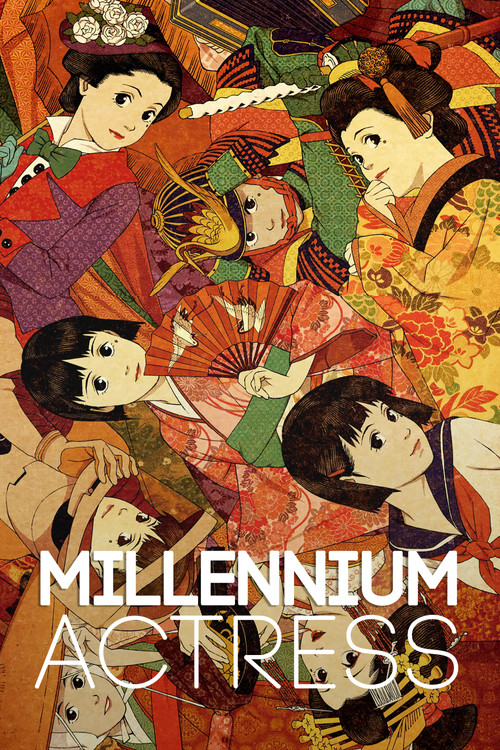
Documentary filmmaker Genya Tachibana has carried a single key for thirty years. He found it as a boy in the rubble of a burned movie studio, and it belonged to Chiyoko Fujiwara, the most famous actress Japan ever had. When he finally tracks her down to a remote mountain home, the key unlocks something neither of them expected: a flood of memories spanning seven decades of Japanese history and cinema.
This is Satoshi Kon's second feature, following Perfect Blue, and his first original story. Where Kon's debut was a tight psychological thriller, Millennium Actress is something looser and warmer. The film moves through Chiyoko's life and filmography in a single flowing motion, with Genya and his cameraman Kyoji literally pulled into her memories. They become part of her movies, her past, and eventually her final revelation. Madhouse produced the film on a reported budget of $1.2 million, with Susumu Hirasawa's electronic score weaving together traditional Japanese instruments and synthesizers.
The voice cast is anchored by three actresses playing Chiyoko at different ages: Fumiko Orikasa as the young girl, Mami Koyama as the adult star, and Miyoko Shoji as the elderly recluse. Shozo Iizuka voices Genya with a quiet intensity that matches the film's emotional core. Released in Japan in September 2002 after a festival premiere at Fantasia in 2001, it earned a modest theatrical run but has since become one of the most studied and beloved anime films of the 2000s.
Availability and pricing can change. Confirm on the provider's site before purchasing.
Genya Tachibana and his cameraman Kyoji Ida drive through the mountains to visit Chiyoko Fujiwara, an actress who vanished from public life at the height of her fame. Genya brings a key he found decades ago among the ruins of Ginei Movie Studios. When he hands it to Chiyoko, she begins to tell her story.
Her life started during the Great Kanto Earthquake of 1923. Her father died in the disaster, and she grew up in her mother's confectionery shop. A talent scout spotted her as a schoolgirl and cast her in a wartime propaganda film. Her mother objected, but Chiyoko was already drawn to the world of cinema. Soon after, she met a painter who was hiding from the authorities. He was a political dissident, and she hid him in the family storehouse. Before he fled to Manchuria, he gave her a key. He called it the most important thing there is and promised to return for her. She ran to catch his train but arrived too late. She never learned his name.
As Chiyoko narrates, the boundaries between her memories and her films begin to melt. Genya and Kyoji find themselves physically inside her stories. They become characters in her movies, watching her chase the painter across centuries and genres. In one scene she is a samurai-era princess; in another, a Meiji-era revolutionary; then a wartime nurse; then an astronaut in a future space station. The painter appears only as a fleeting figure, always just out of reach. A man with a scar across his face pursues her through every film, a shadow she cannot shake.
Her career spans decades. She rises from starlet to national treasure. A rival actress named Eiko Shimao steals the key at one point, leading to a confrontation that reveals hidden layers in their relationship. A kind man named Junichi proposes marriage, offering a stable life away from the chase. Chiyoko considers it but cannot let go of her search. The key remains her anchor through every role, every year, every failed attempt to find the painter.
Genya reveals that he was present at a pivotal moment in her life. As a young assistant on the set of her final film, an earthquake struck and destroyed the studio set. Genya saved her life. That moment cemented his lifelong devotion. Now, as Chiyoko tells her story, the interview becomes a journey through Japan's 20th century, from pre-war militarism through postwar reconstruction to the present day. Her memories grow fragmented, nonlinear, blending her personal history with the nation's history. The key connects each phase, a thread through the labyrinth.
Millennium Actress - Official Trailer
Critical Consensus
Millennium Actress is a visually stunning and emotionally resonant meditation on memory, cinema, and unrequited love. Satoshi Kon's masterful blending of reality and film within film creates a hypnotic, heartfelt experience that transcends its animated medium. While its nonlinear narrative may challenge some viewers, the film's warmth and ambition make it an essential work of Japanese animation.
“The movie is a dazzling meditation on the relationship between movies and memory, between the roles we play and the lives we lead.”
Roger Ebert
RogerEbert.com
“A rapturous, time-bending meditation on love, cinema and Japanese history that is at once dizzyingly complex and emotionally direct.”
A.O. Scott
The New York Times
“A rich, multi-layered work that repays repeat viewing, with a technical polish and narrative sophistication that puts many live-action films to shame.”
Derek Elley
Variety
“A breathtaking fusion of animation and live-action sensibilities, blending genres and time periods with breathtaking fluidity and deep emotional resonance.”
David Rooney
The Hollywood Reporter
Miyoko Shoji
Chiyoko Fujiwara (70's) (voice)
Mami Koyama
Chiyoko Fujiwara (20-40's) (voice)
Fumiko Orikasa
Chiyoko Fujiwara (10-20's) (voice)
Shozo Iizuka
Genya Tachibana (voice)
Shoko Tsuda
Eiko Shimao (voice)
Masaya Onosaka
Kyoji Ida (voice)
Masane Tsukayama
The Man with the Scar (voice)
Koichi Yamadera
The Man of the Key / The Painter (voice)
Hisako Kyoda
Chiyoko's Mother (voice)
Tomie Kataoka
Mino (voice)
Director
Satoshi Kon
Writers
Satoshi Kon, Sadayuki Murai
Composer
Susumu Hirasawa
Cinematographer
Hisao Shirai
Producer
Taro Maki
Mainichi Film Awards (2002)
Best Animation Film: Won
Fantasia Film Festival (2003)
Best Animated Film: Won
Tokyo Anime Awards (2003)
Best Feature Film: Won
Tokyo Anime Awards (2003)
Best Director: Won
Tokyo Anime Awards (2003)
Best Music: Won
Tokyo Anime Awards (2003)
Best Art Direction: Won
Online Film Critics Society Awards (2004)
Best Animated Feature: Nominated
Annie Awards (2004)
Best Animated Feature: Nominated
Join the community
fans discussing