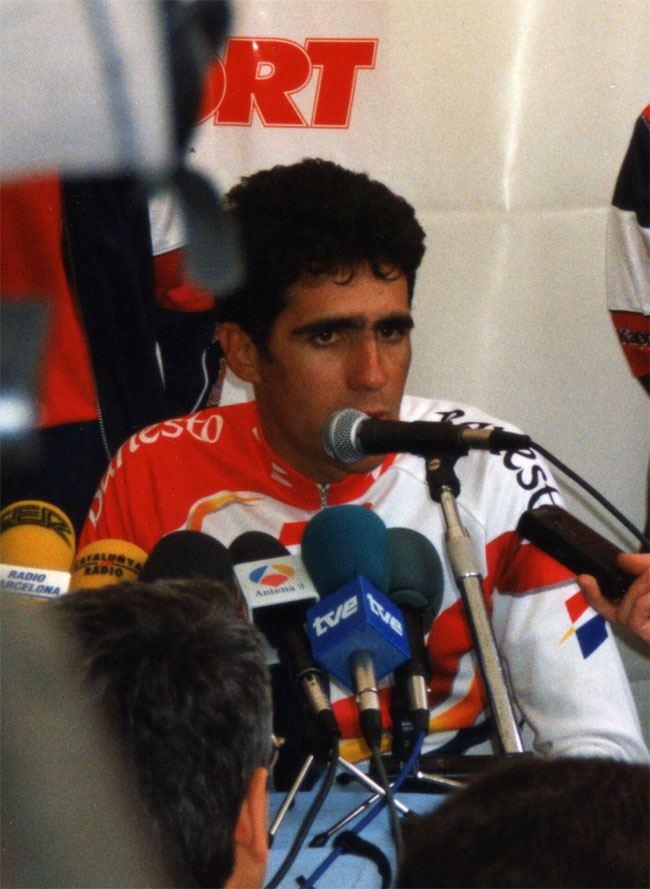
Miguel Induráin
 Spain
SpainBirthday
+1964-07-16
Birth Sign
Cancer
Birthplace
Villava/Atarrabia
Age
62 years old
About
Miguel Induráin Larraya, born July 16, 1964, in Villava/Atarrabia, Spain, is a retired road racing cyclist who dominated the sport in the 1990s. Standing 186 centimeters and weighing 76 kilograms, his imposing physique earned him the nicknames "Miguelón" and "Big Mig." Induráin's career is defined by his unprecedented five consecutive Tour de France victories from 1991 to 1995, a feat no other rider has matched. He also won the Giro d'Italia twice, in 1992 and 1993, achieving the rare Giro-Tour double in the same season both times. His 60 days in the Tour's yellow jersey and his record-tying five overall wins place him alongside legends Jacques Anquetil, Bernard Hinault, Eddy Merckx, and Tadej Pogačar. Induráin's early promise was evident when, at 18, he became the youngest winner of the Spanish amateur national road championship. At 20, he was the youngest rider to lead the Vuelta a España and also claimed a stage win in the Tour de l'Avenir. His breakthrough on the world stage came in 1991 when he won his first Tour de France, a title he would defend successfully for the next four years. In 1993, he came within 19 seconds of cycling's Triple Crown, finishing second in the World Championship after already winning the Giro and the Tour. His time trial prowess and ability to maintain a steady rhythm in the mountains made him nearly unbeatable in stage races. After retiring in 1996, Induráin remained a respected figure in Spanish sport. His legacy is not just in the numbers, but in the way he redefined endurance racing. He proved that a rider of his size could excel in the high mountains, and his calm, methodical approach to racing inspired a generation of cyclists. Today, he is remembered as one of the greatest Grand Tour riders in history, a champion whose achievements have yet to be surpassed.
Fame & Fandom
Miguel Induráin commands a global attention that transcends the typical trajectory of retired athletes, maintaining a presence anchored in historical significance rather than fleeting media cycles. According to the iFANN Global Fame Rankings, he is currently the 38th most famous person in Olympic Sports, a position he has held steady since the previous assessment cycle. This placement reflects his enduring status as a benchmark for endurance and consistency within the sporting world, where his five consecutive Tour de France victories remain the primary metric of comparison for modern competitors. While the iFANN system tracks these signals across diverse media channels, the result is a clear indication of his stature among the pantheon of cycling legends.
Despite this high ranking, his fanbase does not operate under a formal moniker or organized structure. Unlike contemporary pop culture figures who cultivate specific fandom names, Induráin's supporters are primarily cycling enthusiasts, historians, and Spanish nationals who revere him as the greatest cyclist in their nation's history. There are no records of a collective group with a distinct title, nor are there documented rituals or campaigns bearing his name. His influence persists through institutional honors, such as the GP Miguel Indurain race, and the continued citation of his physiological anomalies by experts, ensuring his legacy remains relevant without the need for an active, self-organized fan community.
Interesting Facts and Legends
Miguel Induráin possesses a resting heart rate of 28 beats per minute and a lung capacity of 7.8 liters, a physical profile that defied conventional athletic understanding during his era. He was the only Spaniard to win the World Time Trial Championship, a fact often cited as foundational to his national mythology. A widely retold story from his retirement highlights the primitive nutrition strategies of the 1990s Tour de France, where riders subsisted on bananas, small cakes, and sandwiches without the benefit of modern sports science. This anecdote contrasts sharply with the myth of his superhuman body, reinforcing the narrative of a rider who conquered the mountains through raw talent and sheer will. His victory at the 1996 Tour de France marked the definitive end of his career, cementing his status as a dominant force who left the sport at his peak immediately after securing his final triumph.
Awards & Accolades
Keywords
Quick Facts
- Profession
- sport cyclist
- Born
- +1964-07-16
- Birthplace
- Villava/Atarrabia
- Gender
- Male
- Birth Sign
- Cancer
Join the community
fans discussing