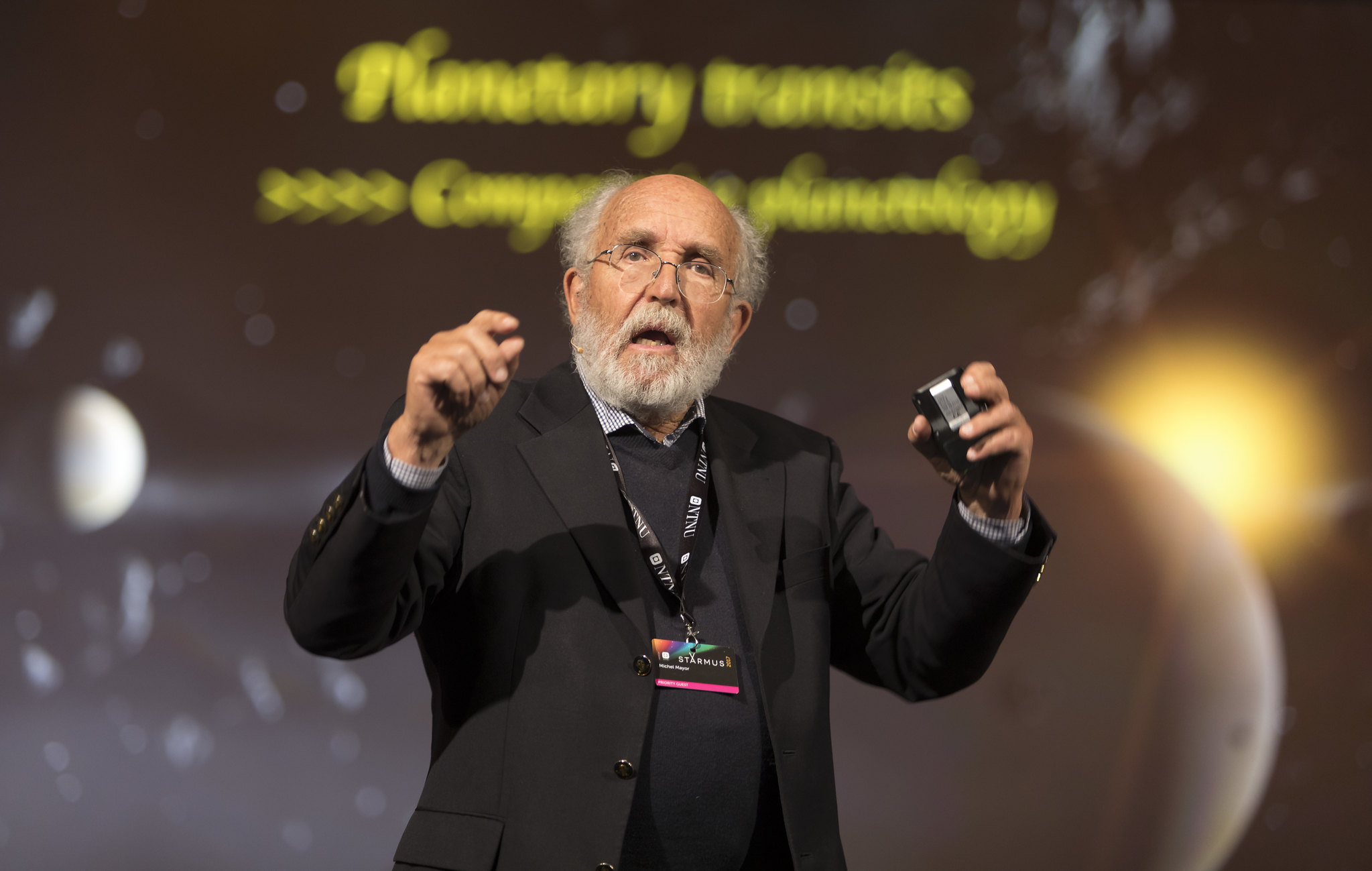
Michel Mayor
 Switzerland
astrophysicist•astronomer•university teacher
Also known as: Michel G. E. Mayor, Michel Gustave Mayor, M. G. E. Mayor
Birthday
January 12, 1942
Birth Sign
Capricorn
Birthplace
Lausanne, Switzerland
Age
84 years old
About
Michel Mayor is a distinguished Swiss astrophysicist and professor emeritus at the University of Geneva, universally recognized for his pivotal role in reshaping our understanding of the cosmos. Born on January 12, 1942, in Lausanne, he is a Capricorn who has dedicated his life to unraveling the mysteries of the universe through precise astronomical measurements. His global reputation rests on the 1995 detection of 51 Pegasi b, the first exoplanet found orbiting a sun-like star, a feat that fundamentally altered humanity's perception of its place in the universe and sparked a new era of planetary science.
The Nobel Committee recognized this monumental achievement in 2019 when they awarded him the Nobel Prize in Physics alongside James Peebles and Didier Queloz. As of 2026, Mayor remains an active researcher and public intellectual at the Observatory of Geneva, driven by an enduring passion for discovery even after formally retiring from his full-time professorship in 2007. He continues to publish research on exoplanet atmospheres and engages in public discourse regarding the future of humanity and the search for life elsewhere, distinguishing himself as a revered elder statesman of science rather than a traditional celebrity.
Early Life & Background
Michel Gustave Édouard Mayor was born in Lausanne, Vaud, Switzerland, into a family environment that nurtured his early curiosity about the natural world. While public records offer fewer details about his specific childhood hobbies compared to entertainment figures, his academic path was both rigorous and clearly defined from a young age. He pursued higher education in physics and astronomy at the University of Geneva, where he immersed himself in the complex study of stellar mechanics and spectroscopy. This foundational period prepared him for a career focused on the minute variations in starlight that would later define his legacy.
After earning his doctorate in astronomy in 1971, Mayor began building his professional foundation at prestigious institutions globally. He held research positions at the University of Cambridge and the European Southern Observatory (ESO), focusing intensely on developing the high-precision measurement techniques required to detect subtle movements in stars. These formative years were dedicated to mastering the art of radial velocity measurements, a skill set that would prove essential for finding planets beyond our solar system. By the late 1980s, Mayor had established himself as a leading figure in the field, and in 1988, he was appointed Professor of Astronomy at the University of Geneva.
During this pre-breakthrough period, he collaborated with colleagues to build the ELODIE spectrograph at the Haute-Provence Observatory. This instrument was designed specifically to measure the tiny gravitational wobbles of stars caused by orbiting planets, setting the stage for a discovery that would change astronomy forever. His early work involved refining these tools to unprecedented levels of accuracy, laying the groundwork for the historic announcement that would follow just a few years later.
Career Growth
The defining moment of Michel Mayor's career arrived on October 6, 1995, when he and his PhD student Didier Queloz announced the discovery of 51 Pegasi b. This was the first confirmed detection of an exoplanet orbiting a main-sequence star similar to the Sun. Before this announcement, exoplanets were only theorized or found around pulsars; Mayor and Queloz proved that planetary systems were common, sparking a global race to find more worlds and launching the modern era of exoplanet science. The image of the two of them accepting the Nobel Prize together remains an iconic representation of mentorship and scientific continuity.
Following this monumental discovery, Mayor received numerous accolades recognizing his contributions to science. In 2010, he was awarded the Viktor Ambartsumian International Prize and the Balzan Prize for the study of the formation and evolution of the universe. His work continued to gain international recognition with the Gruber Prize in Cosmology in 2012, shared with Geoff Marcy and Paul Butler, and the Draper Prize in 2011 from the National Academy of Sciences. He also received the Eddington Medal from the Royal Astronomical Society in 2013 and the Kyoto Prize in Basic Sciences in 2015 for his lifetime achievements in astronomy.
In October 2019, the scientific community crowned Mayor's career when he shared the Nobel Prize in Physics with James Peebles and Didier Queloz. The committee cited their work "for the discovery of an exoplanet orbiting a solar-type star." Even after retiring from his full professorship in 2007, Mayor remained an active researcher at the Observatory of Geneva. As of 2026, he continues to publish research on exoplanet atmospheres, analyze data from next-generation telescopes, and engage in public discourse regarding the fragility of humanity and the search for life elsewhere.
Career Timeline
Public Image & Style
Mayor is portrayed as the archetypal humble scientist. Media coverage emphasizes his modesty, his dedication to the truth, and his thoughtful tone in interviews. He is not seen as a "celebrity" in the traditional sense but as a revered elder statesman of science. His presence is characterized by cautionary yet hopeful reflections on human existence and the search for extraterrestrial life. He rarely seeks the spotlight outside of academic conferences and major award ceremonies, preferring to let his discoveries speak for themselves.
His media presence is confined to scientific journals like Nature, Science, and Astronomy & Astrophysics, as well as major newspapers such as The Guardian, Le Monde, and El País following significant announcements. He does not feature on commercial fashion or lifestyle magazine covers, and his digital footprint is managed through institutional channels like the University of Geneva's website and academic networks. His tone in interviews is consistently philosophical, often reflecting on the existential risks facing humanity while maintaining hope for future discoveries.
Fame & Fandom (iFAMOUS Rankings)
The global audience for Michel Mayor consists not of a dedicated fanbase organizing around personal milestones, but of the international astronomical community and science enthusiasts who engage with his work through lectures and educational initiatives. There is no formal or unofficial name for this collective, as the concept of a fandom does not apply to a scientist whose influence is measured by citations and the adoption of discovery methods rather than chart positions. While there are no records of fan-driven campaigns, subway ads, or birthday billboards, the scientific community has honored his contributions through significant events following his 2019 Nobel Prize.
The iFANN Global Fame Engine evaluated Michel Mayor in September 2026 and determined that he holds no placement in the published rankings, meaning he currently lacks a specific position within the Global Top 1,000 or any Top-100 scope list. This absence of a numeric rank reflects his standing as a figure whose fame is rooted in verified scientific history rather than viral popularity or commercial consumption signals. His legacy is defined by the verification of other worlds, a scientific achievement so profound it generated a new field of study, distinguishing him from entertainment figures where such metrics typically drive ranking placements. Fans are organized through academic societies like the American Astronomical Society rather than fan clubs, interacting primarily through Q&A sessions at conferences.
Interesting Facts and Legends
Michel Mayor is known for his humility and philosophical reflections on the human condition. In an April 2026 interview with El País, he stated, "People think humanity is eternal, but we are animals and we will become extinct," framing his scientific work within a broader context of survival. Despite his fame for finding distant worlds, he has publicly expressed skepticism about the feasibility of interstellar travel to these planets in the near future due to the vast distances involved.
The discovery of 51 Pegasi b relied on measuring the star's "wobble" caused by the planet's gravity. This required detecting speed changes of just a few meters per second, comparable to a walking human speed relative to a moving train. It was actually Didier Queloz, a young PhD student at the time, who spotted the signal in the data, while Mayor provided the mentorship and theoretical framework. The image of the two of them accepting the Nobel Prize together remains an iconic representation of mentorship and scientific continuity.
Additionally, a news item from September 4, 2026, mentions "Jean-Michel Mayor" being appointed as the technical director of the Saudi baseball federation. This is a distinct individual; the name "Jean-Michel" indicates a different person, likely a sports figure, and should not be conflated with the astrophysicist Michel Mayor. Mayor does not maintain a personal social media presence like Instagram or Twitter/X; his influence is measured by citation counts and institutional reach.
Notable Quotes
“People think humanity is eternal, but we are animals and we will become extinct.”
“The discovery of 51 Pegasi b opened the door to a new era of astronomy.”
“It is completely crazy to think we could colonize another planet in the near future.”
Family & Personal Life
Michel Mayor maintains a notably private personal life, particularly regarding his romantic history and family. Unlike many public figures, there are no widely reported or documented accounts of marriages, engagements, or high-profile romantic relationships in credible biographical sources. He is often described as having dedicated his life almost exclusively to his work in astronomy, with no public record of children or spouses. Given the lack of any marital announcements or public partner disclosures over decades, he is generally considered to have lived a life focused on his scientific pursuits without a publicly acknowledged long-term romantic partnership.
While specific details about his siblings or household members are not extensively documented in public records, his upbringing in Lausanne fostered a deep interest in science. Public photographs show an elderly man of average build, consistent with his age of 84 in 2026. No official height is listed in scientific databases, and his physical attributes remain a secondary metric compared to his scientific contributions. The absence of family news in credible archives reinforces the narrative of a man whose primary devotion was to the stars.
Notable Connections
Relationships & Dating History
Michel Mayor maintains a notably private personal life, particularly regarding his romantic history. Unlike many public figures, there are no widely reported or documented accounts of marriages, engagements, or high-profile romantic relationships in credible biographical sources or news archives. He is often described as having dedicated his life almost exclusively to his work in astronomy. There is no public record of children or spouses. As of 2026, his relationship status is effectively unknown to the public due to his deliberate privacy; however, given the lack of any marital announcements or public partner disclosures over decades, he is generally considered to have lived a life focused on his scientific pursuits without a publicly acknowledged long-term romantic partnership.
Salary, Net Worth In 2026
$3 Million
iFANN Editorial Team estimate
Estimating the net worth of a university professor and Nobel laureate like Michel Mayor is distinct from celebrity wealth calculations. His income derives primarily from salaries, grants, and lecture fees rather than commercial ventures, endorsements, or real estate speculation. iFANN currently estimates Michel Mayor's net worth at approximately $3 million. This figure reflects a conservative assessment based on a Swiss professor's salary scale, the Nobel Prize stipend, and international speaking engagements.
Major revenue streams include his tenure salary at the University of Geneva, which is substantial but capped by Swiss academic scales, and the cash award from the Nobel Prize, which was approximately 10 million Swedish Kronor (roughly $1 million USD) shared among the laureates. Additionally, he receives significant funding from the Swiss National Science Foundation and international bodies for his ongoing research. Unlike entertainers, Mayor does not have business ventures, endorsement deals, or production companies driving his wealth. His financial status is accumulated through a long career in academia and the prestige associated with his discoveries. Credible assessments suggest a range between $1 million and $5 million USD, accounting for his extensive lecture fees and grant funding over decades.
Awards Won (7)
Michel Mayor's accolades reflect the highest echelons of scientific achievement. He shares the 2019 Nobel Prize in Physics with James Peebles and Didier Queloz. He also received the 2015 Kyoto Prize in Basic Sciences, the 2010 Viktor Ambartsumian International Prize, the 2012 Gruber Prize in Cosmology, the 2013 Eddington Medal, and the 2010 Balzan Prize. He has been awarded multiple honorary doctorates from universities worldwide.
2019 · Physics
Discovery of an exoplanet orbiting a solar-type star
2015 · Basic Sciences
Pioneering work in the search for extrasolar planets
Known For
Discovery of 51 Pegasi b
1995 · Co-discoverer
Nobel Prize in Physics
2019 · Laureate
Keywords
Sources
Quick Facts
- Profession
- university teacher, astrophysicist, astronomer
- Born
- January 12, 1942
- Birthplace
- Lausanne, Switzerland
- Gender
- Male
- Birth Sign
- Capricorn
Personal Details
- Full Name
- Michel Gustave Édouard Mayor
- Children
- Education
- PhD in Astronomy, University of Geneva (1971)
Frequently Asked Questions
Who is Michel Mayor?
What did Michel Mayor win the Nobel Prize for?
Is Michel Mayor still alive in 2026?
How old is Michel Mayor?
Does Michel Mayor have children or a spouse?
Social Media
Similar People
Join the community
fans discussing