Menelaus
Appears In
The Odyssey
Species
Human
First Appearance
Iliad, 8th century BCE
Occupation
King of Sparta
Creator
Homer
Overview
Origin Story
Menelaus grew up in the shadow of the cursed House of Atreus. His father Atreus ruled Mycenae until his murder by Aegisthus. Menelaus and his brother Agamemnon fled to Sparta where they found shelter with King Tyndareus. There Menelaus won the hand of Helen, daughter of Zeus and Leda, and eventually succeeded Tyndareus as king.
His peaceful rule shattered when the Trojan prince Paris took Helen to Troy. Bound by the Oath of Tyndareus that all her former suitors had sworn, Menelaus called on the Greek kings to help him retrieve his wife. This personal wrong became the spark that launched the Trojan War.
Personality
Menelaus shows courage on the battlefield and a strong sense of honor. Ancient writers describe him as moderate in stature, auburn-haired, and handsome, with a pleasing personality that wins him friends. He values proper ritual, as seen when he delays his journey home to give his helmsman Phrontis an honorable burial.
Though often remembered as the wronged husband, he demonstrates the ability to forgive. He also displays hospitality and generosity, especially toward Telemachus in Sparta. His name can mean either restraint of the people or wrath of the people, and both sides appear in his story.
Story Arc
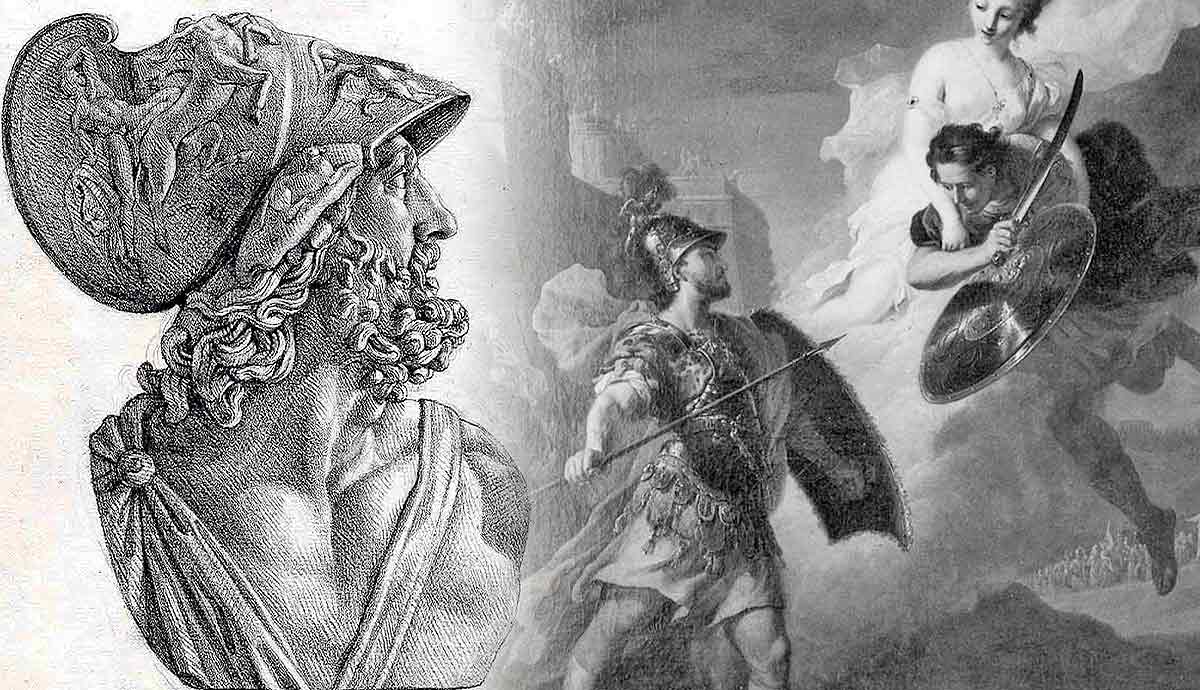
Menelaus begins as a king living in domestic happiness with Helen. The abduction changes him into a vengeful warrior who fights at Troy for ten years. He duels Paris in single combat and nearly kills him, only for the goddess Aphrodite to intervene. He takes part in the final capture of the city from inside the Trojan Horse.
After the war he intends to kill Helen but drops his sword when he sees her again. They reconcile and sail home together, though storms and delays make the voyage difficult. By the time Telemachus visits in the Odyssey, Menelaus has settled back into kingship. He speaks with regret about lost comrades yet enjoys the wealth won from Troy. Later traditions say he and Helen receive immortality in the Elysian Fields because of her divine parentage.
Powers & Abilities
Skilled spear fighter
Charioteer
Military leadership
Diplomacy
Equipment & Signature Items
Bronze armor
Spear
Sword
Relationships
Helen
Love InterestHis wife whose abduction triggered the Trojan War; he ultimately forgives her and they reunite.
Agamemnon
FamilyElder brother and overall commander of the Greek forces during the war.
Paris
EnemyTrojan prince who took Helen; Menelaus fights him in direct combat.
Odysseus
AllyFellow warrior who devised the Oath of Tyndareus and the Trojan Horse.
Telemachus
OtherSon of Odysseus whom Menelaus hosts generously in Sparta.
Memorable Quotes
“In the Odyssey he tells Telemachus how the war still brings him sorrow and how many fine men were lost.”
“Before their duel he addresses Paris about the wrong done to him and the need to settle it by combat.”
Portrayed By
Key Appearances
The Iliad
The Odyssey
Helen of Troy
Reception & Legacy
Fans of classical literature often see Menelaus as an honorable but sometimes underappreciated figure. While Helen, Achilles, and Odysseus dominate modern retellings, Menelaus represents the ordinary hero who fights for his home and eventually finds peace. Online discussions in classics communities push back against the modern image of him as merely a cuckolded king, pointing instead to his bravery, sense of duty, and capacity for forgiveness in the original texts.
His story continues to influence Western art, literature, and education. The phrase the face that launched a thousand ships, though about Helen, remains forever tied to his grievance. He appears in countless adaptations, from ancient vase paintings to recent films and novels, usually as the aggrieved husband whose personal stake sets an epic in motion.
Interesting Facts and Legends
He was one of the few Greek kings who returned home safely after the war, unlike his brother Agamemnon.
Later myths grant him and Helen immortality in the Elysian Fields.
The Menelaion near Sparta was an actual ancient shrine where people worshiped him and Helen as heroes.
His palace in the Odyssey is described as especially splendid, filled with the treasures brought back from Troy.
The House of Atreus curse that shaped his family is one of the most famous examples of inherited guilt in Greek myth.
His name has been interpreted as either restraint of the people or wrath of the people.
Frequently Asked Questions
Who is Menelaus?
Does Menelaus die in the Trojan War?
Who plays Menelaus?
Is Menelaus a villain?
Who does Menelaus end up with?
Keywords
Sources
Character Info
Join the community
fans discussing