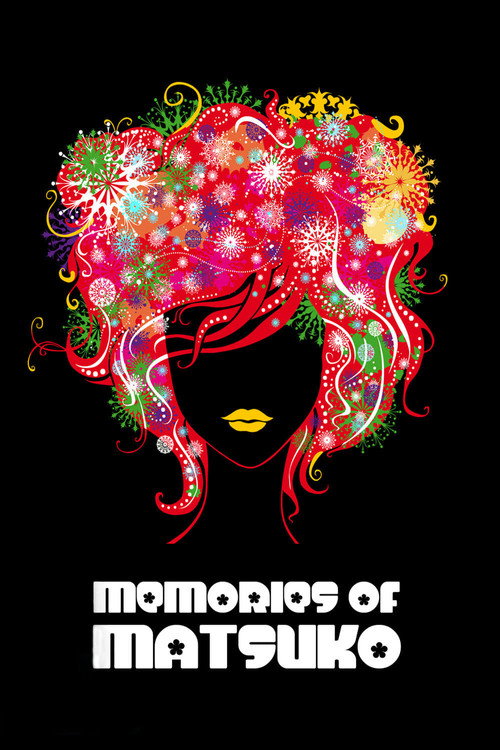
In 2006, Japanese director Tetsuya Nakashima unleashed a film that looked like nothing else in contemporary cinema. Memories of Matsuko tells the story of Matsuko Kawajiri, a woman whose life collapses from promising schoolteacher to isolated recluse, but it does so through a barrage of candy-colored musical numbers, stop-motion animation, and fantasy sequences. Miki Nakatani delivers a fearless, shapeshifting performance in the lead, swinging from giddy schoolgirl energy to hollow-eyed despair without losing the thread of a woman who never stops believing love will save her.
Based on Muneki Yamada's novel, the film opens with Matsuko's murder and follows her nephew Sho as he sorts through her belongings, piecing together the shattered narrative of her life. Nakashima, already known for Kamikaze Girls, pushes his visual maximalism even further here, borrowing from Depression-era Hollywood weepies, Japanese TV variety shows, and pop idol culture to create a language for Matsuko's inner world. The result is a sugar-rush tragedy that refuses to choose between comedy and sorrow, and it's why the film has become a cult favorite far beyond Japan.
Released on May 27, 2006, the movie was backed by a consortium that included TBS, TOHO, and Warner Music Japan. It earned a 7.8/10 on IMDb and strong audience scores on Rotten Tomatoes, but its real legacy is in how it expands what a movie musical can be. Nakatani's performance is often cited as one of the great female turns in 21st-century Japanese film, and the movie's reputation has only grown with each home video release.
PlotSpoiler-free
Sho Kawajiri is a directionless college student when he gets word that his aunt, Matsuko, has been found dead, beaten in a park near the river where she lived. He barely remembers her, just vague childhood impressions of a strange, disheveled woman. When he goes to clean out her cramped apartment, he finds a lifetime of clutter: old photographs, faded diaries, and receipts that trace a path through decades of Japanese history. As he starts reading, her story unfolds in fragments, and he becomes a detective of his own family's secrets.
Matsuko grows up in a comfortable postwar home, but she's overshadowed by her younger sister Kumi, who is bedridden with illness. Their father dotes on Kumi and barely looks at Matsuko. Desperate for his attention, Matsuko learns that making a funny face, a comical grimace, makes him smile. She carries that tic into adulthood, and it becomes a sad signature of her need to please. She becomes a middle school teacher, and for a while, life seems bright. She loves her students, sings with them, and imagines a future full of possibility.
That future shatters when a student named Shuji Okura is accused of stealing. Matsuko tries to protect him, taking the blame herself, but the situation spirals. She's fired, and when she goes home seeking comfort, her father's coldness pushes her over the edge. She runs away with a colleague, beginning a pattern that will define her life: she gives everything to men who give nothing back.
Her first serious lover is Yoichi Ryu, a brilliant but tortured writer who beats her and then kills himself. His rival, a married man, takes her in briefly before discarding her. By her late twenties, Matsuko is working as a bar hostess, then a prostitute, and she's arrested for killing a client in a fit of rage. In prison, she finds a strange kind of order, learning a trade and making a friend, Megumi Sawamura. But when she's released, she drifts again, and her life narrows to a series of small rooms and smaller hopes.
Throughout it all, Matsuko's inner world stays vivid. She imagines herself as a pop star, sings to the camera, and turns her pain into elaborate fantasy sequences. The film's visual style mirrors her refusal to see her life as tragic. She keeps loving, keeps hoping, even when every man she meets lets her down. Sho, listening to her story, starts to understand that his aunt wasn't pathetic. She was relentless.
A visually dazzling tragicomedy that balances candy-colored musical fantasy with brutal reality, anchored by Miki Nakatani's fearless performance. Critics praise its emotional depth and stylistic audacity, though some find the excess overwhelming. The film's cult status is well-earned.
 Japan
Japan