 United States
“Memento is a movie that demands your full attention, and rewards you with a puzzle that fits together perfectly, yet leaves you with a lingering sense of unease.”
Roger Ebert
Chicago Sun-Times
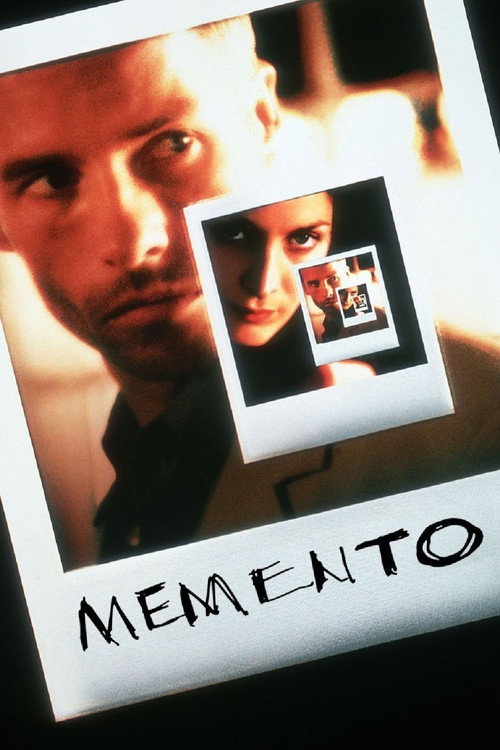
Leonard Shelby hunts for the man who raped and murdered his wife, but a rare form of short-term memory loss makes the quest nearly impossible. He remembers life before the accident yet cannot hold onto what happened just fifteen minutes ago. Christopher Nolan directs this tight thriller that turns the detective genre on its head by placing the audience inside Leonard's fractured mind.
Produced on a modest budget of $9 million, the film grossed over $40 million worldwide upon its October 2000 release. Critics and audiences quickly embraced the puzzle, earning it an impressive rating from thousands of voters. The movie blends mystery and psychological thriller elements without relying on big-budget action sequences or special effects. Instead, it builds tension through narrative structure and performance.
Stream
Availability and pricing can change. Confirm on the provider's site before purchasing.
Leonard Shelby lives in a state of perpetual confusion after a brutal home invasion left him with anterograde amnesia. He cannot form new memories, so he relies on a system of Polaroid photographs, handwritten notes, and permanent tattoos to track his progress and remember facts he deems essential. His primary directive is to find and kill the man responsible for his wife's death, a mission he believes is supported by the evidence he has meticulously gathered. The film presents two parallel timelines: one moving forward chronologically as Leonard wakes each day, and another running backward, revealing events leading up to the start of the forward sequence. These threads converge at the center, forcing the viewer to piece together the truth alongside Leonard, who is constantly being manipulated by those around him.
During his journey, Leonard encounters several key figures who influence his path. Sammy Jankis serves as a cautionary tale Leonard often recounts, though the details of Sammy's story remain murky and potentially fabricated by Leonard himself to rationalize his own actions. Natalie, a waitress at a diner, offers Leonard shelter and information, though her motives stay ambiguous. Teddy, a charismatic drug dealer, claims to be helping Leonard track down the killer while seemingly manipulating him into doing his dirty work. Burt, a motel owner, provides a safe haven but remains deeply involved in the criminal underworld.
As the reverse timeline progresses, Leonard becomes increasingly paranoid and confused. He questions whether the people he meets are trustworthy or if he is being led astray. The central conflict arises not just from the hunt for the murderer, but from Leonard's inability to distinguish between fact and fiction. Every clue he finds points toward a different suspect, and every interaction leaves him more desperate and isolated. The tension builds as the timelines approach their meeting point, revealing that the clues Leonard relies on may have been planted by the very people he trusts. The film explores themes of identity, the fallibility of memory, and the human tendency to construct narratives that justify our actions, even if those narratives are built on lies.
The narrative structure forces the audience to experience Leonard's disorientation firsthand. Without the ability to retain context from scene to scene, Leonard must constantly re-evaluate his situation based on incomplete or altered information. This creates a unique viewing experience where the viewer shares his vulnerability and suspicion. As Leonard gets closer to his goal, the line between hunter and hunted blurs, setting the stage for a revelation that recontextualizes everything seen previously.
Official Restoration Trailer
Trailer
10th Anniversary Trailer
Critical Consensus
Memento stands as a masterclass in nonlinear storytelling, blending a gripping mystery with a profound psychological exploration of memory and identity. Christopher Nolan's direction, combined with Guy Pearce's intense performance, creates a tense, atmospheric experience that challenges the audience to question the reliability of perception. The film demonstrates how innovative narrative structures can enhance emotional depth rather than obscure it.
“Memento is a movie that demands your full attention, and rewards you with a puzzle that fits together perfectly, yet leaves you with a lingering sense of unease.”
Roger Ebert
Chicago Sun-Times
“Mr. Nolan has crafted a thriller that is as much about the nature of memory as it is about the mechanics of murder, creating a film that is both intellectually stimulating and emotionally resonant.”
A.O. Scott
The New York Times
“Guy Pearce gives a tour-de-force performance as a man trapped in a loop of his own making, while Christopher Nolan directs with a precision that makes the complex structure feel effortless.”
Peter Travers
Rolling Stone
“Memento is a bold, ambitious film that pushes the boundaries of the thriller genre, offering a fresh perspective on the concept of justice and the fragility of the human mind.”
Kenneth Turan
Los Angeles Times
Guy Pearce
Leonard Shelby
Carrie-Anne Moss
Natalie
Joe Pantoliano
Edward 'Teddy' Gammell
Mark Boone Junior
Burt
Russ Fega
Waiter
Jorja Fox
Mrs. Shelby
Stephen Tobolowsky
Sammy Jankis
Director
Christopher Nolan
Writers
Jonathan Nolan, Christopher Nolan
Composer
David Julyan
Cinematographer
Wally Pfister
Producers
Suzanne Todd, Jennifer Todd, Christopher Nolan
Academy Awards (2002)
Best Original Screenplay: Nominated
BAFTA Awards (2002)
Best Original Screenplay: Nominated
Independent Spirit Awards (2002)
Best First Feature: Won
Saturn Awards (2002)
Best Horror Film: Won
Sundance Film Festival (2001)
Grand Jury Prize (Dramatic): Won
Join the community
fans discussing