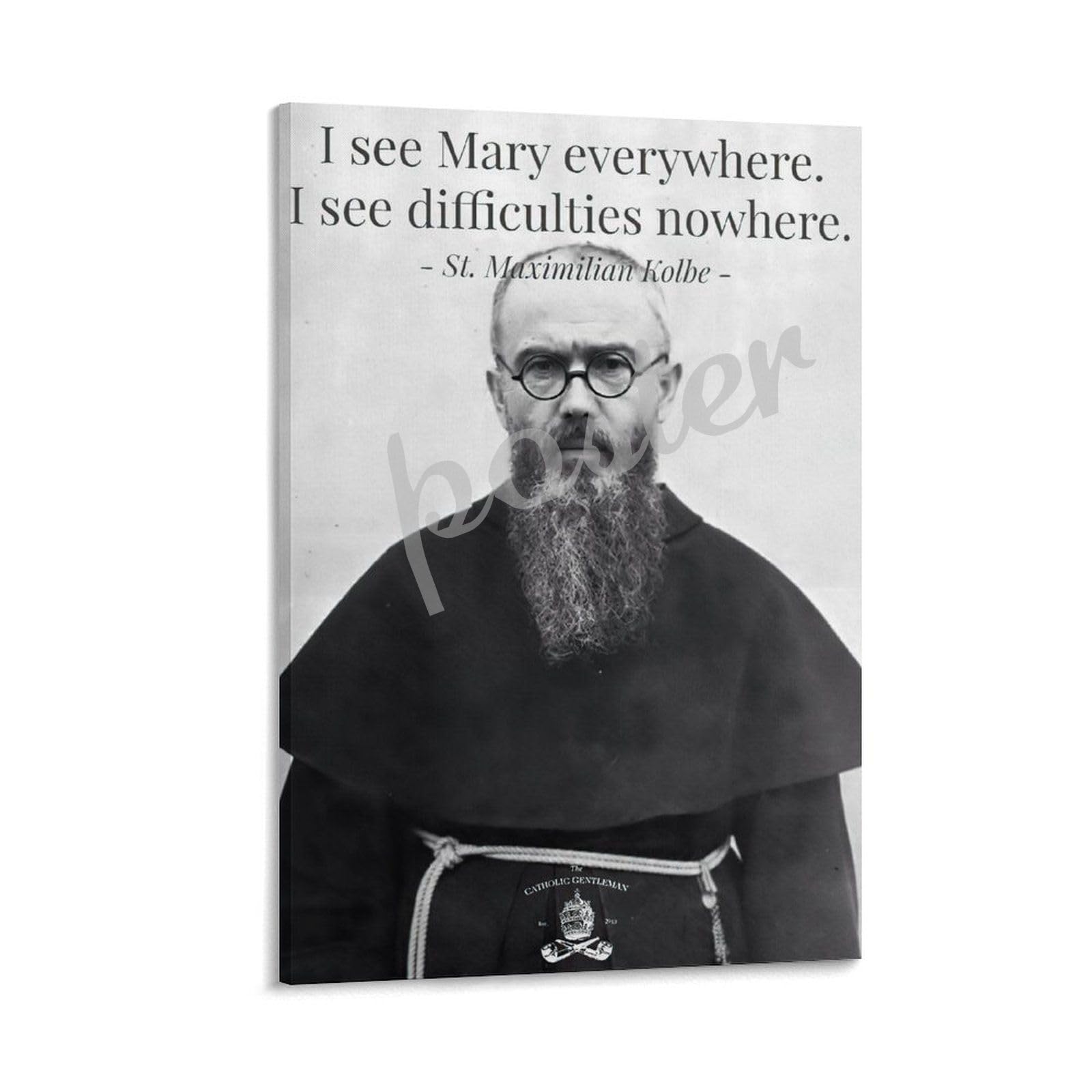
Maximilian Kolbe
 Poland
Conventual Franciscan friar•priest•missionary•amateur radio operator
Also known as: Maximilian Maria Kolbe, Maksymilian Maria Kolbe, Raimund Kolbe, Father Maximilian, Saint Maximilian Kolbe
Birthday
January 8, 1894
Birth Sign
Capricorn
Birthplace
Zduńska Wola, Poland
Age
Died at 47
Height
5 ft 6 in (168 cm)
About
Maximilian Kolbe was a Polish Conventual Franciscan friar and priest who gave his life for a stranger at Auschwitz. Born Raymund Kolbe in 1894, he became a missionary, publisher, and founder of the Militia Immaculatae, a global movement dedicated to Marian consecration. His monastery at Niepokalanów grew into a massive publishing and religious center, and he personally launched a radio station with call sign SP3RN. In 1941, after volunteering to die in place of a fellow prisoner, he was killed by lethal injection. Pope John Paul II canonized him in 1982 as a martyr of charity.
Today Kolbe is remembered as the patron saint of amateur radio operators, drug addicts, political prisoners, families, journalists, and prisoners. His feast day falls on August 14, the anniversary of his death. Devotional communities worldwide honor his sacrifice, and his story remains a powerful example of selfless love in Holocaust education.
Early Life & Background
Raymund Kolbe came into the world on January 8, 1894, in Zduńska Wola, a textile town in the Kingdom of Poland, then part of the Russian Empire. His father Julius worked as a weaver and later ran a religious bookstore; his mother Maria was equally devout. Both parents belonged to Franciscan lay organizations, and young Raymund absorbed that piety early. He had four brothers, but only Alfons lived to adulthood.
Around age ten, Kolbe reported a vision of the Virgin Mary offering him two crowns, one white for chastity and one red for martyrdom. He said he chose both. That moment steered his entire life. In 1907, at thirteen, he and his brother Francis entered the Conventual Franciscan minor seminary in Lwów. He was drawn to mathematics and physics, and developed a fascination with electricity and radio.
Kolbe entered the novitiate in 1910, taking the religious name Maximilian, and professed first vows on September 5, 1911. He studied philosophy in Kraków and theology in Rome, earning doctorates in both by 1919. During those years in Rome, he built his own amateur radio equipment, a hobby that would later serve his missionary work. The intellectual rigor and technical curiosity of his youth laid the groundwork for the publishing empire and radio station he would create at Niepokalanów.
Career Growth
Kolbe's breakthrough came in 1917, while still a seminarian in Rome, when he founded the Militia Immaculatae, an international movement for consecration to the Immaculate Virgin. Ordained a priest on April 28, 1918, he returned to Poland the next year and began teaching church history in Kraków. In 1922 he launched the monthly magazine Rycerz Niepokalanej (Knight of the Immaculate), which by 1939 reached a circulation of over one million copies.
In 1927 he established the monastery of Niepokalanów near Warsaw, a self-sufficient religious city that at its peak housed more than 700 friars. The complex included a printing press, a fire brigade, and an amateur radio station with call sign SP3RN. From 1930 to 1936, Kolbe served as a missionary in Japan, founding a similar monastery in Nagasaki in 1931. That structure survived the 1945 atomic bombing because its hillside location deflected the blast. He returned to Poland in 1936 to lead Niepokalanów.
When Germany invaded in September 1939, Kolbe refused to abandon his monastery and sheltered roughly 3,000 Polish refugees, including about 1,500 Jews. The Gestapo arrested him in February 1941. He was sent to Auschwitz in May, assigned prisoner number 16670. There he continued to hear confessions and comfort fellow prisoners. In late July, after an escape, ten men were selected for starvation. Kolbe stepped forward and offered his life for Franciszek Gajowniczek, a married man with children. He was the only volunteer. After two weeks without food or water, he was still alive and was executed by lethal injection of carbolic acid on August 14, 1941. His body was cremated the next day, the feast of the Assumption.
Career Timeline
Public Image & Style
Kolbe's public image is that of a heroic martyr whose selfless sacrifice transcends religious boundaries. Catholic media often call him the Knight of the Immaculata, a warrior for Marian devotion. His story is frequently cited in Holocaust education as an example of extraordinary moral courage. Photographs show a gentle-faced friar in a Franciscan habit, and his calm demeanor in the face of death has become legendary. Devotional communities worldwide celebrate his feast day on August 14 with special masses and prayers. Social media accounts dedicated to his memory share his story, especially around that date, keeping his legacy alive for new generations.
Fame & Fandom
The devotion surrounding Maximilian Kolbe is distinct because it transcends the modern concept of fandom, operating instead as a living spiritual movement rooted in the Militia of the Immaculata. His followers do not seek celebrity status or chart positions; they gather for pilgrimage to Auschwitz and Niepokalanów, reciting novenas and engaging in charitable work that mirrors his own life. While there is no formal fan club name akin to those found in pop culture, the global community of Franciscans and Marian devotees maintains a rigorous tradition of veneration, treating his legacy as a theological imperative rather than a commercial brand. This unique dynamic ensures his story remains a constant source of moral reflection rather than fleeting viral attention. Within this framework of enduring reverence, his standing in global historical consciousness has solidified into measurable prominence. The iFANN Global Fame Rankings place him as the 11th most famous person in Pastors, a position he holds steady from the previous cycle. This ranking reflects the profound impact of his martyrdom on religious discourse worldwide.
Interesting Facts and Legends
Maximilian Kolbe held amateur radio license SP3RN, making him the patron saint of amateur radio operators. The monastery he founded in Nagasaki survived the atomic bombing because it sat on a hillside that deflected the blast. He earned doctorates in both philosophy (1915) and theology (1919) from Roman institutions. His magazine Rycerz Niepokalanej had a monthly circulation exceeding one million copies at its peak. During the Nazi occupation, he sheltered about 3,000 Polish refugees, including roughly 1,500 Jews, at Niepokalanów. At age ten, he reported a vision of the Virgin Mary offering him white and red crowns, symbolizing chastity and martyrdom. His Auschwitz prisoner number was 16670. He survived two weeks of starvation before being killed by lethal injection. A powerful legend from Cell 18 describes how Kolbe taught informal theology classes to fellow prisoners during their final days, turning the bunker into a classroom of spiritual resistance. Another enduring story focuses on the Miraculous Medal, which he distributed as a weapon for evangelization long before his arrest, a practice that continues to inspire modern reflections on faith under persecution.
Notable Quotes
“I am a Catholic priest. Let me take his place. He has a wife and children.”
“Do not hate anyone. Hate no one. Love everyone.”
“For Jesus Christ I am prepared to suffer more.”
Family & Personal Life
Kolbe's parents, Julius and Maria, were devout Catholics active in Franciscan lay organizations. His father worked as a weaver and later ran a religious bookstore. Of his four brothers, only Alfons survived into adulthood. As a priest and friar, Kolbe took vows of chastity, poverty, and obedience, so he had no spouse or children. His family was his religious community at Niepokalanów, where he lived with hundreds of fellow friars. He maintained a close bond with his brother Francis, who also entered the Franciscan order.
Notable Connections
Franciszek Gajowniczek, the Polish army sergeant whose life Kolbe saved at Auschwitz, survived the war and attended Kolbe's canonization in 1982. Pope John Paul II canonized Kolbe and declared him a martyr of charity. Pope Paul VI beatified him in 1971. Pope Pius XII ordered the beatification investigations in 1947. Kolbe's parents, Julius and Maria, were devout Catholics, and his brother Francis also became a Franciscan. The spirituality of St. Francis of Assisi shaped Kolbe's vocation.
Relationships & Dating History
Maximilian Kolbe was a Catholic priest and Conventual Franciscan friar who took a vow of celibacy. He had no dating history, romantic relationships, marriages, or children. His life was devoted entirely to his religious vocation. At the time of his death in 1941, he was single, as he had always been.
Death & Aftermath
Died
August 14, 1941 (aged 47)
Death Place
Auschwitz, Oświęcim, Poland
Cause of Death
Starvation, dehydration, and phenol injection
The Nazi administration at Auschwitz recorded the death of Maximilian Maria Kolbe on August 14, 1941, following his voluntary substitution for a fellow prisoner in Block 13. The official ruling attributed his passing to starvation and dehydration after fourteen days of confinement in a sealed underground cell, with the final act being a lethal injection of phenol administered by guards when only he remained alive among the group. Immediately following the war, Kolbe was revered within the Catholic community as a hero of charity, though no formal funeral service took place in 1941 due to the conditions of the concentration camp.
His body was likely cremated in the camp ovens, and his remains were likely scattered or interred in the ashes of the crematorium, leaving no known physical burial site. Public commemoration began decades later, culminating in Pope John Paul II celebrating a Mass at the former camp site on June 15, 1982, where he canonized Kolbe as a Martyr of Charity alongside Beatification by Pope Paul VI in 1971. Since then, tributes have included annual feast day celebrations on August 14th featuring vigils and masses worldwide, while institutions such as the University of St.
Mary of the Lake and numerous parishes bear his name. The Vatican released the film The Martyrdom of St. Maximilian Kolbe in 1994, and the Franciscan Order manages his personal writings and radio equipment archives through the St. Maximilian Kolbe Foundation. He is now recognized as the patron saint of families, drug addicts, and political prisoners, with the preserved Block 13 at the Auschwitz-Birkenau State Museum standing as a permanent memorial to his sacrifice.
Net Worth (Estate Value)
Maximilian Kolbe took a vow of poverty and owned no personal wealth. He died in 1941, and no commercial net worth estimates exist for him. His legacy is preserved through the Catholic Church, which maintains shrines and memorial sites, including the National Shrine of St. Maximilian Kolbe in Libertyville, Illinois. The Franciscan order manages his spiritual and historical legacy, but there is no revenue-generating estate. Any income from devotional materials or pilgrimages goes to religious and charitable causes, not to personal heirs.
Awards Won (2)
Kolbe received the highest honors of the Catholic Church. Pope Paul VI beatified him on October 17, 1971, and Pope John Paul II canonized him on October 10, 1982, declaring him a martyr of charity. These recognitions celebrate his heroic sacrifice and lifelong devotion to the Immaculate Virgin.
1982 · Saint
Martyrdom at Auschwitz
1971 · Blessed
Martyrdom at Auschwitz
Known For
Martyrdom at Auschwitz
1941 · Volunteered to die in place of a fellow prisoner
Founding of Niepokalanów
1927 · Founder and guardian
Militia Immaculatae
1917 · Founder
Keywords
Sources
Quick Facts
- Born
- January 8, 1894
- Birthplace
- Zduńska Wola, Poland
- Died
- August 14, 1941
- Death Place
- Auschwitz
- Gender
- Male
- Birth Sign
- Capricorn
- Profession
- Conventual Franciscan friar, priest, missionary, amateur radio operator
Personal Details
- Full Name
- Raymund Kolbe
- Height
- 5 ft 6 in (168 cm)
- Education
- Doctorates in philosophy (1915) and theology (1919) from Pontifical Gregorian University and Pontifical International Athenaeum Seraphicum, Rome
Frequently Asked Questions
How did Maximilian Kolbe die?
Why did Maximilian Kolbe volunteer to die?
What is Maximilian Kolbe the patron saint of?
Was Maximilian Kolbe married or did he have children?
What happened to the man Maximilian Kolbe saved?
Similar People
Join the community
fans discussing