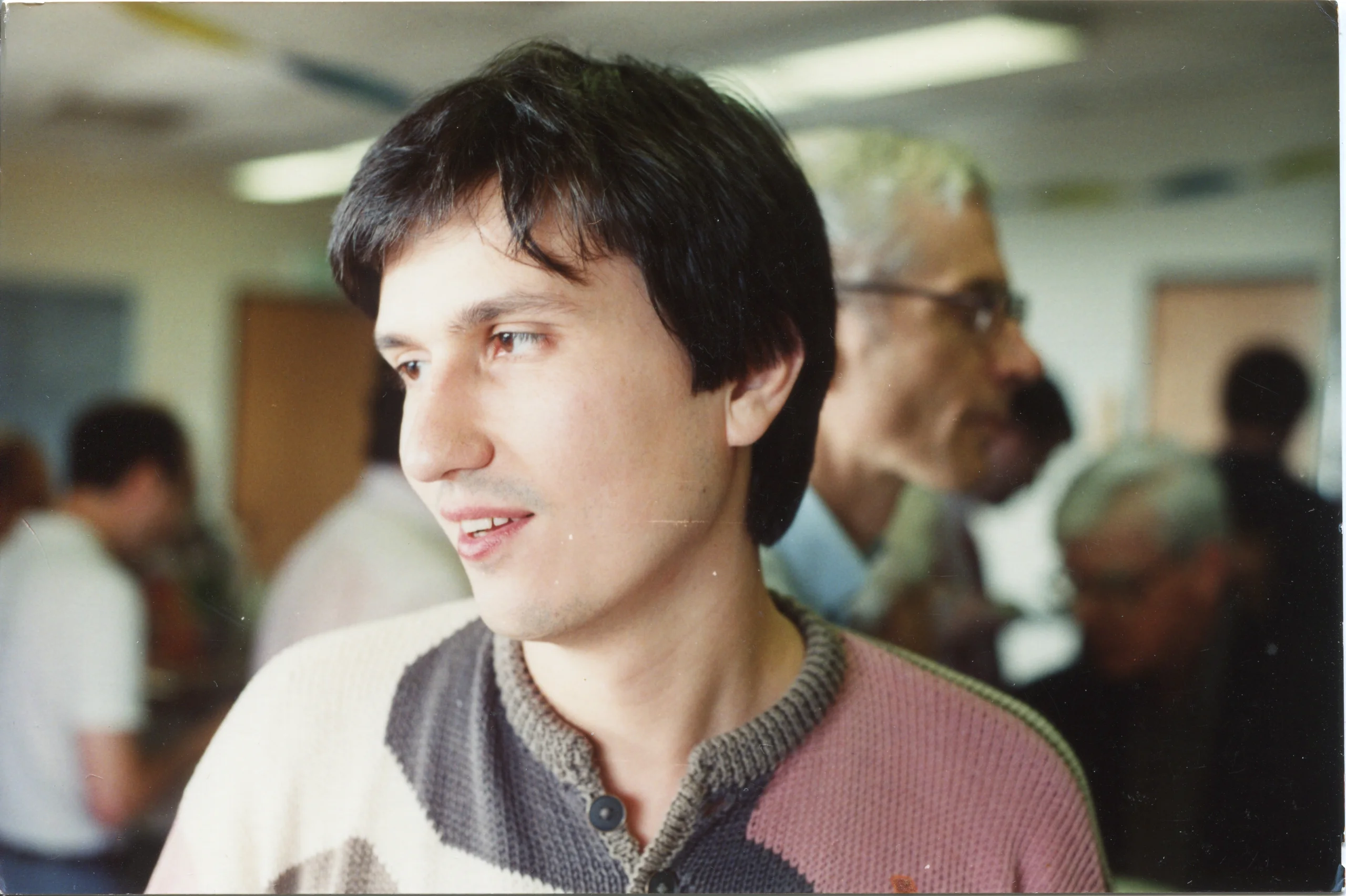
Maxim Kontsevich
 Russia
mathematician•mathematical physicist
Birthday
August 25, 1964
Birth Sign
Sagittarius
Birthplace
Khimki, Russia
Age
62 years old
About
Maxim Kontsevich is a Russian and French mathematician and mathematical physicist, widely regarded for his transformative contributions to algebraic geometry, topology, and quantum field theory. He holds a permanent professorship at the Institut des Hautes Études Scientifiques (IHES) near Paris and a distinguished professorship at the University of Miami.
Kontsevich's work has earned him the Fields Medal in 1998, often described as the Nobel Prize of mathematics, along with the Crafoord Prize, the Shaw Prize, and two Breakthrough Prizes. He is known for proving Edward Witten's conjecture on moduli spaces of curves, which opened new directions in enumerative geometry and string theory.
Today, he continues to pioneer research at the intersection of mathematics and theoretical physics, leading the ERC Synergy Grant project ReNew Quantum. His influence extends across disciplines, with collaborators and students advancing his ideas worldwide.
Early Life & Background
Maxim Lvovich Kontsevich was born on August 25, 1964, in Khimki, a town near Moscow. His father, Lev Rafailovich Kontsevich, was a Soviet orientalist who created the Kontsevich system for the Cyrillization of the Korean language. His mother trained as an engineer, and his elder brother Leonid later pursued computer imaging research in San Francisco.
Kontsevich showed extraordinary mathematical talent early. At sixteen, he placed second in the All-Union Mathematics Olympiad, a national competition for the Soviet Union's brightest students. He entered Moscow State University in 1980, where he studied under influential mathematicians, including Israil Gelfand. He left without a degree in 1985 to work as a researcher at the Institute for Information Transmission Problems in Moscow.
His early work there caught the attention of the Max Planck Institute in Bonn, which invited him for a research stay. During that time, he proved the Witten conjecture, a result that stunned mathematicians like Michael Atiyah and led to an extended appointment. He completed his doctorate at the University of Bonn in 1992, with Don Zagier as his advisor.
Career Growth
Kontsevich's proof of the Witten conjecture in the early 1990s marked his breakthrough, linking intersection theory on moduli spaces of curves to integrable systems. This work earned him the EMS Prize and the Otto Hahn Medal in 1992. He held a professorship at the University of California, Berkeley, from 1994 to 1995, before joining IHES as a permanent professor in 1995.
His research on Gromov-Witten invariants and Calabi-Yau manifolds was fundamental to mirror symmetry, a topic at the heart of string theory. In 1998, he received the Fields Medal for his contributions. He later developed the Kontsevich integral, a universal Vassiliev invariant for knots, and formulated the deformation quantization of Poisson manifolds, now known as Kontsevich quantization.
His later honors include the Henri Poincaré Prize (1997), the Crafoord Prize (2008), the Shaw Prize (2012), and the Breakthrough Prize in Mathematics (2015). He also received the Breakthrough Prize in Fundamental Physics in 2012 for his work on quantum field theory. As of 2026, he remains active at IHES and the University of Miami, leading the ERC Synergy Grant project ReNew Quantum.
Career Timeline
Public Image & Style
Kontsevich is regarded in mathematical circles as a visionary, known for his ability to connect deep ideas across disciplines. Colleagues often describe his style as intuitive and bold, tackling problems that seem intractable with surprising elegance.
His proof of the Witten conjecture at a young age became legendary, and he is frequently cited as an inspiration by younger mathematicians. He is not a public figure in the mainstream media, but within the academic community, his lectures are highly anticipated and his papers are read closely.
He is seen as a bridge between pure mathematics and theoretical physics, with a reputation for avoiding publicity while letting his work speak for itself.
Fame & Fandom (iFAMOUS Rankings)
Maxim Kontsevich is currently evaluated by the iFANN Global Fame Engine but holds no placement in the published rankings, meaning he does not appear on the Global Top 1,000 list or any scope-specific top-100 charts. While his name resonates deeply within the halls of mathematics and theoretical physics, this absence from the public fame indices reflects a career dedicated to specialized inquiry rather than mass-market celebrity. The mathematician operates in a realm where influence is measured by citations and the depth of insight rather than viral reach or search volume. His audience consists almost entirely of fellow researchers, students, and scholars who engage with his work through peer-reviewed journals and academic seminars. There is no formal fandom name attached to his legacy; the community that reveres his contributions identifies simply as the mathematical community. Unlike pop icons who inspire organized campaigns, fan-funded projects, or collective rituals, Kontsevich's admirers are defined by their professional engagement with his proofs. His most iconic moments are not red-carpet appearances or stage outbursts, but the publication of transformative theorems like the homological mirror symmetry conjecture. These intellectual milestones have sparked decades of research and collaboration across disciplines, creating a lineage of academic mentorship that spans continents. Even his receipt of major awards, such as the Breakthrough Prize, is celebrated as a scientific milestone rather than a media event. In the rare instances where he steps into the public eye, it is to discuss complex geometric problems or lead research teams on audacious new proofs, maintaining a quiet dignity that defines his unique position in modern science.
Interesting Facts and Legends
The father of Maxim Kontsevich, Lev, was an orientalist who developed the Kontsevich system for transliterating Korean into Cyrillic script, a system still used in Russia today. His brother Leonid works in computer imaging research, and the two have occasionally collaborated on projects involving image recognition. Kontsevich left Moscow State University without a degree, a path that would be unusual for a future Fields Medalist. He holds dual citizenship in Russia and France, reflecting his long association with IHES. In 2025, he received the AMS Moore Prize, a relatively recent addition to his long list of honors. Beyond these personal details, Kontsevich is legendary for formulating the homological mirror symmetry conjecture in 1994, a breakthrough that bridged symplectic geometry and algebraic geometry and revolutionized string theory. This achievement earned him the Fields Medal and remains a cornerstone of modern mathematical thought. More recently, in late 2025, he led a team to produce a new proof for a decades-old geometry problem inspired by string theory, described as both audacious and brilliant by observers in Quanta Magazine. These verified events stand as the primary legends of his career, overshadowing any potential pop-culture myths. His influence extends through his 10 students and 16 descendants in the Mathematics Genealogy Project, marking a clear lineage of academic mentorship rather than a fanbase driven by celebrity worship.
Notable Quotes
“Mathematics is an evolving discipline.”
“The beauty of mathematics lies in its unexpected connections.”
Family & Personal Life
Maxim Kontsevich was born into an intellectual family in Khimki, Russia. His father, Lev Rafailovich Kontsevich, was a Soviet orientalist and linguist, known for creating the Kontsevich system for Cyrillization of the Korean language. His mother was an engineer by training. He has an elder brother, Leonid, who works in computer imaging research and lives in San Francisco.
Details about Kontsevich's personal household, including a spouse or children, are not publicly documented. He has maintained a private personal life, focusing public attention on his mathematical work.
Notable Connections
Kontsevich's doctoral advisor was Don Zagier, a prominent number theorist. He studied under Israil Gelfand at Moscow State University. His proof of the Witten conjecture was praised by Michael Atiyah. He has collaborated with Yuri Manin on mirror symmetry, and his notable students include Serguei Barannikov. He also interacted with Edward Witten, whose conjecture he proved.
Relationships & Dating History
Maxim Kontsevich has kept his personal relationships largely out of the public eye. There is no documented information about a spouse, partner, or significant dating history in available sources. He is known to be intensely focused on his work, and his private life remains private.
As of 2026, his relationship status is not publicly reported, and he appears to be single.
Salary, Net Worth In 2026
$5 Million
iFANN Editorial Team estimate
Per iFANN's editorial analysis, Maxim Kontsevich's net worth is estimated at $5 Million as of 2026, primarily accumulated through his distinguished academic career. As a permanent professor at IHES and a distinguished professor at the University of Miami, his salary is supplemented by substantial research grants, including the ERC Synergy Grant for the ReNew Quantum project, which provides funding over several years. His income sources also include prize money from prestigious awards. The Fields Medal carries a monetary award of 15,000 Canadian dollars, while the Breakthrough Prize in Mathematics comes with a $3 million prize, which he received in 2015. The Shaw Prize and Crafoord Prize also include significant cash awards. Kontsevich has not engaged in commercial ventures or public speaking circuits, so his wealth is modest compared to applied scientists. This figure reflects a life dedicated to theoretical research rather than financial gain.
Awards Won (9)
Maxim Kontsevich has received the most prestigious honors in mathematics and physics. His Fields Medal in 1998 is the pinnacle, alongside the Crafoord Prize, Shaw Prize, and two Breakthrough Prizes. He has also won the Henri Poincaré Prize and the EMS Prize, among others.
2015 · Mathematics
For his contributions to mathematical physics and geometry
2012 · Physics
For his work on quantum field theory and string theory
Known For
Proof of Witten conjecture
1992 · Mathematician
Kontsevich integral
1993 · Mathematician
Deformation quantization
1997 · Mathematician
Keywords
Sources
Quick Facts
- Profession
- mathematician, mathematical physicist
- Born
- August 25, 1964
- Birthplace
- Khimki, Russia
- Gender
- Male
- Birth Sign
- Sagittarius
- Nationality
- Russian, French
- Education
- University of Bonn (PhD, 1992)
Personal Details
- Full Name
- Maxim Lvovich Kontsevich
- Education
- Moscow State University (no degree), University of Bonn (PhD, 1992)
Frequently Asked Questions
Who is Maxim Kontsevich?
What is Maxim Kontsevich's net worth in 2026?
Is Maxim Kontsevich still active in 2026?
What is Maxim Kontsevich best known for?
Where was Maxim Kontsevich born?
Similar People

Join the community
fans discussing