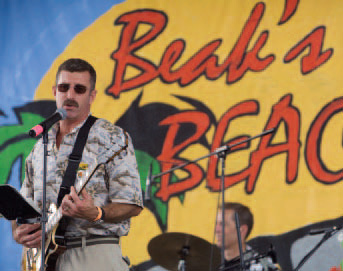
Max Q
 United States
The only professional rock band made entirely of astronauts
11
Members
About
Max Q exists outside the standard machinery of the music industry. There are no managers booking gigs, no publicists crafting narratives, and no record deals pushing singles. The group relies entirely on its members to coordinate logistics, from arranging transportation to splitting venue payments. This self-sufficient model reflects the autonomy required of astronauts who must manage complex missions with limited external support.
The lineup shifts constantly based on flight assignments, training cycles, and retirements. In 2009, the roster included future International Space Station crew members like Chris Hadfield, Dan Burbank, and Tracy Caldwell Dyson alongside veterans like Ken Cockrell. Despite this fluidity, the band maintains a consistent identity rooted in classic rock covers and high-energy performances. They play where they can, often at NASA events or local bars in Houston, proving that professional scientists can also be passionate musicians.
Formation Story
Brewster Shaw and Robert L. Gibson started Max Q in early 1987 while stationed in Houston. Both were experienced astronauts who wanted a creative outlet beyond their technical duties. They recruited George "Pinky" Nelson as a founding bassist, completing the initial trio. The name "Max Q" was chosen to reflect their profession, referencing the point of maximum dynamic pressure a rocket experiences during ascent. Gibson claims he coined the term, though Shaw also asserts he came up with it first.
The band did not follow a traditional path of auditions or demo recordings. Their first performance happened shortly after formation at the Boot Hill Saloon in Houston. Unlike commercial groups, Max Q never aimed for chart success or album sales. They simply played when they could, using their shared passion for rock music to bond outside the rigid structure of NASA training. Over the years, members rotated in and out as their careers evolved, but the core mission remained: having fun and making noise together.
Members
Former Members
Brewster Shaw (Brewster H. Shaw)
Rhythm Guitar · 1987–1990s
Robert "Hoot" Gibson (Robert Lee Gibson Jr.)
Lead Vocals, Lead Guitar · 1987–1990s
George "Pinky" Nelson (George D. Nelson)
Bass Guitar · 1987–1990s
Steven A. Hawley (Steven Alan Hawley)
Keyboards · 1987–1990s
Jim Wetherbee (James H. Wetherbee)
Drums · 1987–1990s
Carl Walz (Carl E. Walz)
Lead Vocals · 1990s–2000s
Susan Helms (Susan Jay Helms)
Lead Vocals, Keyboards · 1990s–2000s
Kevin "Chili" Chilton (Kevin M. Chilton)
Lead Vocals, Guitar · 1990s–2000s
Pierre Thuot (Pierre Jean-François Thuot)
Bass Guitar · 1990s–2000s
Musical Style
Max Q plays straightforward rock music, leaning heavily on classic rock covers and original material written by members. Chris Hadfield once joked that the band is like a Space Shuttle because it "makes lots of noise but no music," highlighting their amateur status despite the members' technical brilliance. Their sound remains consistent with garage rock aesthetics, prioritizing energy over precision.
Since the group does not produce studio albums, their musical style evolves only through the personal tastes of new members joining the fold. They rely on instruments that can be transported easily or found at practice venues. The lack of a fixed rhythm section means drummers rotate frequently, adapting to whoever is available for a given show.
Cultural Impact
Max Q serves as a cultural bridge between science and entertainment. They demonstrate that astronauts pursue diverse interests beyond their high-stakes jobs. Media outlets frequently feature the band in documentaries about astronaut hobbies, showcasing the human side of space exploration. Their existence challenges the stereotype that scientists cannot maintain creative outlets.
The band gained wider attention indirectly through member Chris Hadfield's viral 2013 cover of David Bowie's "Space Oddity" recorded on the International Space Station. While Hadfield performed solo, his connection to Max Q helped popularize the idea of astronauts as musicians. The group remains a symbol of the balance between rigorous scientific work and personal passions.
Fandom Culture
Max Q does not have an official fandom, lightstick, or fan color. Fans are primarily space enthusiasts, NASA supporters, and followers of individual astronauts. There are no organized fan projects or traditions specific to the band. Interest in Max Q usually spikes when members perform live or appear in media segments about astronaut life.
Awards & Accolades
View 1 records, honours and achievementsMilestones
Band formed by Brewster Shaw and Robert L. Gibson
Active roster included multiple future ISS crew members
Chris Hadfield's viral "Space Oddity" cover boosts interest in astronaut musicians
Trivia
The band's name refers to the engineering term for maximum dynamic pressure during a rocket launch., Chris Hadfield famously joked that Max Q makes lots of noise but no music., The group has never released a commercial album or single., Members collectively manage all logistics including transport and venue booking., No permanent drummer exists due to the difficulty of transporting drums during missions.
Keywords
Sources
Quick Facts
- Origin
- United States
- Status
- Active
Group Info
- Formed
- January 1987
- Debut
- 1987
- Origin
- Houston, Texas, United States
- Company
- Independent
- Label
- None
- Status
- Active
Social Media
Also Known As
Join the community
fans discussing