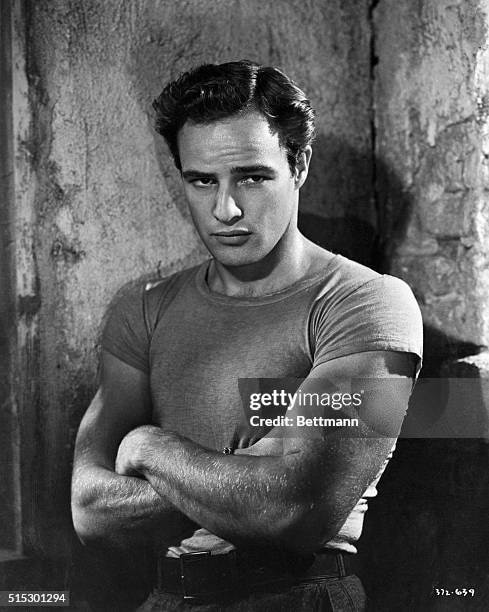
Marlon Brando
 United States
film actor•stage actor•television actor
Also known as: Bud
Birthday
April 3, 1924
Birth Sign
Aries
Birthplace
Omaha, Nebraska, USA
Age
Died at 80
Height
5 ft 10 in (178 cm)
About
Marlon Brando Jr., an American film, stage, and television actor, fundamentally changed how performers approached their craft. Born on April 3, 1924, he introduced the Stanislavski system and method acting to mainstream audiences, emphasizing raw emotional honesty and naturalistic delivery. Throughout a career that spanned over five decades, Brando starred in more than 40 films and several television projects, earning numerous accolades including two Academy Awards, two Golden Globe Awards, three BAFTAs, and a Primetime Emmy.
His distinctive style, characterized by intense emotional depth and a brooding presence, made him an icon of rebellion and a profound influence on generations of actors. Brando's performances often delved into complex characters, from the vulnerable Terry Malloy in On the Waterfront to the formidable Vito Corleone in The Godfather. Even after his passing in 2004, his work continues to be studied in acting schools and celebrated by film enthusiasts worldwide, solidifying his place as one of cinema's most important figures.
Early Life & Background
Marlon Brando's early life was marked by a challenging home environment, growing up with an abusive father and a mother who struggled with alcoholism. He learned to play-act to try and engage his mother, perhaps unknowingly cultivating his performance skills from a young age. His childhood spanned Nebraska, California, and Illinois. School wasn't always a smooth path; he was expelled from Libertyville High School after riding a motorcycle through the hallways, and later from Shattuck Military Academy in 1943 for insubordination. A bad knee kept him out of World War II military service, which opened a different path for him.
In 1943, Brando moved to New York City to live with his older sister, Jocelyn, who was already pursuing acting studies. He initially took on manual labor, digging ditches, until his father agreed to finance his formal education. This led him to the Dramatic Workshop of the New School for Social Research, where he began classes with Stella Adler. There, he immersed himself in the Stanislavski system and the method acting technique, which would become the cornerstone of his revolutionary approach to acting. This period of intense study and early stage work laid the groundwork for his eventual breakthrough.
Career Growth
Marlon Brando’s breakthrough arrived with a visceral force in 1947 when he took on the role of Stanley Kowalski in Tennessee Williams' A Streetcar Named Desire on Broadway. His raw, emotionally charged performance redefined theatrical acting, introducing a naturalistic intensity that captivated audiences and critics alike. He reprised this iconic role in the 1951 film adaptation, earning his first Academy Award nomination for Best Actor and making a significant impact on Hollywood.
The 1950s saw Brando rise to unparalleled stardom. He won his first Academy Award for Best Actor in 1955 for his powerful portrayal of Terry Malloy in On the Waterfront, a film where he delivered the now-famous line, "I coulda been a contender." That decade also featured him as the rebellious Johnny Strabler in The Wild One (1953), creating an enduring cultural image of defiance. He continued to deliver memorable performances in films like Viva Zapata! (1952) and Julius Caesar (1953), earning further Oscar nominations. In 1961, Brando stepped behind the camera to direct and star in the western One-Eyed Jacks, his only directorial effort.
Two decades later, Brando delivered another career-defining performance as Vito Corleone in The Godfather (1972), which earned him his second Academy Award for Best Actor. He famously declined the award, sending Sacheen Littlefeather to protest Hollywood's depiction of Native Americans. The 1970s also saw him in demanding roles such as Paul in Last Tango in Paris (1973) and the enigmatic Colonel Kurtz in Francis Ford Coppola's Apocalypse Now (1979). Brando even took on a smaller, yet highly paid, role as Jor-El in Superman (1978). His later career included an Oscar nomination for A Dry White Season (1989), a comedic turn in The Freshman (1990), and his final film appearance in The Score (2001) alongside Robert De Niro and Edward Norton. Over his career, Brando appeared in over 40 films and several television projects, leaving behind a filmography that consistently challenged and redefined cinematic performance.
Career Timeline
Public Image & Style
Marlon Brando cultivated a public image defined by his transformative method acting and a rebellious, often brooding, persona. He was celebrated for his raw, naturalistic style, frequently delivering lines with a mumbling, slurred cadence that conveyed immense emotional depth. This approach stood in stark contrast to the more classical, formal acting styles of his contemporaries, making him a revolutionary figure in cinema. The media often portrayed him as a troubled genius, acknowledging his profound impact on acting while also noting his eccentricities, weight fluctuations, and challenging behavior on film sets, especially later in his career.
Beyond his artistic contributions, Brando was also recognized for his activism, particularly his outspoken support for civil rights and Native American causes. This added another layer to his public persona, showcasing a man deeply committed to social justice. Fans, particularly cinephiles and acting students, hold him in high esteem, studying his performances as master classes in emotional truth and character immersion. While there isn't a single official fandom name, his work is consistently discussed and analyzed across classic film forums and academic circles, cementing his status as an enduring cultural icon.
Fame & Fandom (iFAMOUS Rankings)
Marlon Brando remains a towering figure in cinema history, though iFANN's Global Fame Engine currently evaluates him as unranked in the published lists of the top 1,000 most famous people globally. While he does not hold a specific numeric placement in the current rankings, his enduring cultural footprint dwarfs many contemporary stars who do appear on those lists. The absence of a formal ranking reflects how his fame has shifted from active celebrity metrics to a permanent, academic status within film studies and acting circles. Unlike modern icons with organized fanbases, Brando never cultivated a collective name for his admirers; there is no "Brandomania" or similar designation documented by researchers. Instead, his legacy is sustained by a decentralized community of film students, method acting enthusiasts, and cultural historians who revere him as the pioneer of realistic acting. This audience engages with his work through deep analysis of the Stanislavski system rather than social media campaigns or birthday drives. Historically, Brando famously avoided such adoration, refusing award ceremonies and interviews while viewing the celebrity machine with skepticism. Today, interaction with his image is managed primarily by the Marlon Brando Estate, which oversees collaborations like the aviator frame collection and maintains his environmental legacy through the eco-hotel on Tetiaroa. Fans connect with his mythos by studying verified incidents of extreme behavior and legendary performances that blend fact with folklore, ensuring his influence persists long after his passing.
Interesting Facts and Legends
Born Marlon Brando Jr., he was affectionately known as "Bud" during his childhood years. Beyond his acting prowess, he possessed a surprising talent for music, often playing the bongos and imitating various animal sounds with remarkable accuracy. A vocal advocate for civil rights, he actively participated in the 1963 March on Washington. His unconventional approach to memorizing lines involved relying on cue cards placed around the set rather than learning them beforehand. One of his most notable acts of protest was declining his 1973 Oscar for The Godfather, sending Sacheen Littlefeather to highlight Native American issues. He also owned a private atoll in French Polynesia, Tetiaroa, purchased in 1966. Legend speaks of his immense power during pre-production for The Godfather when he allegedly threatened to quit if Burt Reynolds were cast as Sonny Corleone, successfully forcing Francis Ford Coppola to recast the role. Another widely retold story involves his eccentric lifestyle on his private island, where he served a specific three-ingredient coconut ice cream dessert known as "Real Mounds Bar." While some tales blur into folklore, such as Courtney Love believing he might be her grandfather due to an alleged affair with her grandmother Paula Fox, these stories add layers to the mythology surrounding the man who changed how actors lived their roles on screen.
Notable Quotes
“I coulda been a contender. I coulda been somebody, instead of a bum, which is what I am.”
“An actor is a guy who, if you ain't talking about him, ain't listening.”
“Privacy is not something that I'm merely entitled to, it's an absolute prerequisite for my survival.”
“The only thing an actor owes his public is not to bore them.”
“If we are not our brother's keeper, at least let us not be his executioner.”
Family & Personal Life
Marlon Brando Jr. was born to Marlon Brando Sr., a traveling salesman, and Dorothy Pennebaker Brando, an aspiring actress who co-founded the Omaha Community Playhouse. His parents' struggles with alcoholism created a challenging upbringing. He had two older sisters, Jocelyn Brando, who also pursued an acting career, and Frances Brando. Throughout his life, Brando became a father to 11 children. He had Christian Devi with Anna Kashfi; Miko Castaneda and Rebecca with Movita Castaneda; Simon Teihotu and Cheyenne with Tarita Teriipaia; and Ninna Priscilla, Myles Jonathan, and Timothy Gahan with Maria Cristina Ruiz. Additionally, he adopted three children, including Petra Brando-Corval, the daughter of his assistant.
Notable Connections
Relationships & Dating History
Marlon Brando had a complex and extensive dating history, marked by three marriages and several high-profile relationships. His first marriage was to actress Anna Kashfi, whom he wed on October 11, 1957. Their union was tumultuous and brief, ending in divorce in 1959 after they had one son, Christian Devi Brando. A bitter custody battle followed their split.
He then married Mexican-American actress Movita Castaneda in 1960. They had two children, Miko Castaneda Brando and Rebecca Brando, before their marriage concluded in divorce in 1968. While still married to Movita, Brando met Tarita Teriipaia, a Tahitian actress, during the filming of Mutiny on the Bounty in 1962. They married, and had two children, Simon Teihotu Brando and Cheyenne Brando. This marriage lasted until their separation in 1972 and subsequent divorce, with Tarita remaining in Tahiti.
Beyond his marriages, Brando had a significant romantic relationship with actress Rita Moreno in the early 1950s, a period she later described as intense. He also dated French-born actress France Nuyen in the late 1950s. A long-term partner was actress Jill Banner, who lived on his property from the 1960s until her death in a 1982 car accident. Later in life, Brando had a long-term relationship with his former housekeeper, Maria Cristina Ruiz, from 1988 to around 2001. They had three children: Ninna Priscilla, Myles Jonathan, and Timothy Gahan. As of 2004, the year of his death, Marlon Brando was reportedly single after having separated from Maria Cristina Ruiz.
- DatedRita Moreno1950 - 1953They had a brief but intense romantic relationship in the early 1950s.
- DatedFrance Nuyen1957 - 1959Brando had a relationship with the French-born actress in the late 1950s.
- DivorcedAnna Kashfi1957 - 1959Married actress Anna Kashfi in 1957; they had one son, Christian Devi Brando, before divorcing in 1959.
- DivorcedMovita Castaneda1960 - 1968Married Mexican-American actress Movita Castaneda in 1960; they had two children, Miko and Rebecca, before divorcing in 1968.
- DivorcedTarita Teriipaia1962 - 1972Married Tahitian actress Tarita Teriipaia, whom he met on the set of Mutiny on the Bounty; they had two children, Simon Teihotu and Cheyenne.
- In a RelationshipJill Banner1960 - 1982Had a long-term relationship with actress Jill Banner, who lived on his property until her death in 1982.
- SeparatedMaria Cristina Ruiz1988 - 2001Had a long-term relationship with his former housekeeper, Maria Cristina Ruiz; they had three children: Ninna Priscilla, Myles Jonathan, and Timothy Gahan.
Death & Aftermath
Died
July 1, 2004 (aged 80)
Death Place
Beverly Hills, California, USA
Cause of Death
Respiratory failure from fibrosing alveolitis and pneumonia
Tributes poured in from peers, institutions, and officials globally immediately following the announcement, with major media outlets issuing statements honoring a legacy that had fundamentally changed how performers approached their craft. The actor passed away on July 1, 2004, at his residence located at 8735 Doheny Road in Beverly Hills, California, where he had been bedridden for some time prior to his final moments. His last public appearance is generally considered to be his acceptance speech for the Academy Honorary Award in 1973, though he made rare brief appearances in interviews for Don Juan DeMarco in 1994 and promotional events for The Score in 2001. The official cause of death was reported as respiratory failure resulting from fibrosing alveolitis combined with pneumonia and a ruptured diaphragm, findings established through a post-mortem examination by the Los Angeles County Coroner's office.
A private funeral service took place shortly after his death at Hollywood Forever Cemetery in Hollywood, California, attended only by family members, close friends, and select industry figures. Brando was cremated, and his ashes were scattered in Tahiti at the atoll of Tetiaroa, a location he had purchased and developed into an eco-friendly resort reflecting his lifelong commitment to environmental activism. The Marlon Brando Estate has actively managed his legacy since then, licensing his image for collaborations and maintaining the eco-hotel on Tetiaroa while the Marlon Brando Trust manages his Instagram account to share content related to his life and work.
Net Worth (Estate Value)
$30 Million
iFANN Editorial Team estimate
Marlon Brando, who passed away in 2004, left behind an estate that has continued to generate significant value. Per iFANN's editorial analysis, his estate is estimated to be worth $30 Million as of 2026. His financial legacy stems from a remarkable career that saw him command some of the highest salaries in Hollywood history during his time. For example, Brando earned an astonishing $1 million for just 12 days of work on Superman in 1978, and later $3.5 million for his role in Apocalypse Now in 1979. He also received $5 million for The Island of Dr. Moreau in 1996. A major asset in his estate is Tetiaroa, a private atoll in French Polynesia, which he purchased in 1966 for $300,000. After his death, this property was developed into a luxury eco-resort called The Brando, managed by Pacific Beachcomber. This resort has become a substantial revenue stream for the estate, reportedly generating $5-10 million annually since 2014. The estate also benefits from ongoing film royalties, licensing deals for his image, and merchandise. His children, particularly Miko Brando, play a role in managing these assets and ensuring the continued financial trajectory of his legacy. While probate filings in 2004 initially valued his estate at approximately $21.6 million, subsequent income from the resort and licensing, despite legal fees and debts, has sustained its value over the years.
Awards Won (35)
Marlon Brando's acting career brought him significant recognition and numerous awards. He won two Academy Awards for Best Actor, first for his compelling performance in On the Waterfront in 1955, and then for his iconic portrayal of Vito Corleone in The Godfather in 1973, which he famously declined. He also secured five Golden Globe Awards, including two for World Film Favorites and two for Best Actor in a Motion Picture – Drama. The British Academy Film Awards honored him with three Best Foreign Actor awards. Additionally, Brando received a Primetime Emmy Award for his supporting role in Roots: The Next Generations and a Best Actor award at the Cannes Film Festival for Viva Zapata! His stage work was also celebrated with two Theater World Awards early in his career.
1973 · Best Actor in a Leading Role
The Godfather
1955 · Best Actor in a Leading Role
On the Waterfront
1974 · World Film Favorites
1973 · World Film Favorites
1973 · Best Actor in a Motion Picture – Drama
The Godfather
1956 · World Film Favorites
1955 · Best Actor in a Motion Picture – Drama
On the Waterfront
Known For
The Godfather
1972 · Vito Corleone
On the Waterfront
1954 · Terry Malloy
A Streetcar Named Desire
1951 · Stanley Kowalski
The Wild One
1953 · Johnny Strabler
Apocalypse Now
1979 · Colonel Walter E. Kurtz
Keywords
Sources
Quick Facts
- Profession
- film actor, stage actor, television actor
- Born
- April 3, 1924
- Birthplace
- Omaha, Nebraska, USA
- Died
- July 1, 2004
- Death Place
- Westwood, Los Angeles, California
- Gender
- Male
- Spouse
- Anna Kashfi, Movita Castaneda, Tarita Teriipaia
- Birth Sign
- Aries
Personal Details
- Full Name
- Marlon Brando Jr.
- Height
- 5 ft 10 in (178 cm)
- Spouse
- Anna Kashfi, Movita Castaneda, Tarita Teriipaia
- Children
- 11
- Education
- The New School for Social Research, Actors' Studio
Filmography
46
Total
41
Film
5
TV
Frequently Asked Questions
How old was Marlon Brando when he passed away?
What was Marlon Brando's net worth in 2026?
Why did Marlon Brando decline his Oscar for The Godfather?
Who were Marlon Brando's children?
What was Marlon Brando best known for?
Social Media
Join the community
fans discussing