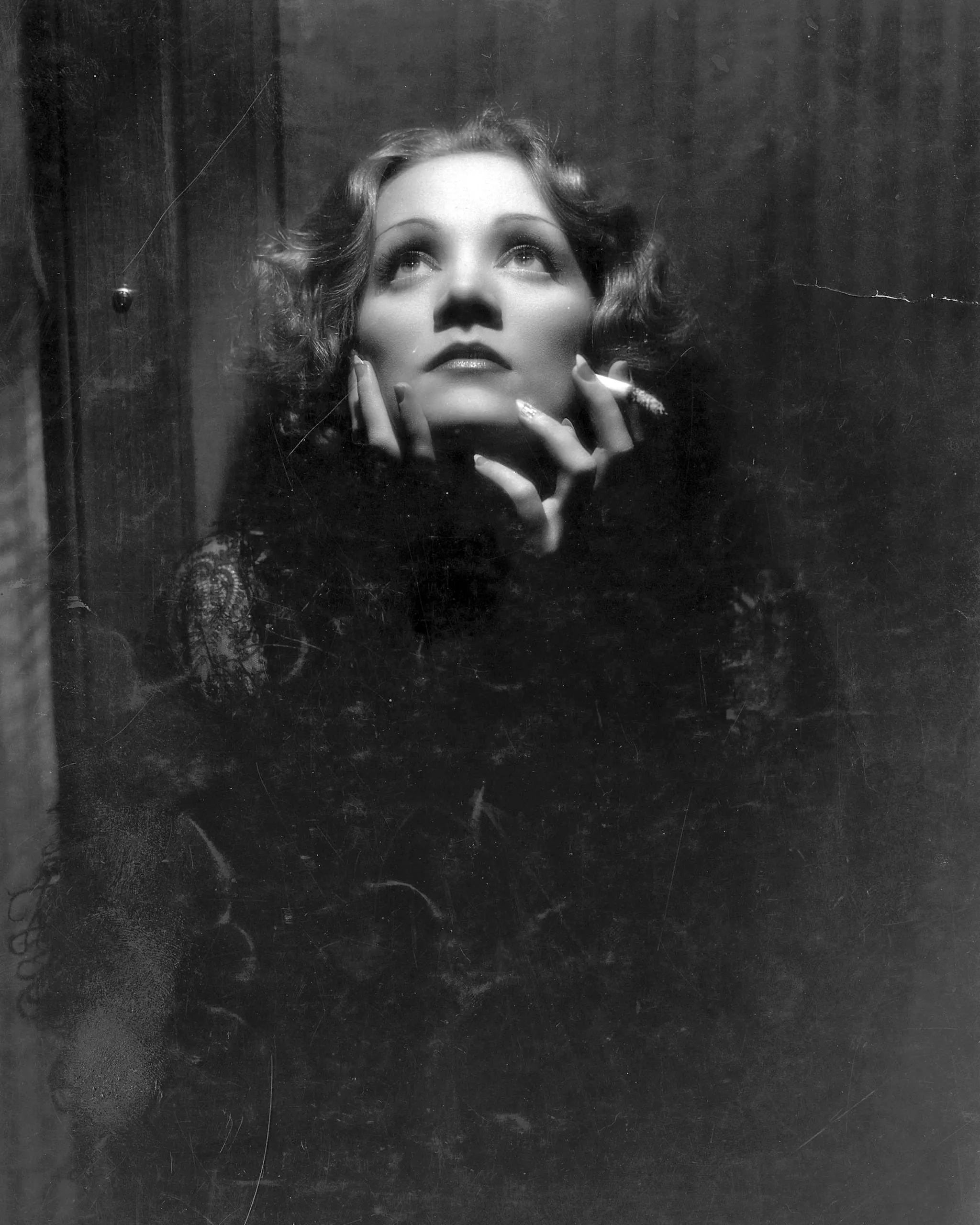
Marlene Dietrich
 Germany
film actor•singer•autobiographer
Also known as: Dietrich
Birthday
December 27, 1901
Birth Sign
Sagittarius
Birthplace
Rote Insel, Berlin, Germany
Age
Died at 90
Height
5 ft 5 in (165 cm)
About
Marlene Dietrich was a German-American actress and singer whose cool, androgynous glamour made her one of the most enduring icons of 20th-century cinema. Born Marie Magdalene Dietrich in Berlin, she became an international star with The Blue Angel (1930), then built a Hollywood career under the direction of Josef von Sternberg. Her voice, her legs, and her defiance of convention turned her into a symbol of sophistication and sexual ambiguity.
Dietrich was also a fierce anti-Nazi who entertained Allied troops during World War II and was honored by both the United States and France. She spent her later years as a celebrated cabaret performer, captivating audiences in Las Vegas, London, and Paris. Her legacy lives on through her films, her music, and her influence on fashion and popular culture.
Early Life & Background
Marie Magdalene Dietrich was born in the Rote Insel district of Berlin, the daughter of a police lieutenant and a homemaker. After her father died in 1907, her mother remarried a cavalry officer, and the family moved in military circles. Dietrich trained as a violinist with aspirations of a concert career, but a wrist injury ended that dream. She then turned to acting, studying under Max Reinhardt at the Deutsches Theater.
In the 1920s, she worked in Berlin's vibrant cabaret and theater scene, appearing in silent films and musicals. Her first credited film role came in 1923 with The Little Napoleon. That same year she married production assistant Rudolf Sieber, and their daughter Maria was born in 1924. She continued to take bit parts in films, but it was her stage work that caught the eye of director Josef von Sternberg, who cast her as Lola Lola in The Blue Angel in 1930. The role, with its sultry rendition of "Falling in Love Again," made her an overnight sensation and launched her international career.
Career Growth
After The Blue Angel, Dietrich signed with Paramount Pictures and made five more films with von Sternberg, including Morocco (1930), which earned her an Oscar nomination, and Shanghai Express (1932). Known for her androgynous style and deep voice, she became one of the highest-paid actresses of the era.
During World War II, Dietrich became a U.S. citizen and entertained troops on the front lines, selling war bonds and broadcasting anti-Nazi messages. Her sister was sent to a concentration camp in retaliation. After the war, she starred in Alfred Hitchcock's Stage Fright (1950), Billy Wilder's Witness for the Prosecution (1957), and Judgment at Nuremberg (1961). From the 1950s to the 1970s, she built a second career as a live performer, thrilling audiences with her cabaret shows. She retired from performing in the 1970s after a leg injury.
Career Timeline
Public Image & Style
Dietrich's public image was built on a carefully constructed androgyny, mixing masculine tailoring with feminine glamour. She was known for her meticulous self-presentation and her belief in the power of transformation, a philosophy that inspired designers from Coco Chanel to Rick Owens, who cited her as a major influence for his 2026 collection. Her mysterious, sophisticated persona made her a cultural icon, celebrated by film historians, fashion enthusiasts, and cabaret performers. She had no official fandom name, but her legacy endures through tributes like Ute Lemper's cabaret show Marlene Dietrich.
Fame & Fandom
Marlene Dietrich cultivated a legacy defined by distance and mystique, lacking a formal, unified fandom name in the modern sense. Unlike contemporary celebrity cults, her admirers operate through established institutions like the Marlene Dietrich Society rather than grassroots social media campaigns. Her supporters are typically identified as enthusiasts of classic Hollywood or cabaret, drawn to her iconic tuxedo-and-cigarette-holder persona and her philosophy of self-invention. While she maintained a guarded relationship with the public, refusing meet-and-greets to preserve her aura, her influence persists through high-profile revivals and academic projects that celebrate her gender-bending performances and wartime patriotism. This enduring appeal places her firmly within the global consciousness, where her status is quantified by authoritative metrics. According to the iFANN Global Fame Rankings, she holds the position of the 36th most famous person in Germany, a standing that has remained steady across recent cycles. These rankings reflect her sustained presence in cultural memory, tracking attention across global media coverage, search patterns, and consumption signals without relying on transient viral trends. The absence of a specific fan club moniker does not diminish her impact; instead, it highlights a unique form of reverence where the audience engages with her art and mythology rather than seeking direct interaction. Her daughter Maria Riva acted as a gatekeeper for decades, ensuring that the narrative remained curated until the estate's ongoing management continues this tradition. Even as new biographical projects emerge, the core of her fame remains rooted in the verified historical events of her life, from her breakout in The Blue Angel to her USO tours, creating a stable foundation for her ranking.
Interesting Facts and Legends
Dietrich reportedly smoked up to fifty cigarettes daily, making the habit an integral part of her signature aesthetic. She was among the first actresses to wear trousers in public, significantly contributing to the normalization of women's pants as fashionable attire. Paramount Insurance placed a million-dollar value on her legs alone. During World War II, she recorded anti-Nazi songs and broadcast messages directly to German troops, defying her origins to support the Allies. Known for her sharp aphoristic wit, she once declared, "I am not a star. I am a legend." A widely retold story from her stage career describes her performance of "Lili Marleen" while wearing men's clothing, a visual choice that challenged 1930s norms and disarmed audiences with a projected masculine authority. Another enduring legend portrays her as the "Goddess of Smoke" during her later years on Park Avenue, highlighting her ability to maintain glamour and reclusiveness well into old age. In 2026, her private library was featured at a rare book fair in Berlin, offering collectors a glimpse into her intellectual side beyond the screen.
Notable Quotes
“I am not a star. I am a legend.”
“The average man is more interested in a woman who is interested in him than he is in a woman with beautiful legs.”
“I dress for the image, not for myself.”
“Transforming yourself with rigour into something better than what was there before.”
Family & Personal Life
Dietrich's father, Louis Erich Otto Dietrich, was a police lieutenant who died when she was six. Her mother, Wilhelmina Felsing, later married Eduard von Losch, a cavalry officer. Dietrich had one sister, Elisabeth, who was sent to a concentration camp during World War II because of Dietrich's anti-Nazi activities.
Dietrich married production assistant Rudolf Sieber in 1923, and they had one daughter, Maria, born in 1924. The marriage was unconventional, with the couple living largely separate lives, but they remained married until Sieber's death in 1976. Maria Riva became an actress and later wrote a biography of her mother. She died in 2025 at age 100.
Notable Connections
Dietrich's most significant collaborations were with director Josef von Sternberg, who directed her in six films, including The Blue Angel and Morocco. She also worked with Alfred Hitchcock on Stage Fright and Billy Wilder on Witness for the Prosecution. Her daughter Maria Riva, an actress, wrote a biography of her mother. Fashion designer Rick Owens has cited Dietrich as a major inspiration.
Relationships & Dating History
Dietrich married Rudolf Sieber in 1923. The marriage was unconventional, with Sieber having a long-term mistress and Dietrich having numerous affairs, but they remained married until his death in 1976. Her relationship with director Josef von Sternberg was both professional and romantic, lasting from 1930 to 1935. After the war, she had a significant relationship with French actor Jean Gabin, which ended because he wanted a conventional domestic life. She also had a long affair with Yul Brynner during the 1950s and 1960s. Dietrich was known for her bisexuality, with relationships that included singer Edith Piaf. She was widowed at the time of her death in 1992.
- MarriedRudolf Sieber1923 - 1976Married until his death; unconventional but lasting union.
- DatedJosef von Sternberg1930 - 1935Professional and romantic relationship during their six-film collaboration.
- DatedJean Gabin1946 - 1949Post-war romance; ended due to differing desires for domestic life.
- DatedYul Brynner1956 - 1965Long-standing relationship spanning years.
Death & Aftermath
Died
May 6, 1992 (aged 90)
Death Place
Paris, France
Cause of Death
Kidney failure due to heavy smoking
Tributes poured in from the film industry and political leaders who recognized her contributions as both an artist and a patriotic figure for her work supporting Allied troops during World War II. Marlene Dietrich passed away on May 6, 1992, at the age of ninety, in her sleep at her apartment located at 57 Avenue Montaigne in Paris, France. The official cause of death was reported as kidney failure, a condition attributed to her long-term heavy smoking habit which reportedly reached up to fifty cigarettes a day. Her final days were spent in relative privacy at her Paris residence, with no widely documented last public appearances occurring shortly before her death, though she had maintained a rigorous touring schedule until the late 1980s.
Following her death, her remains were cremated and her ashes were scattered over the Atlantic Ocean off the coast of New York near the Hamptons, a location chosen for its personal significance to her. The funeral or memorial service was held privately, reflecting her wish for privacy even in death. Posthumously, her legacy has been maintained through various releases, honors, and tributes, including a biographical film titled Berlinweh, Yearning for a Home announced for production around 2026. Her private library was featured at the Berlin Rare Book Fair in 2026, marking the 125th anniversary of her birth, while a tribute show by Ute Lemper was presented at 54 Below in early 2026.
Her influence continues to inspire fashion and art, such as Rick Owens' Autumn/Winter 2026 collection, and her estate is managed by M. Dietrich, Inc., which controls her image and likeness to ensure her brand remains active through licensing and archival projects.
Net Worth (Estate Value)
$2 Million
iFANN Editorial Team estimate
Upon her death in 1992, Marlene Dietrich left an estate valued at approximately $2 million, which has since been managed by her heirs. The estate continues to generate revenue through licensing agreements for her image, music royalties, and residuals from her extensive filmography. Posthumous releases and renewed cultural interest have contributed to the growth of these assets, including the upcoming biopic Berlinweh – Yearning for a Home directed by Agnieszka Holland and Till Lindemann's 2026 EP featuring a cover of a Dietrich song. Per iFANN's editorial analysis, the estate is estimated to be worth around $2.4 million as of 2026.
Awards Won (9)
Dietrich received one Academy Award nomination for Best Actress for Morocco (1930). Her major honors include the Kennedy Center Honors in 1979 and the French Legion of Honor for her wartime service. She was also awarded the Medal of Freedom, the highest U.S. civilian honor at the time, for entertaining troops during World War II.
1968 · Special Tony Award
—N/a
1979 · Lifetime Achievement
Overall career
Known For
The Blue Angel
1930 · Lola Lola
Morocco
1930 · Mademoiselle Amy Jolly
Shanghai Express
1932 · Shanghai Lily
Witness for the Prosecution
1957 · Christine Vole
Keywords
Sources
Quick Facts
- Profession
- film actor, singer, autobiographer
- Born
- December 27, 1901
- Birthplace
- Rote Insel, Berlin, Germany
- Died
- May 6, 1992
- Death Place
- Paris, France
- Gender
- Female
- Spouse
- Rudolf Sieber
- Birth Sign
- Sagittarius
- Height
- 5 ft 5 in (165 cm)
- Children
- Maria Riva
Personal Details
- Full Name
- Marie Magdalene Dietrich
- Height
- 5 ft 5 in (165 cm)
- Spouse
- Rudolf Sieber
- Children
- Maria Riva
- Education
- Victoria-Luisen-Schule, Berlin; studied acting under Max Reinhardt at the Deutsches Theater
Filmography
50
Total
45
Film
5
TV
Frequently Asked Questions
What was Marlene Dietrich's real name?
Was Marlene Dietrich married?
How did Marlene Dietrich die?
What was Marlene Dietrich's most famous song?
Did Marlene Dietrich have children?
Social Media
Similar People
Join the community
fans discussing