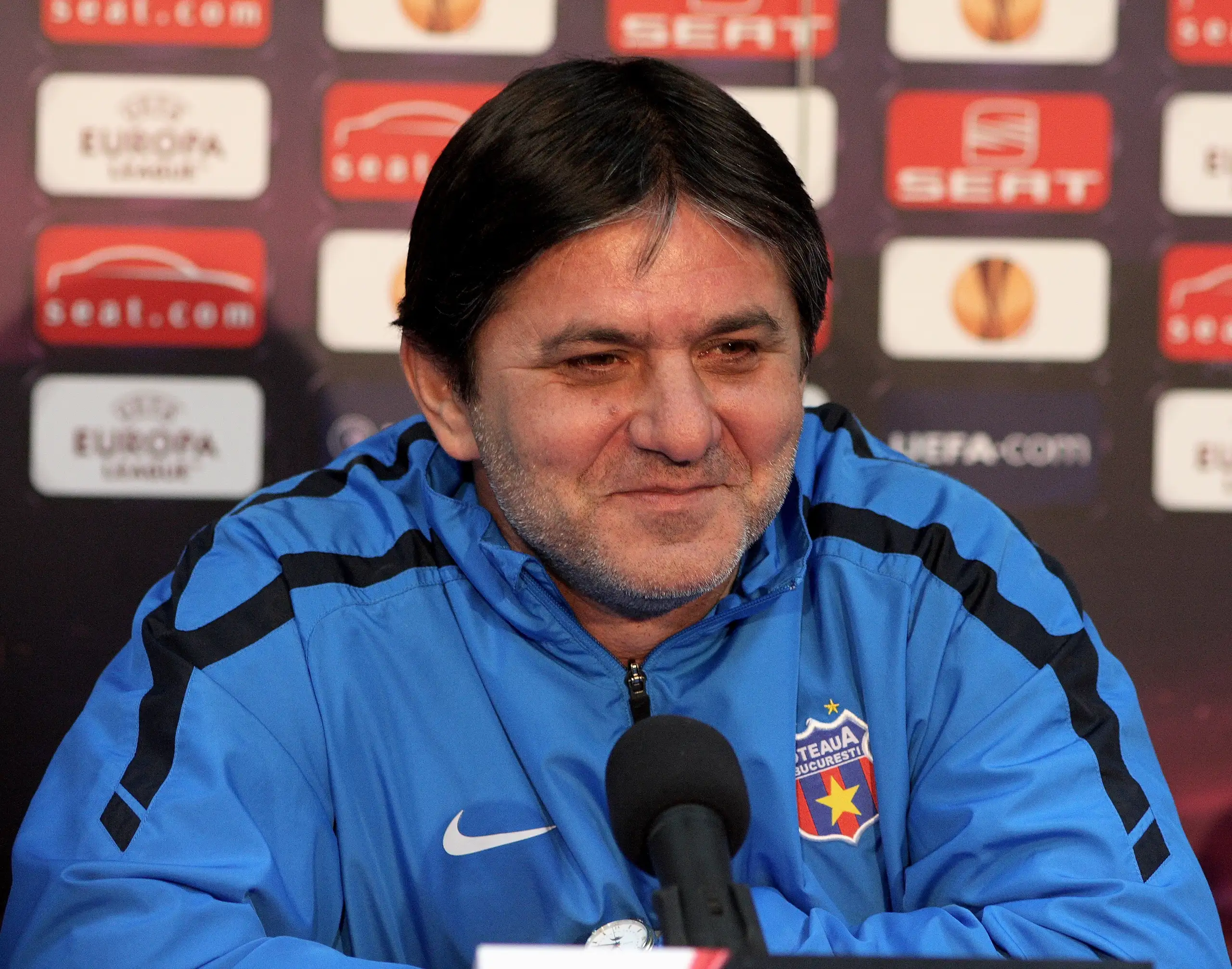
Marius Lăcătuș
 Romania
Association football player•association football coach
Also known as: Guriță
Birthday
April 5, 1964
Birth Sign
Aries
Birthplace
Brașov, Romania
Age
62 years old
Height
6 ft 0 in (182 cm)
About
Marius Lăcătuș is a Romanian former footballer and coach, widely regarded as one of the greatest players in his country's history. He spent the bulk of his career at Steaua București, where he won a record ten Romanian league titles and lifted the European Cup in 1986. Known for his technical skill, leadership, and loyalty, Lăcătuș served as captain of Steaua for five years and remains the club's all-time top scorer in European competitions with 16 goals. He also represented Romania at two World Cups and earned 78 caps. After retiring, he moved into coaching, including a stint as head coach of Steaua. In 2021, the club retired his number 7 shirt in recognition of his extraordinary contribution.
Early Life & Background
Born in Brașov, a city in the Carpathian foothills, Lăcătuș grew up in a country where football was the national passion. He joined Steaua București's youth academy in 1979, quickly impressing coaches with his natural finishing and ability to read the game. He made his senior debut in 1980, at just 16, but it took several seasons for him to establish himself as a regular in a squad packed with talent. His breakthrough came under coach Emerich Jenei in the mid-1980s, as Steaua began to dominate Romanian football. By the 1985–86 season, Lăcătuș had become a key player, scoring crucial goals in the European Cup run. The final against Barcelona in Seville on May 7, 1986, proved his defining moment: he scored the equalizer that forced extra time and penalties, which Steaua won 2–0 to become the first Eastern European club to claim the trophy.
Career Growth
After the 1986 European Cup triumph, Lăcătuș continued to pile up domestic honors with Steaua, winning league titles in 1987, 1988, 1989, and 1990. He also earned individual acclaim, being named Romanian Footballer of the Year in 1986 and again in 1989. In 1990, he moved to Italy to play for Fiorentina, but the adventure lasted only one season. He then joined Real Oviedo in Spain, where he played for a year before returning to Steaua in 1992. Back in Bucharest, he won four more league titles and the Romanian Cup, and in 1994 he was made captain. He led the team to the 1995–96 double and retired in 1999 with ten league winners' medals, a record in Romanian football. After hanging up his boots, he managed several clubs, including Steaua, where he resigned in 2008 after a heavy Champions League defeat to Lyon. He also had a brief spell as caretaker coach of the Romania national team.
Public Image & Style
Lăcătuș is revered in Romania as a symbol of the golden generation of the 1980s. He is known for his humility and his unwavering loyalty to Steaua, often turning down more lucrative offers to stay with the club. Fans affectionately call him "The King of Steaua" and celebrate his legacy with chants and banners at matches. His public persona is that of a dignified leader, a contrast to the flashier stars of the modern era. He rarely gives interviews, but when he does, he speaks with the measured calm of a man who has seen it all. His social media presence is modest, but he uses it to share historical moments and to support the current Steaua team.
Fame & Fandom
The devotion to Marius Lăcătuș in Romania is a quiet, enduring force rather than a loud, organized movement. Fans revere him as the King of Steaua, a title earned through decades of loyalty and technical mastery that has never been matched by a modern celebrity cult. Unlike pop stars or influencers, he does not have a formal fandom name, nor are there records of fan-funded campaigns, birthday billboards, or viral social media movements dedicated solely to his person. His legacy lives on through chants at Ghencea Stadium and the collective memory of a golden generation, but there is no official moniker for his supporters. The audience remains a diffuse group of football purists who value his history over his current visibility. In the landscape of global recognition, iFANN's Global Fame Engine has evaluated this figure thoroughly. Marius Lăcătuș is currently evaluated but holds no placement in the published rankings (Global Top 1,000 or a Top-100 scope list). He does not appear on any Top-100 scope list, meaning his fame, while profound within his specific cultural sphere, has not translated into a quantifiable rank among the world's most famous individuals today. This absence from the charts reflects the nature of his stardom: deeply rooted in historical achievement rather than contemporary consumption signals or media saturation. The scale of his impact is measured in the enduring respect of a nation and the preservation of club records, not in global search volume or international chart positions. While the world moves on to newer icons, Lăcătuș remains a singular figure whose influence is confined to the annals of European football history. The lack of a numeric rank underscores that his fame is qualitative, defined by the reverence of those who witnessed his career firsthand. There are no trending hashtags or organized fan clubs pushing his profile upward in the digital age; instead, his presence is maintained through the annual celebration of the 1986 European Cup victory and the stories told by older generations. The iFANN data confirms that while he is a titan of Romanian sport, he exists outside the current metrics of global celebrity dominance.
Interesting Facts and Legends
Lăcătuș earned the nickname "Guriță" (Little Mouth) among Steaua fans due to his habit of constant chatter during matches. Despite playing as a striker, he was the team's primary penalty taker, scoring over 100 career goals with an unusual stutter-step technique that frequently deceived goalkeepers. In the 1986 European Cup final shootout, he scored the decisive penalty after having to retake an initial miss. He also netted a legendary goal against the Soviet Union in the 1990 World Cup, widely considered one of the finest strikes in Romanian history. Off the pitch, he is an avid fisherman who enjoys the mountains near his hometown. A defining chapter of his lore involves the violent clash with Real Madrid known as the Battle of Bucharest, where chaos forced the match abandonment and solidified his central role in late-1980s football culture. Historians recount the moment when he scored what is documented as his last goal in Serie A while playing for AC Milan, marking the end of a significant Italian chapter before returning to Romania. Another pivotal story often retold by historians involves the Battle of Bucharest against Liverpool, where despite a regime ban on spectators, tens of thousands stormed the stadium. Lăcătuș scored the equalizer in that chaotic atmosphere, a moment fans still celebrate as the time Romanian football defied political oppression.
Family & Personal Life
Lăcătuș has always kept his family life private, and little is known about his parents or siblings. He is a father, but the identities of his children have not been widely reported. He has spoken publicly about the importance of family values and how his upbringing in Brașov shaped his disciplined approach to football. After his playing career, he settled in Bucharest, where he lives a quiet life away from the spotlight. He remains close to his former teammates and is often seen at Steaua events, where he is treated like royalty.
Relationships & Dating History
Marius Lăcătuș has kept his romantic life out of the public eye throughout his career and after. There are no documented reports of any long-term relationships, marriages, or divorces in credible sources. He is known to be a father, but the identity of his children's mother has never been confirmed. He has never been linked to any high-profile partners in the media, which is rare for a footballer of his stature. As of 2026, his relationship status remains unknown, and he continues to guard his privacy fiercely. This discretion has only added to his mystique, as fans respect his decision to keep his personal life separate from his public persona.
Salary, Net Worth In 2026
$4 Million
iFANN Editorial Team estimate
Estimates of Marius Lăcătuș's net worth vary, but per iFANN's editorial analysis, the total stands at $4 Million as of 2026. His wealth stems primarily from his playing career in Romania, where salaries were modest compared to Western Europe. He also earned from coaching roles and endorsements with Romanian brands. Unlike many modern stars, he has not invested in flashy businesses or real estate ventures, preferring to keep a low profile. Most of his assets are likely tied up in property in Bucharest. Given his retirement from top-level coaching, his income now comes from occasional media appearances and ambassadorial work for Steaua. There are no reports of significant financial troubles, and he appears to live comfortably on his savings and pensions.
Awards Won (20)
Marius Lăcătuș won the European Cup in 1986, ten Romanian league titles, six Romanian Cups, and a Super Cup. He was named Romanian Footballer of the Year in 1986 and 1989. He also holds the record for most league titles won by a player in Romania. In 2021, his number 7 shirt was retired by Steaua București.
1986 · UEFA Champions League
Steaua București
1996 · Liga I
Steaua București
1995 · Liga I
Steaua București
1994 · Liga I
Steaua București
1993 · Liga I
Steaua București
1990 · Liga I
Steaua București
1989 · Liga I
Steaua București
1988 · Liga I
Steaua București
1987 · Liga I
Steaua București
1986 · Liga I
Steaua București
1985 · Liga I
Steaua București
Known For
Steaua București
1980-1999 · Forward, Captain
Romania national team
1984-1998 · Forward
1986 European Cup winner
1986 · Key player
Keywords
Sources
Quick Facts
- Profession
- Association football player, association football coach
- Born
- April 5, 1964
- Birthplace
- Brașov, Romania
- Height
- 6 ft 0 in (182 cm)
- Position
- Forward
- Number of Romanian league titles
- 10
- European Cup wins
- 1
- International caps
- 78
- International goals
- 19
Personal Details
- Full Name
- Marius Mihai Lăcătuș
- Height
- 6 ft 0 in (182 cm)
Frequently Asked Questions
How many Romanian league titles did Marius Lăcătuș win?
Did Marius Lăcătuș play in the 1990 World Cup?
What is Marius Lăcătuș's current status?
Why was Marius Lăcătuș's jersey retired?
Which clubs did Marius Lăcătuș play for outside Romania?
Social Media
Similar People
Join the community
fans discussing