“It is a movie that understands that the most terrifying thing about the financial crisis was not the complexity of the instruments, but the banality of the people who created them.”
A.O. Scott
The New York Times
 United States
"Be first. Be smarter. Or cheat."
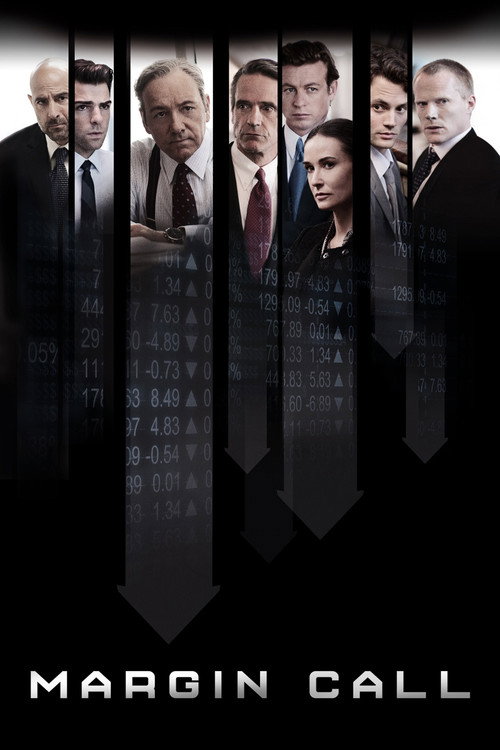
J.C. Chandor's Margin Call strips away the glamour usually associated with Wall Street to reveal a tense, claustrophobic thriller set during a single night in September 2008. The film follows an entry-level analyst who discovers a fatal flaw in his firm's risk models just as the global financial system begins to crack. This discovery triggers a frantic chain of events that forces senior executives to make impossible moral choices before dawn breaks.
The movie functions less like a traditional drama and more like a procedural puzzle where the pieces are human lives and billions of dollars in assets. Instead of focusing on the external chaos of the crash, the camera stays locked inside the sterile offices of a fictional investment bank. We watch as knowledge travels from the bottom floor to the top, illuminating how cold calculation can override basic human decency when survival is at stake.
Availability and pricing can change. Confirm on the provider's site before purchasing.
The story ignites late on a Sunday night in September 2008 when Peter Sullivan, a junior quantitative analyst played by Zachary Quinto, works late at his desk. While running a standard risk model update, he spots a terrifying anomaly: the firm's exposure to toxic mortgage-backed securities is far higher than anyone realized. The math shows that if the market continues its current trajectory, the entire company will be insolvent within days. Peter knows he cannot ignore these numbers but fears the consequences of speaking up. He takes his findings to Eric Dale, a veteran quantitative analyst played by Stanley Tucci, who happens to be walking out the door for good due to an impending layoff.
Eric immediately grasps the gravity of the situation. He asks Peter to keep quiet while he double-checks the calculations one last time before leaving the building. Security escorts him out, but the data remains. Peter eventually brings the updated figures to Will Emerson, the head of risk management, played by Paul Bettany. Will sees the same catastrophe unfolding and realizes they have no choice but to wake up the sleeping executives. The narrative shifts into high gear as the team scrambles to alert Sam Rogers, the Chief Risk Officer played by Kevin Spacey, and finally John Tuld, the ruthless CEO played by Jeremy Irons.
As the night wears on, the group gathers in conference rooms to debate their next move. They face a dilemma that defines the film's moral core: how do you save your own skin without destroying everyone else? Selling the bad assets slowly would drive prices down further and hurt the firm. Dumping them all at once would crash the market and destroy competitors, but it might save the institution. Characters like Jared Cohen, a charismatic sales trader played by Simon Baker, and Seth Bregman, another junior analyst played by Penn Badgley, navigate this shifting landscape of power and fear. The tension builds not through car chases or gunfights but through rapid-fire dialogue about leverage, liquidity, and the cold logic of capitalism.
The executives weigh the options until they reach a grim consensus. They decide to execute a massive fire sale, offloading the worthless paper onto unsuspecting investors just before the market opens. The film maintains a relentless pace throughout, focusing on the psychological toll of making decisions that will ruin thousands of lives to save a few billion. It leaves the audience questioning whether any of the characters can escape the consequences of their actions without revealing the specific fate of the individuals involved in the final moments of the trading day.
International Trailer
Official Trailer
Critical Consensus
This film serves as a masterclass in tension, stripping away Hollywood gloss to deliver a claustrophobic thriller that feels terrifyingly plausible. Anchored by a stellar ensemble cast and a script treating complex finance with clarity, it offers a chilling look at the moral bankruptcy of the 2008 crisis. The drama proves you do not need explosions to create suspense, relying instead on the weight of impossible choices.
“It is a movie that understands that the most terrifying thing about the financial crisis was not the complexity of the instruments, but the banality of the people who created them.”
A.O. Scott
The New York Times
“J.C. Chandor has crafted a taut, intelligent thriller that holds you hostage in a room full of sharks. Jeremy Irons is a force of nature as the cold-blooded CEO.”
Peter Travers
Rolling Stone
“A sharp, sobering and deeply unsettling portrait of the financial meltdown, delivered with a precision that matches the subject matter. The acting is uniformly superb.”
Todd McCarthy
The Hollywood Reporter
“Margin Call is the rare movie that makes you feel the heat of the crisis without ever showing a burning building. It's a study in the cold logic of greed.”
David Edelstein
New York Magazine
Kevin Spacey
Sam Rogers
Jeremy Irons
John Tuld
Paul Bettany
Will Emerson
Zachary Quinto
Peter Sullivan
Stanley Tucci
Eric Dale
Simon Baker
Jared Cohen
Penn Badgley
Seth Bregman
Demi Moore
Sarah Rogers
Mary McDonnell
Mary Rogers
Aasif Mandvi
Ramesh Shah
Director
J.C. Chandor
Writer
J.C. Chandor
Composer
Nathan Larson
Cinematographer
Frankie DeMarco
Producers
Robert Ogden Barnum, Michael Benaroya, Neal Dodson, Joe Jenckes, Corey Moosa
Independent Spirit Awards (2012)
Best First Feature: Won
Independent Spirit Awards (2012)
Best Male Lead: Nominated
Writers Guild of America (2012)
Best Original Screenplay: Nominated
Critics' Choice Movie Awards (2012)
Best Acting Ensemble: Nominated
Join the community
fans discussing