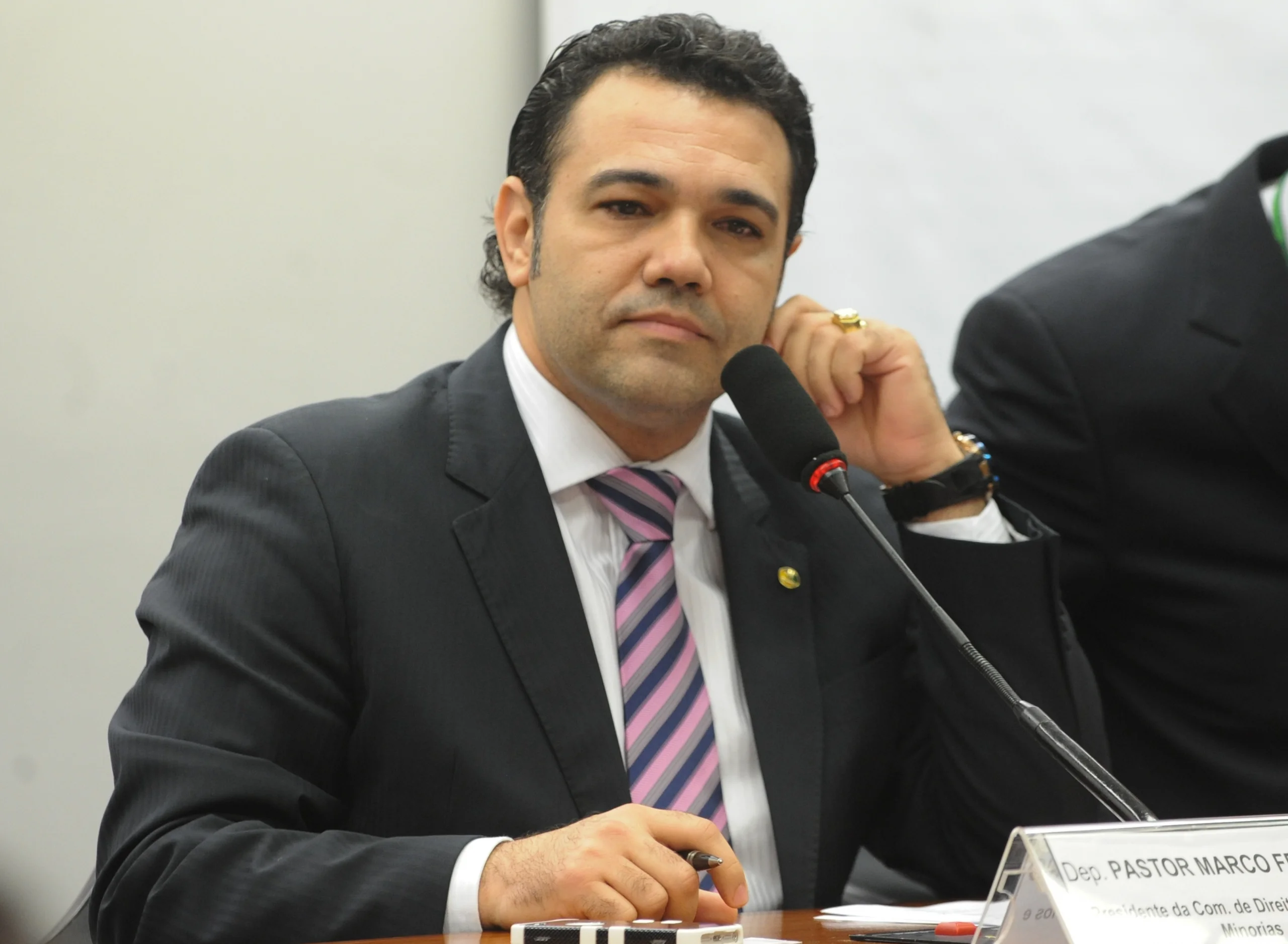
Marco Feliciano
 Brazil
Also known as: Pastor Marco Feliciano
Birthday
October 12, 1972
Birth Sign
Libra
Birthplace
Orlândia, São Paulo, Brazil
Age
54 years old
About
Marco Antônio Feliciano is a Brazilian pastor, writer, film producer, and federal deputy representing São Paulo. Since taking office in 2011, he has become one of the most polarizing figures in the country's politics, known for his unapologetically conservative Christian worldview. His election to lead the Chamber of Deputies' Commission on Human Rights and Minorities in 2013 ignited nationwide protests, with critics pointing to his past remarks about Africans, LGBTQ individuals, women, and Catholics. Those comments have shadowed his career ever since, shaping how both supporters and detractors see him.
Today Feliciano remains an active legislator under the Liberal Party (PL), a prominent voice in the evangelical caucus, and the president of the Assembleia de Deus Catedral do Avivamento. His social media reach is considerable: nearly 4.8 million Facebook followers and hundreds of thousands on Instagram and YouTube. To his supporters, he is a fearless defender of family values; to his critics, a symbol of religious intolerance in public office. Either way, his influence on Brazil's religious right is hard to overstate.
Early Life & Background
Marco Feliciano's story begins in the small city of Orlândia, in the interior of São Paulo state, where he was born in 1972. Raised in a religious household, he felt the call to ministry early and became a pastor in the Assembly of God church. His leadership skills and commanding presence quickly set him apart, and he founded the Catedral do Avivamento, a neo-Pentecostal congregation that grew into a significant religious community.
Before entering politics, Feliciano built a career as a theologian and author, writing books on faith and social issues that found a receptive audience in Brazil's large evangelical population. He also produced films with religious themes, further extending his influence. His work as a pastor gave him a platform and a network of followers who would later become his political base. By the late 2000s, he was a well-known figure in evangelical circles, and the jump to electoral politics felt natural.
His first run for Congress came in 2010, and he won a seat representing São Paulo. The campaign drew on his pastoral reputation and his promise to bring Christian values to the capital. That victory marked the transition from religious leader to political player, setting the stage for the controversial career that followed.
Career Growth
Feliciano took office as a federal deputy in 2011. His breakthrough moment came in 2013 when he was elected president of the Commission on Human Rights and Minorities. The appointment sparked immediate backlash from human rights organizations, who pointed to his history of offensive statements about Africans, LGBTQ individuals, women, and Catholics. Protests erupted, and calls for his resignation grew loud, but he held on to the position until 2014.
Over the years, he has been re-elected multiple times, most recently with nearly 400,000 votes. In 2018, he ran under the Podemos party, but was expelled from its São Paulo branch in December 2019 for supporting President Jair Bolsonaro. Feliciano called the expulsion a source of pride. Around that time, there was even talk of him becoming Bolsonaro's running mate, though the idea reportedly did not sit well with military circles.
In 2021, he faced potential legal trouble over allegations of religious discrimination. In 2024, he joined the Liberal Party (PL) and became involved in disputes within the evangelical front over tax exemptions for pastors. In February 2025, he promoted a cryptocurrency that later collapsed, drawing comparisons to the scandal surrounding Argentina's president, Javier Milei. More recently, in February 2026, Supreme Court Justice Alexandre de Moraes authorized Feliciano to visit Bolsonaro at a military facility, a sign of his continued closeness to the former president.
Career Timeline
Public Image & Style
Feliciano's public image is defined by his staunchly conservative Christian stance. He is a hero to many evangelicals who see him as a defender of traditional values in a secularizing society. To his critics, he represents intolerance and the dangerous mixing of religion and politics. His social media voice blends pastoral counsel with political advocacy, often using religious language to frame his positions. He has made headlines for his comments on LGBTQ issues and his opposition to what he sees as moral decay. Mainstream media often portray him negatively, but his followers remain fiercely loyal. There is no official fandom name, but his online community is active and engaged.
Fame & Fandom (iFAMOUS Rankings)
Marco Feliciano commands a support base that functions less like a traditional pop-culture fandom and more as a mobilized political and religious coalition. His followers, primarily evangelicals and conservative voters in Brazil, rally around his defense of traditional values rather than any celebrity persona or performance art. There are no organized fan clubs with specific names, no fan-funded billboards for birthdays, and no shared rituals of inside jokes that define the community. Instead, the bond is forged through electoral loyalty and shared theological convictions. The public discourse surrounding him is defined by intense polarization; where supporters see a champion of faith, detractors witness a figure of intolerance. This dynamic has created a unique cultural mythology rooted not in adoration but in high-stakes controversy. The defining chapter of this narrative occurred in 2013 when his appointment to lead the Commission on Human Rights and Minorities ignited nationwide protests and international condemnation, cementing his status as a lightning rod for national debate. While he maintains a massive digital footprint with hundreds of thousands of subscribers across platforms, these channels serve as extensions of his ministry and legislative work rather than hubs for fan-to-fan interaction. Despite the lack of a formal fandom structure, his influence remains palpable across Brazilian society. According to the iFANN Global Fame Rankings, Marco Feliciano is currently the 87th most famous person in Pastors, a position holding steady from the previous cycle. This placement reflects his sustained visibility within the global religious landscape.
Interesting Facts and Legends
Marco Feliciano identifies himself as a singer and has performed at gospel events, including the Culto Interligados em Cristo alongside singer Sued Silva. He is the author of several theology books that have sold well in Brazil, though specific sales figures remain private. In 2018, he released a video warning about the "ascension" of drag queen Pabllo Vittar, which drew widespread criticism for its homophobic tone. He has also publicly condemned the comedy group Porta dos Fundos for mocking Jesus. His official parliamentary name is MARCO ANTÔNIO FELICIANO, and he is a Libra. The most significant moment in his public lore occurred in April 2013 when he was appointed head of the National Human Rights Council. This decision sparked massive nationwide protests and international backlash due to his history of inflammatory remarks against the LGBTQ+ community and other groups. Critics labeled the move an attempt to place a fundamentalist pastor at the helm of the country's human rights body, leading to accusations of violating anti-discrimination laws. He served as the first president of the Chamber of Deputies' Commission on Human Rights and Minorities until resigning in 2015 amidst the uproar. Even in 2026, he remained a polarizing voice, making headlines with statements such as "Violence Is Not Only Against Women, but Also Against Children." These incidents form the core of his public identity, marking him as a central figure in the intersection of religion and politics.
Notable Quotes
“Ser expulso por apoiar Bolsonaro é motivo de orgulho.”
“É um ultraje ter na frente evangélica raiz quem apoia o governo Lula.”
Family & Personal Life
Marco Feliciano is married to Everaldina Feliciano. The couple has children together, though they keep details of their family life largely private. His wife occasionally appears in his social media posts, supporting his political and pastoral work. The family resides in São Paulo, where Feliciano leads his church. He has not publicly shared extensive information about his parents or siblings, and there are no public records of pets or other family anecdotes.
Notable Connections
Marco Feliciano is closely associated with former President Jair Bolsonaro, having supported him and receiving authorization to visit him in 2026. He is also allied with conservative politician Bia Kicis, with whom he was permitted to visit Bolsonaro. In the religious sphere, he has collaborated with gospel singer Sued Silva at events like Interligados em Cristo. His Instagram follows include fellow conservative politician Nikolas Ferreira.
Relationships & Dating History
Marco Feliciano is a married man. He is wed to Everaldina Feliciano, and the couple has children together. Unlike many politicians, Feliciano keeps his family life out of the spotlight, and there is no public record of any previous relationships, divorces, or scandals. As of 2026, he remains married to Everaldina, and there is no indication of any change in his marital status.
- MarriedEveraldina FelicianoCurrentMarried to Everaldina, with whom he has children.
Salary, Net Worth In 2026
$2 Million
iFANN Editorial Team estimate
Marco Feliciano's net worth is not widely reported, but as a federal deputy and prominent pastor, his income streams are diverse. His parliamentary salary in Brazil is around R$ 33,000 per month (roughly $6,500), which adds up to about $78,000 annually. As president of the Assembleia de Deus Catedral do Avivamento, he likely receives a pastoral stipend, though the exact amount is not public. His books on theology have sold well, and he earns from speaking engagements at conferences and church events. He also produces films and has a YouTube channel with over 448,000 subscribers, which can generate ad revenue. Per iFANN's editorial analysis, his estimated net worth in 2026 is around $2 Million, accumulated over his decades of public work.
Awards & Accolades
Known For
Federal Deputy for São Paulo
2011-present · Politician
President of the Commission on Human Rights and Minorities
2013-2014 · Chairman
Pastor and Founder of Catedral do Avivamento
· Religious Leader
Keywords
Sources
Quick Facts
- Profession
- writer, politician, pastor
- Born
- October 12, 1972
- Birthplace
- Orlândia, São Paulo, Brazil
- Gender
- Male
- Birth Sign
- Libra
- Political Party
- Liberal Party (PL)
- Spouse
- Everaldina Feliciano
Personal Details
- Full Name
- Marco Antônio Feliciano
- Spouse
- Everaldina Feliciano
Frequently Asked Questions
Is Marco Feliciano married?
What party is Marco Feliciano affiliated with?
What is Marco Feliciano's net worth in 2026?
How old is Marco Feliciano?
What controversies has Marco Feliciano been involved in?
Social Media
Join the community
fans discussing