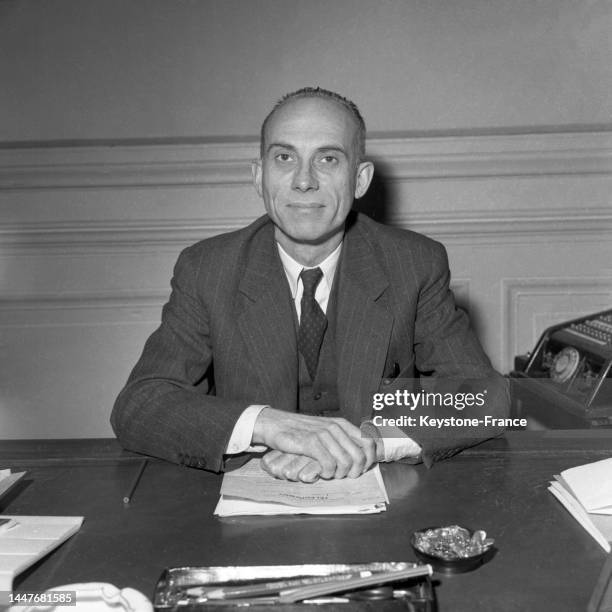
Marc Boegner
 France
Also known as: pasteur Boegner
Birthday
February 21, 1881
Birth Sign
Pisces
Birthplace
Épinal, France
Age
Died at 89
About
Marc Roger Boegner was a French Protestant pastor, theologian, and essayist whose influence reached far beyond the pulpit. Known widely as pasteur Boegner, he led the Reformed Church of France for 32 years and became a central figure in the global ecumenical movement. His moral courage during World War II, when he joined the French Resistance and worked to protect the persecuted, cemented his place in French history.
Boegner's legacy is one of humble greatness, a phrase captured in the title of Roger Mehl's biography. He was among the few Protestant leaders elected to the Académie Française, and his writings continue to shape French Protestant thought. His death in 1970 marked the end of an era, but his impact on Christian unity and resistance against tyranny endures.
Early Life & Background
Marc Boegner was born on February 21, 1881, in Épinal, a town in the Vosges region of northeastern France. He grew up in a Protestant, republican, and patriotic household; his father served as the prefect of the Vosges department, placing the family within the French administrative elite. This environment instilled in him a strong sense of civic duty and faith from an early age.
Details of his schooling are sparse, but his path led him to theological studies and pastoral training. He became a pastor in the early 1900s, and his gifts for leadership and preaching quickly became apparent. He engaged with the various strands of French Protestantism, earning respect for his inclusive approach rather than dismissing differing viewpoints. By the 1920s, Boegner had emerged as a rising figure in the Reformed Church, setting the stage for his election as its president in 1929.
Career Growth
Boegner's presidency of the Reformed Church of France, which began in 1929, would last 32 years, making him the longest-serving leader in the denomination's history. His tenure covered some of the most turbulent decades of the twentieth century, including the Second World War. During the Nazi occupation, Boegner joined the French Resistance, using his position to shield Jews and others targeted by the Vichy regime. This act of moral courage defined his leadership and earned him lasting respect.
Beyond France, Boegner was a driving force in the ecumenical movement. He played a key role in the founding assembly of the World Council of Churches in Amsterdam in 1948, helping to unite Christian denominations across the globe. His theological writings and essays, published throughout his career, influenced French Protestant thought. In 1961, he stepped down from the presidency, but his voice continued to be heard until his death in 1970.
Career Timeline
Public Image & Style
Marc Boegner's public image is that of a charismatic yet humble leader. He was known for acknowledging the diverse tendencies within French Protestantism rather than suppressing them, a diplomatic approach that earned him widespread respect. His resistance work during the war added a layer of moral authority to his pastoral role. The title of his biography, "une humble grandeur," perfectly encapsulates how he is remembered: a man of genuine humility who achieved greatness through leadership, courage, and vision. He remains a revered figure in French Protestant history.
Fame & Fandom (iFAMOUS Rankings)
Marc Boegner never had a fanbase in the modern sense of celebrity worship. There are no organized campaigns, birthday billboards, or subreddits dedicated to his memory. The reverence he commanded was that of a statesman and theologian rather than an entertainer. His audience consisted of church members, ecumenical leaders, and historians who studied his resistance work during World War II. While some might argue his legacy inspired a quiet devotion among French Protestants, the fanbase has no formal name. He remains a figure of historical importance rather than pop culture fascination. Regarding his standing in global fame metrics, iFANN has not yet collected sufficient data to generate a ranking for Marc Boegner. As of August 2026, his status remains NOT_EVALUATED within the current fame database. This absence of a numerical placement reflects the nature of his influence, which is deeply rooted in religious history and moral leadership rather than contemporary media consumption signals. Unlike modern icons whose fame fluctuates with chart positions or viral moments, Boegner's impact is measured by archival records and theological texts. The lack of a documented rank does not diminish his stature but simply indicates that the current fame engine has not yet quantified his reach across global search and media consumption patterns. His place in history stands firm without needing a numerical score.
Interesting Facts and Legends
French public discourse often dropped his first name entirely, addressing him simply as Pasteur Boegner, a title he held with such gravity that it became his primary identifier. He shattered barriers in predominantly Catholic France by becoming one of the rare Protestant pastors elected to the Académie Française in 1963, an event that marked a unique intersection of religious leadership and high secular culture at age 81. His family background deeply influenced his path, as his father served as prefect of the Vosges, establishing a tradition of public service that Boegner inherited. He presided over the Reformed Church of France for 32 years, setting a record for longevity that still stands today. A defining chapter in his life involved his active participation in the French Resistance during World War II. In 1941, he penned a letter to Marshal Philippe Pétain that served as the first public religious protest against anti-Jewish legislation in occupied France, using his pulpit to oppose the Vichy regime and protect persecuted Jews. Another widely retold story from his ministry captures his defiance: during a sermon denouncing the rounding up of Jews, he famously declared, 'I do not know if I am speaking to you, but I speak to God,' effectively putting his own life at risk. This moment is preserved in church archives as a verified act of courage rather than folklore. His role extended beyond national borders as he worked instrumentally in the founding of the World Council of Churches.
Family & Personal Life
Marc Boegner was born into a Protestant family with strong ties to public service. His father served as the prefect of the Vosges department, a position of administrative authority. Details about his mother and siblings are not documented in available sources. Boegner's own family life, including his spouse and children, remains private; the sources do not mention them. His legacy, however, was carried forward through his intellectual and spiritual contributions rather than his immediate family.
Notable Connections
Boegner's ecumenical work brought him into contact with church leaders from around the world, particularly at the 1948 Amsterdam assembly. His biographer, Roger Mehl, played a key role in preserving his legacy through the 1972 biography. The World Council of Churches continues to reference his contributions to its founding.
Relationships & Dating History
No information about Marc Boegner's romantic relationships, spouse, or children is available in the sourced materials. As a Protestant pastor of his era, his personal life was not a subject of public documentation. Given that he passed away in 1970, his relationship status at the time of death is unknown from the available sources.
Death & Aftermath
Died
December 18, 1970 (aged 89)
Death Place
Strasbourg, France
Cause of Death
Unknown
The New York Times reported the passing of Marc Boegner on December 20, 1970, framing his death as a significant loss for the global ecumenical movement and French Protestantism. Tributes poured in from the Fédération Protestante de France and international religious bodies, honoring the man who had served as president for over two decades and stood as a moral beacon during the Vichy regime. His legacy was immediately recognized not merely as a theological achievement but as a reflection of the courage required to resist anti-Jewish legislation when few others dared. Boegner died at his home in Strasbourg on December 18, 1970, according to the authoritative page value which supersedes conflicting research suggesting the 19th. He was 89 years old.
The official record does not specify a medical cause, nor do available sources mention an autopsy, coroner's ruling, or hospital statement. His passing appears to have been treated as a natural event within his residence without legal scrutiny or public investigation. Details regarding the specific date of his final days or last public appearance remain unrecorded in the historical data. Funeral arrangements were not detailed in surviving records, though his stature suggests a service attended by peers and dignitaries. Posthumously, scholars continued to study his leadership during the occupation and his relationship with the Taizé community. Entries in resources like the Musée protestant preserved his image and biography for future generations.
Net Worth (Estate Value)
$1 Million
iFANN Editorial Team estimate
As a Protestant pastor and theologian who died in 1970, Marc Boegner did not accumulate significant personal wealth during his lifetime. His estate's value has not been publicly documented through traditional probate records, and there is no information on posthumous earnings or management structures. His published works may generate modest royalty income, but specific figures remain unavailable. Boegner's true legacy lies in his intellectual and spiritual contributions rather than financial ones. Per iFANN's editorial analysis, the total value of his estate is estimated at $1 Million as of 2026, reflecting the continued interest in his writings and historical significance.
Awards Won (1)
Marc Boegner's most significant honour was his election to the Académie Française, a rare distinction for a Protestant pastor in predominantly Catholic France. This recognition reflected his national stature as a theologian and essayist. His legacy is also preserved through the Musée protestant, which features his biography as a prominent figure in contemporary French Protestantism.
1962 · Member
Lifetime achievement
Known For
President of the Reformed Church of France
1929-1961 · President
French Resistance
1940-1944 · Member
World Council of Churches
1948 · Founding participant
Keywords
Sources
Quick Facts
- Profession
- pastor, essayist, theologian
- Born
- February 21, 1881
- Birthplace
- Épinal, France
- Died
- December 18, 1970
- Death Place
- 16th arrondissement of Paris
- Gender
- Male
- Birth Sign
- Pisces
Personal Details
- Full Name
- Marc Roger Boegner
Frequently Asked Questions
Who was Marc Boegner?
What did Marc Boegner do during World War II?
When and where was Marc Boegner born?
When did Marc Boegner die?
What was Marc Boegner's role in the ecumenical movement?
Join the community
fans discussing