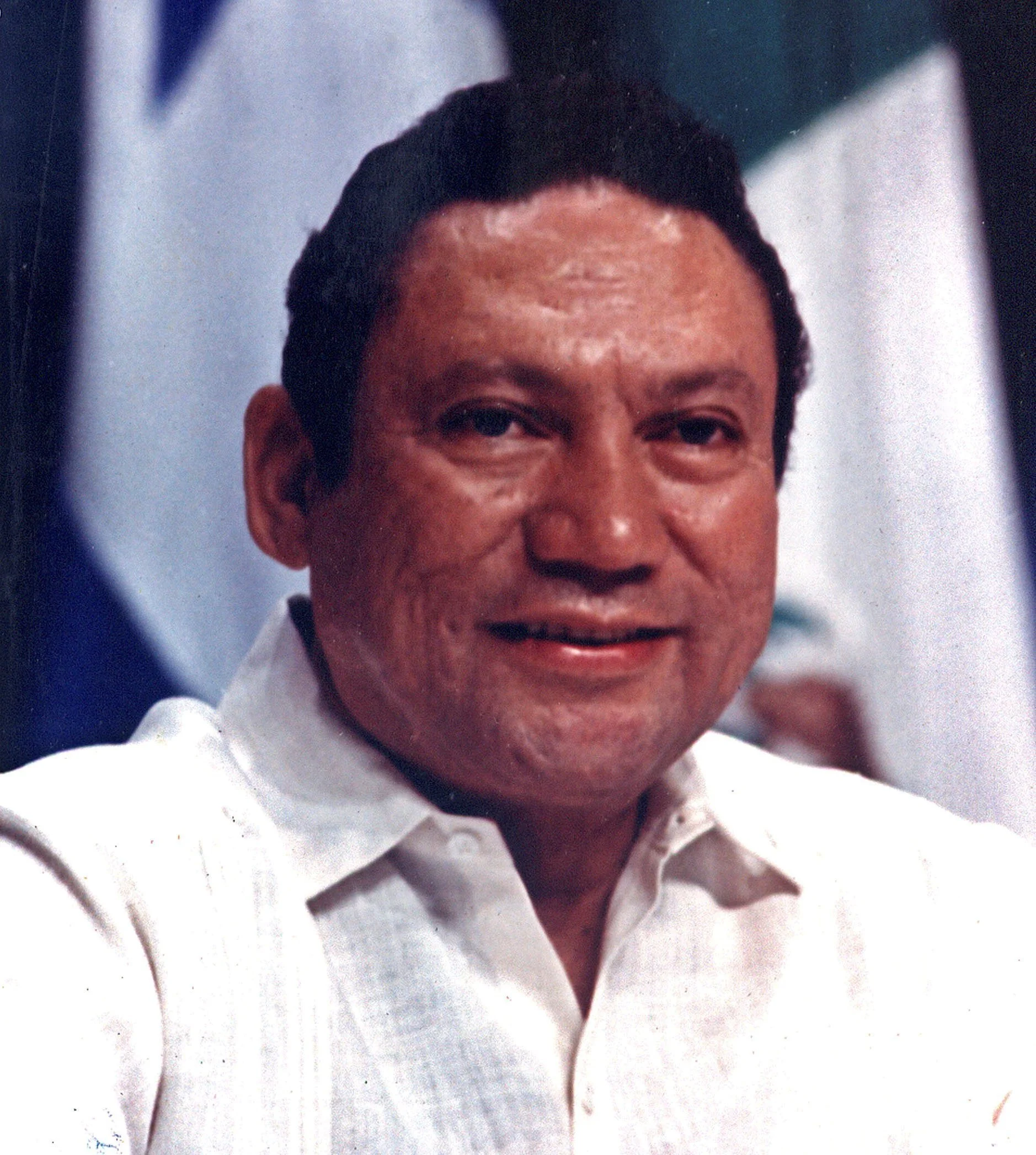
Manuel Noriega
 Panama
politician•military personnel•drug lord
Also known as: Pineapple Face, El Dictador
Birthday
February 11, 1934
Birth Sign
Aquarius
Birthplace
Panama City, Panama
Age
Died at 83
About
Manuel Antonio Noriega was a Panamanian military officer and politician who served as the de facto ruler of Panama from 1983 to 1989, though he never held the official title of president. He came to power through a combination of military maneuvering and alliance with Omar Torrijos, and his regime was marked by political repression and drug trafficking. Noriega's rule ended with the U.S. invasion of Panama in December 1989, and he was captured, tried, and imprisoned in the United States.
Noriega's legacy is defined by his dual role as a Cold War asset and a convicted drug lord. He maintained secret ties to U.S. intelligence agencies since the 1950s, funneling weapons and cash to U.S.-backed forces in Latin America, while also amassing a personal fortune from drug trafficking. After his ouster, he spent years in U.S. and French prisons, then returned to Panama to face further convictions. He died in 2017 at age 83.
Early Life & Background
Noriega was born on February 11, 1934, in Panama City to a poor family. He was born out of wedlock and grew up in the slums of the capital. He studied at the Chorrillos Military School in Lima, Peru, and later at the School of the Americas, a U.S. military training facility in Panama. These institutions shaped his military career and his early connections with the U.S. military establishment.
Returning to Panama, Noriega rose through the ranks of the Panamanian army, becoming a trusted ally of Omar Torrijos. When Torrijos seized power in a 1968 coup, Noriega was appointed chief of military intelligence. In this role, he built a network of informants and expanded his influence. His loyalty to Torrijos was rewarded, but after Torrijos's death in a plane crash in 1981, Noriega began maneuvering to consolidate power. By 1983, he had outmaneuvered rivals to become the de facto ruler of Panama, ruling through puppet presidents.
Career Growth
Noriega's rise to power was complete by 1983, but his rule was increasingly marked by brutality and corruption. He crushed political opposition, expanded the military's power, and allowed Panama to become a major transshipment point for cocaine. At the same time, he maintained a covert relationship with the CIA, providing intelligence and supporting U.S. operations in Central America.
His downfall began when the U.S. indicted him in 1988 on racketeering and money laundering charges. In December 1989, President George H.W. Bush ordered Operation Just Cause, a military invasion of Panama. After a brief standoff in the Vatican's diplomatic mission, Noriega surrendered to U.S. forces in January 1990. He was flown to Miami, where he was convicted on drug charges in 1992 and sentenced to 40 years in prison. He served 17 years before being extradited to France in 2010, where he was convicted of money laundering. In 2011, he was extradited to Panama to face further convictions. He died in 2017 from complications after brain surgery.
Career Timeline
Public Image & Style
Noriega's public image is that of a military strongman and drug lord who was ousted by U.S. military intervention. He is often portrayed in media as a controversial figure whose career was a tangle of alliances and betrayals. His face, marked by pockmarks, became synonymous with the excesses of Cold War-era dictatorships. He was vilified in the U.S. for his drug trafficking, but some in Panama viewed him as a nationalist who stood up to American imperialism. No fandom or positive cult following exists; his legacy is largely negative.
Fame & Fandom (iFAMOUS Rankings)
Manuel Noriega remains a figure of historical notoriety rather than popular adoration, his name synonymous with the complexities of Cold War intelligence and the excesses of authoritarian rule. His cultural footprint is defined by specific, documented events rather than a living fanbase. iFANN has evaluated this profile and determined that Manuel Noriega is currently unranked in the Global Top 1,000 or any scope list maintained by the organization. The evaluation notes that while he commanded global attention during his tenure as de facto ruler of Panama and subsequent legal battles, he does not currently hold a placement in the published rankings. This absence of a rank reflects his status as a criminal dictator rather than an entertainer or cultural icon who generates sustained public engagement through performance or artistry. There is no formal fandom associated with him; no organized following, ritual, or collective identity exists to support his legacy. Unlike figures with dedicated communities, Noriega's audience consists entirely of historians, political observers, and those interested in true crime narratives. The only anecdotal resonance comes from verified historical moments, such as his refusal to surrender until he could hear Van Halen's album *5150* on repeat. These stories are retold as historical curiosities rather than acts of worship. His legacy is one of infamy, characterized by drug trafficking convictions, CIA ties, and a military coup that ended with U.S. intervention. No fan campaigns have ever emerged to defend or celebrate him, and no unofficial groups claim his memory. The silence surrounding his post-2017 life further confirms the lack of active interest beyond academic or journalistic review.
Interesting Facts and Legends
During his surrender in January 1990, Noriega reportedly listened to Van Halen music for ten days while holed up in the Vatican's diplomatic mission, a detail that became a memorable part of the story. Noriega was a one-time U.S. ally and CIA informant, but his relationship with Washington soured as evidence of his drug dealings mounted. He was born out of wedlock, a fact that shaped his early life in the slums of Panama City. Noriega's rule was marked by the use of puppet presidents; he never held the official title of president. He was diagnosed with a brain tumor in March 2017, just months before his death. A widely circulated legend details his time in the Vatican Nunciature, where he demanded U.S. forces cease attacks so he could listen to the rock band Van Halen's album *5150*. This bizarre negotiation tactic contributed to the eventual end of the siege. Another pivotal moment in his lore involves his capture and subsequent trial, where he was sentenced to 40 years in prison for drug trafficking and money laundering. This legal outcome set a precedent for the extradition of heads of state. His origins as a paid asset for the Central Intelligence Agency during the Cold War remain a central part of his biography, illustrating how he rose from the slums to become a double agent before turning against American interests.
Family & Personal Life
Noriega was married to Felicidad Sieiro de Noriega, and together they had three daughters: Sandra, Thays, and Lorena. Details about his family life are scarce, as he kept his personal affairs largely out of the public eye. His wife and daughters were occasionally seen in public, but they rarely spoke to the media. At the time of his death, he was a widower, though the exact date of his wife's passing is not widely documented.
Notable Connections
Relationships & Dating History
Noriega was married to Felicidad Sieiro de Noriega, and they had three daughters. The marriage was part of his personal life, though specific dates of marriage and divorce are not widely documented. No other public romantic relationships are documented in the sources. As of his death in 2017, he was a widower, though the sources do not specify the date of his wife's death.
- MarriedFelicidad Sieiro de NoriegaMarried and had three daughters; she predeceased him.
Death & Aftermath
Died
May 29, 2017 (aged 83)
Death Place
Panama City, Panama
Cause of Death
Unspecified health issues
The death of Manuel Noriega drew a spectrum of reactions that reflected the polarized nature of his legacy, with global media outlets such as NPR highlighting his complex history as a CIA informant, military commander, and dictator. He passed away on Monday, May 29, 2017, at a hospital in Panama City, Panama, having spent his final days under house arrest while suffering from various health issues. The specific medical condition leading to his death was not detailed in any public autopsy report or coroner's ruling available to officials, and no criminal or civil proceedings were initiated following his natural passing.
A private funeral service was held in Panama for the former de facto ruler, though exact dates, locations, and notable attendees beyond immediate family members remained undisclosed. Given his status as a convicted drug lord and dictator, the event maintained a low profile compared to state funerals for national leaders, and he was buried in Panama without a publicly specified cemetery location. Family statements regarding his death were limited, with official confirmation originating from reports in Panama rather than extensive releases from his relatives.
Net Worth (Estate Value)
$100 Million
iFANN Editorial Team estimate
Per iFANN's editorial analysis, Manuel Noriega's net worth was estimated at $100 Million at the height of his power, derived from his involvement in drug trafficking and other illicit activities. However, after his arrest and conviction, his assets were largely seized by the U.S. government. His estate, managed by his family, has seen little public activity since his death in 2017. The exact value of his estate today is not publicly documented, but it is believed to be minimal compared to his former wealth.
Awards & Accolades
Known For
De facto ruler of Panama
1983-1989 · Dictator
Drug trafficking conviction
1992 · Convicted felon
Keywords
Sources
Quick Facts
- Profession
- politician, military personnel, drug lord
- Born
- +1934-02-11
- Birthplace
- Panama City
- Died
- +2017-05-29
- Death Place
- Hospital Santo Tomas
- Gender
- Male
- Birth Sign
- Aquarius
Personal Details
- Full Name
- Manuel Antonio Noriega
- Spouse
- Felicidad Sieiro de Noriega
- Children
- Sandra, Thays, and Lorena Noriega
- Education
- Chorrillos Military School, Lima; School of the Americas
Frequently Asked Questions
How did Manuel Noriega die?
Was Manuel Noriega a CIA informant?
How long did Manuel Noriega serve in prison?
What was Manuel Noriega's role in Panama?
Did Manuel Noriega have children?
Similar People
Join the community
fans discussing