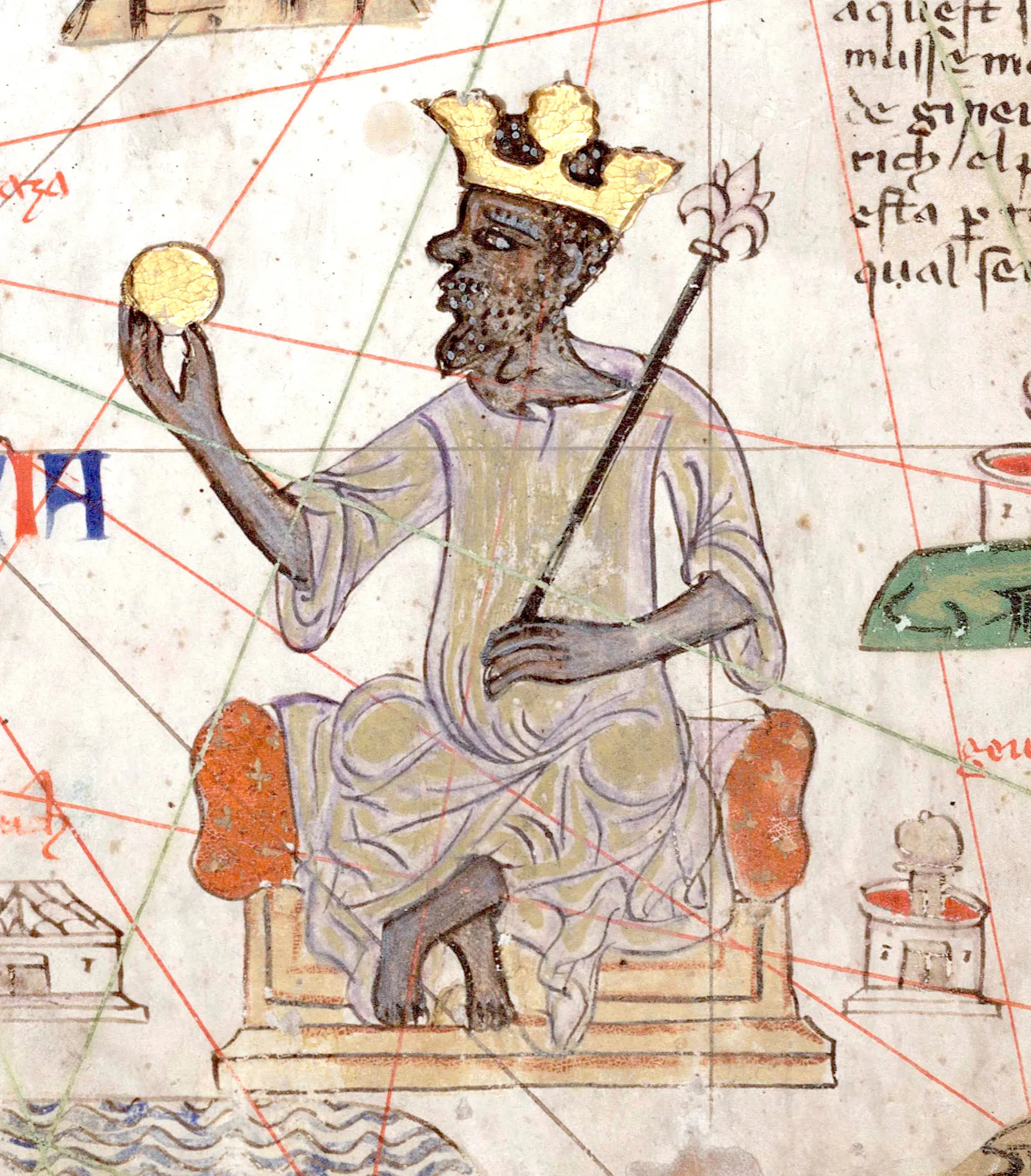
Mansa Musa
 Mali
MaliAlso known as: Musa I, Mansa Musa I
Birthday
+1280
Birth Sign
Capricorn
Birthplace
Mali Empire
Age
Died at 57
About
Mansa Musa, the ninth Mansa of the Mali Empire, ruled from 1312 to 1337 and transformed his kingdom into a powerhouse of wealth and culture. Born around 1280 in the Mali Empire, he ascended to the throne after his predecessor, Abu Bakr II, embarked on an ill-fated Atlantic expedition. Under Musa's leadership, the empire swelled to cover 1.3 million square kilometers, encompassing modern-day Guinea, Senegal, Mauritania, Gambia, and Mali. His reign marked the peak of Mali's power, though Mandinka oral traditions surprisingly mention him less than earlier rulers.
Musa's legendary wealth came from controlling the gold and salt trades. The Mali Empire produced nearly two-thirds of the gold circulating in the medieval Mediterranean, and Musa's empire taxed the salt mines of the Sahara and the gold fields of Bambuk and Bure. Local manuscripts and travelers' accounts describe his riches as almost incomprehensible. Time magazine once noted that there is no accurate way to quantify his wealth, with historian Richard Smith of Ferrum College pointing out that Mali was likely the world's top gold producer at the time. Musa's gold reserves were so vast that during his 1324 Hajj to Mecca, his lavish spending in Cairo reportedly caused inflation in Egypt's gold market, a feat that cemented his reputation across the Muslim world.
Beyond his wealth, Musa expanded Mali's borders, annexing the cities of Gao and Timbuktu. He forged alliances with the Mamluk and Marinid Sultanates and recruited scholars like the Andalusian poet Abu Ishaq al-Sahili to elevate Timbuktu as a center of Islamic learning. His construction projects included parts of the Djinguereber Mosque in Timbuktu, a testament to his commitment to architecture and faith. Musa died around 1337 at age 56, leaving an empire that thrived for generations. His Hajj journey and immense fortune have made him a figure of historical fascination, often cited as the richest person ever to have lived.
Early Life & Background
Musa was born around 1280 into the Keita dynasty, the ruling family of the Mali Empire. His grandfather, Sundiata Keita, had founded the empire decades earlier. Musa grew up in the imperial capital of Niani, in what is now Guinea, where he received a thorough education in Islamic theology, Arabic, and military strategy. As a young prince, he learned the intricacies of governance and trade, skills that would later define his reign.
His path to the throne was unexpected. In the early 1300s, Mansa Abu Bakr II, the reigning emperor, became obsessed with exploring the Atlantic Ocean. He assembled a massive fleet of hundreds of ships, appointed Musa as regent, and set sail westward. The expedition vanished without a trace, and Musa assumed the throne in 1312. His early years as Mansa were spent consolidating power, securing trade routes, and strengthening the empire's Islamic identity. He built alliances with neighboring kingdoms and expanded Mali's influence across West Africa, setting the stage for his legendary Hajj.
Career Growth
Musa's defining moment came in 1324 when he embarked on the Hajj pilgrimage to Mecca. The caravan was staggering: 60,000 men, including 12,000 slaves carrying gold bars, 500 slaves bearing golden staffs, and hundreds of camels laden with gold dust. When he reached Cairo, he distributed gold so generously that the metal's value dropped by 10 to 25 percent, and the Egyptian economy took over a decade to recover. Arab scholar Al-Umari, who interviewed Cairo officials a decade later, recorded that Musa's generosity had left gold prices depressed for years.
After returning from Mecca in 1325, Musa channeled his wealth into building projects. He brought back the Andalusian architect Abu Ishaq al-Sahili, who designed the Djinguereber Mosque in Timbuktu, completed around 1327, and the Sankore Madrasah, a university that became a beacon of Islamic scholarship. Musa also expanded the empire to its greatest extent, annexing the trading cities of Gao and Timbuktu, and forged alliances with the Mamluk Sultanate of Egypt and the Marinid Sultanate of Morocco. His reign turned Timbuktu into a crossroads of trade and learning, attracting scholars from across Africa and the Middle East. Musa died in 1337, leaving an empire at its peak, though his successors struggled to maintain his legacy.
Career Timeline
Public Image & Style
Mansa Musa is universally depicted in art and media as the archetype of unimaginable wealth. The Catalan Atlas shows him enthroned with a gold orb, a visual shorthand that has persisted for centuries. In modern pop culture, he is frequently compared to billionaires like Jeff Bezos, with memes and TikTok videos playing on the phrase "Mansa Musa rich." Online history enthusiasts, sometimes calling themselves "MusaManiacs," debate his net worth and recreate his Hajj in games like Civilization. Educational accounts on social media adopt a formal tone, while meme accounts use humor to highlight his extravagance. His image adorns Malian currency and stamps, and his story is taught in schools across West Africa. The enduring fascination lies in the sheer scale of his wealth, which feels almost mythical in the modern world.
Fame & Fandom
Mansa Musa commands a unique position in the global imagination, sustained not by a modern organized fanbase but by an enduring legacy that transcends centuries. While no formal fandom name exists for this 14th-century monarch, his story has ignited a cultural renaissance driven by historians, filmmakers, and digital creators who celebrate his unprecedented economic power. Recent high-profile projects, including films developed by Ryan Coogler and Jordan Peele alongside graphic novels released in early 2026, have transformed him into a central figure of African history and a symbol of wealth that rivals modern tech billionaires. This engagement is less about celebrity worship and more about reclaiming a narrative of global economic influence, with viral moments like the 3D rendering of Kanye West serving as a reflection of how deeply his image resonates in contemporary internet culture. Despite this surge in interest, iFANN's Global Fame Engine has evaluated this person, but they do not currently hold a placement in the published rankings (Global Top 1,000 or a Top-100 scope list). Mansa Musa is currently unranked in the iFANN Global Top 1,000. He holds no position on any iFANN Top-100 scope list.
Interesting Facts and Legends
During his 1324 Hajj, Musa ordered a new mosque to be built at every Friday prayer stop along the route, leaving a trail of architectural wonders across North Africa. The Catalan Atlas of 1375 depicts him sitting on a gold throne holding a gold nugget, cementing his image as the ultimate symbol of wealth. Musa maintained a navy that patrolled the Niger River, protecting trade routes, while the Djinguereber Mosque he built remains a functioning site in Timbuktu today. Despite his fame in Arab and European sources, Mandinka oral traditions focus more on Sundiata Keita, the empire's founder, and mention Musa surprisingly little. A widely retold legend from his pilgrimage describes how his caravan, estimated at 60,000 people, distributed so much gold in Cairo that it caused hyperinflation, crashing the local economy for over a decade. Another persistent story involves his predecessor Abu-Bakr II, who reportedly set sail across the Atlantic with a massive fleet and never returned, sparking theories of early trans-oceanic discovery. In early 2026, a viral 3D rendering depicting Kanye West as Mansa Musa circulated online before being debunked as a fabrication, adding a layer of modern digital folklore to his historical mythos.
Notable Quotes
“I will make the pilgrimage to Mecca, even if it costs me my entire kingdom.”
“I am the king of the land of gold.”
“The wealth of Mali is not in its gold, but in its people.”
“I have come to your land to seek knowledge, not gold.”
Family & Personal Life
Musa was married to Inari Kunate, who served as his queen and the mother of his son and successor, Mansa Maghan I. As was common for West African monarchs, he likely had additional wives, but their names have not survived in historical records. His son Maghan I ruled only briefly from 1337 to 1341, losing territory due to weak leadership. After Maghan's death, Musa's brother Mansa Sulayman took the throne and ruled until 1360. Musa's grandfather, Sundiata Keita, founded the Mali Empire, and his predecessor, Abu Bakr II, disappeared while exploring the Atlantic. The family's legacy, however, is most remembered through Musa's extraordinary wealth and patronage.
Notable Connections
Mansa Musa was the grandson of Sundiata Keita, the founder of the Mali Empire. His predecessor, Abu Bakr II, disappeared on an Atlantic expedition. Musa's son Mansa Maghan I and brother Mansa Sulayman succeeded him. The Andalusian architect Abu Ishaq al-Sahili designed his mosques. Egyptian scholar Al-Umari recorded his Hajj, and Moroccan traveler Ibn Battuta visited Mali after his death. Mamluk Sultan Al-Nasir Muhammad hosted him in Cairo.
Relationships & Dating History
Mansa Musa was married to Inari Kunate, likely around 1300, and she remained his wife until his death in 1337. She was his queen and the mother of his successor, Mansa Maghan I. As a Muslim ruler, Musa likely had additional wives, a common practice among West African monarchs, but their names are not recorded. His marital status at death was married to Inari Kunate. No posthumous relationships are documented.
- MarriedInari Kunatec. 1300 - 1337Primary wife and queen; mother of Mansa Maghan I.
Death & Aftermath
Died
1337-01-01 (aged 57)
Death Place
Niani
Cause of Death
Reported as natural causes
Mansa Musa passed away in 1337 within the capital of Niani, concluding a reign that had elevated the Mali Empire to its greatest territorial extent. Historical chronicles from scholars like Ibn Khaldun and Al-Umari record his death as a natural event following a long life of governance. Born around 1280, he was approximately fifty-seven years old when he died after returning from his famous pilgrimage over a decade prior. The exact date of his passing remains unconfirmed by primary sources, with historical consensus placing the event sometime between 1332 and 1337 without a specific calendar day.
The immediate aftermath saw a smooth transition of power to his son, Mansa Maghan I, who inherited the throne without legal dispute or public unrest. Specific details regarding the funeral rites remain lost to time, though Islamic burial traditions were observed consistent with his faith. The exact location of his tomb is unknown, with traditions suggesting either Niani or Timbuktu, yet archaeological confirmation has not been established.
His legacy endured through the continued prominence of Timbuktu as a center of learning and trade, even as later rulers struggled to maintain the empire's zenith. Contemporary Arab historians documented his immense wealth and piety, while modern discussions frequently cite him as the richest man who ever lived due to his control of gold reserves. Recent cultural projects have further commemorated his life, ensuring his story continues to shape economic and historical narratives centuries after his passing.
Net Worth (Estate Value)
$400 Billion
iFANN Editorial Team estimate
As of 2026, iFANN currently estimates Mansa Musa's estate at approximately $400 Billion, marking him as the richest person in history by most modern measures. This valuation stems from his absolute control over the gold and salt trades during the Mali Empire's zenith. The kingdom produced nearly two-thirds of the gold circulating in the medieval Mediterranean, and Musa taxed the gold fields of Bambuk and Bure alongside the salt mines of Taghaza. His fortune was further bolstered by monopolizing trans-Saharan trade routes, collecting taxes, and receiving tribute from vassal states. After his death in 1337, the empire passed to his son Maghan I and later his brother Sulayman, though the estate's wealth eventually declined due to succession disputes and the rise of the Songhai Empire. No modern revenue streams exist, yet his legacy continues to generate tourism for Mali, with Timbuktu and the Djinguereber Mosque standing as UNESCO World Heritage sites.
Awards Won (2)
Mansa Musa lived in the 14th century, before modern awards. He received the title "Al-Hajj" after completing his pilgrimage. He was honored by Mamluk Sultan Al-Nasir Muhammad during his visit to Cairo. His legacy is recognized in modern lists as the richest person in history.
1324 · Religious
Hajj to Mecca
1324 · Diplomatic
Visit to Cairo
Known For
Mali Empire
1312-1337 · Mansa
Hajj to Mecca
1324 · Pilgrim
Keywords
Quick Facts
- Profession
- Mansa
- Born
- +1280
- Birthplace
- Mali Empire
- Died
- +1337-01-01
- Gender
- Male
- Spouse
- Inari Kunate
Personal Details
- Full Name
- Musa I of Mali
- Spouse
- Inari Kunate
- Children
- Mansa Maghan I
- Education
- Islamic studies, jurisprudence, Arabic, military strategy
Frequently Asked Questions
How rich was Mansa Musa in today's money?
Did Mansa Musa have a wife?
What was Mansa Musa's net worth when he died?
How many children did Mansa Musa have?
How tall was Mansa Musa?
Social Media
Similar People
Join the community
fans discussing