“The film is as much a story of power structures in a corrupt society as The Counselor is, in this case laying the consequences on the working class.”
Cinephilia Beyond
Cinephilia Beyond
 United States
"He has nothing left to lose, and everything to kill for."
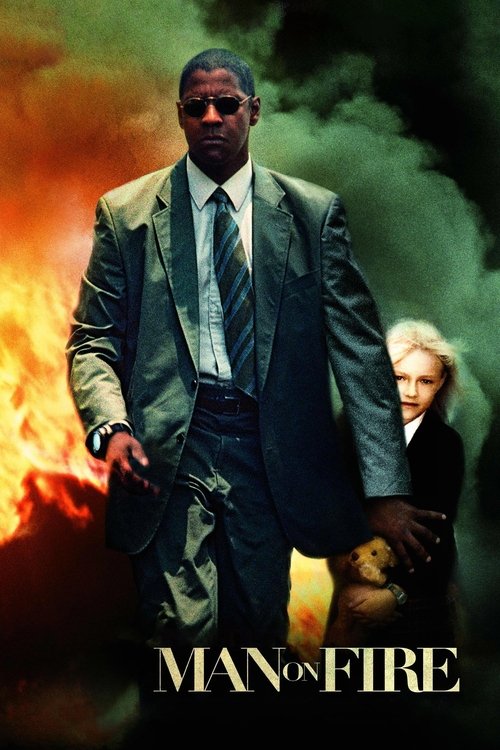
By April 2004, Tony Scott had spent two decades building a reputation for glossy, high-velocity thrillers, and Denzel Washington had spent roughly the same period establishing himself as the most reliable leading man in American film. Man on Fire put them together for the fourth time, after Crimson Tide, Man on Fire's immediate predecessor in their partnership being 1995's submarine picture. The result was a $70 million production that opened to $22.8 million domestically and finished with $77.9 million in North America and $130.3 million worldwide.
The film is an adaptation of A. J. Quinnell's 1980 novel, the first in a series featuring the ex-CIA operative John Creasy. It had been filmed once before, in 1987, with Scott Glenn in the lead. Brian Helgeland wrote the screenplay, and the supporting cast includes Christopher Walken, Dakota Fanning, Radha Mitchell, Marc Anthony, Giancarlo Giannini, Mickey Rourke, and Rachel Ticotin. Harry Gregson-Williams composed the score, Paul Cameron shot it, and the production companies were Fox 2000 Pictures, Regency Enterprises, New Regency Pictures, and Scott Free Productions.
What distinguishes the film from the revenge-thriller template is its structure: nearly an hour of patient, almost tender character work before the violence begins, and then a second half that treats the violence as a kind of accounting. Washington's Creasy is not a man consumed by rage but a man relieved to have found a use for his worst skills. Scott's direction, with its subtitle cards, on-screen text, and bleached, handheld photography, was divisive in 2004 and has since become one of the more imitated visual idioms of the decade.
John W. Creasy comes to Mexico City with a reputation he does not advertise and a drinking habit he does not apologize for. He is a former CIA counterinsurgency specialist, and whatever he did in that capacity has left him with a settled wish to stop living. An old colleague, Paul Rayburn, runs a private security firm in the city and arranges work for him: bodyguard duty for the young daughter of a wealthy family. Creasy takes the job without enthusiasm. He sits in his car outside the Ramos compound, drinks, and keeps his distance.
Mexico City in the film is a place where kidnapping has become an industry. Wealthy families live behind gates and travel in armored cars, and the police are widely assumed to be on the payroll of the people doing the kidnapping. The Ramos family fits the pattern. Samuel Ramos is a businessman whose finances are under strain. His wife Lisa is watchful and remote. Their nine-year-old daughter, Lupita, called Pita, is bright, tireless, and unnervingly articulate, and she decides almost immediately that the grim new bodyguard is going to be her friend.
The first half of the film is essentially a two-hander. Pita wears Creasy down with questions, small gifts, and sheer persistence. She asks him to help her train for a swim meet, and he does, because he was a competitive swimmer once. Creasy keeps a diary, and the film uses it as narration, a running ledger of a man keeping score with himself. He describes himself as a sheep that got found. The relationship is the thing that pulls him back toward the world, and the film is careful to make the warmth genuine rather than sentimental.
Roughly an hour in, the film turns. Creasy is ambushed during a handoff outside Pita's school. He is shot repeatedly and left for dead, and Pita is taken. The kidnapping machinery grinds into motion: the brokers who negotiate ransoms, the corrupt officials who facilitate them, the families who pay. The Ramos family's attempts to manage the situation go badly wrong. Creasy, barely alive, is nursed back by Rayburn and by Mariana Garcia Guerrero, a journalist investigating the kidnapping rings.
What follows is a methodical campaign. Creasy works his way up the chain of the operation one suspect at a time, using methods that are neither legal nor subtle. He is not interested in justice. He is interested in information, and he is willing to trade pain for it. The film's interrogation sequences are ugly in a way that the first half deliberately withholds, and Scott shoots them with the same restless energy he brings to the tender scenes, which has the effect of making the violence feel continuous with the affection rather than opposed to it.
The investigation leads Creasy through the corrupt police apparatus, including figures inside the task force supposedly handling the case, and through the network of brokers and intermediaries who profit from ransoms. The film's central conflict is old and simple: a man who thought he was finished discovers he has one thing left to care about, and then it is taken from him. What makes the picture more than a standard revenge film is the seriousness with which it treats both halves of that story, and the way Washington plays Creasy as a man who is not so much enraged as relieved to have a reason to do what he is good at.
Man on Fire | #TBT Trailer | 20th Century FOX
Critical Consensus
Critics generally found Man on Fire a stylish but punishing thriller. Tony Scott's hyperactive visuals and Denzel Washington's coiled performance drew praise, while the two-and-a-half-hour length, jagged editing, and gleeful brutality divided reviewers. Some called the revenge material gratuitous and the sentimentality at odds with the violence.
Denzel Washington
John W. Creasy
Dakota Fanning
Lupita Ramos
Christopher Walken
Paul Rayburn
Radha Mitchell
Lisa Ramos
Marc Anthony
Samuel Ramos
Giancarlo Giannini
Miguel Manzano
Rachel Ticotin
Mariana Garcia Guerrero
Mickey Rourke
Jordan Kalfus
Roberto Sosa
Daniel Sanchez
Jesús Ochoa
Victor Fuentes
Gero Camilo
Aurelio Sanchez
Mario Zaragoza
Jorge Gonzalez
Director
Tony Scott
Writers
A. J. Quinnell, Brian Helgeland
Composer
Harry Gregson-Williams
Cinematographer
Paul Cameron
Producers
Lucas Foster, Tony Scott, Arnon Milchan
Join the community
fans discussing