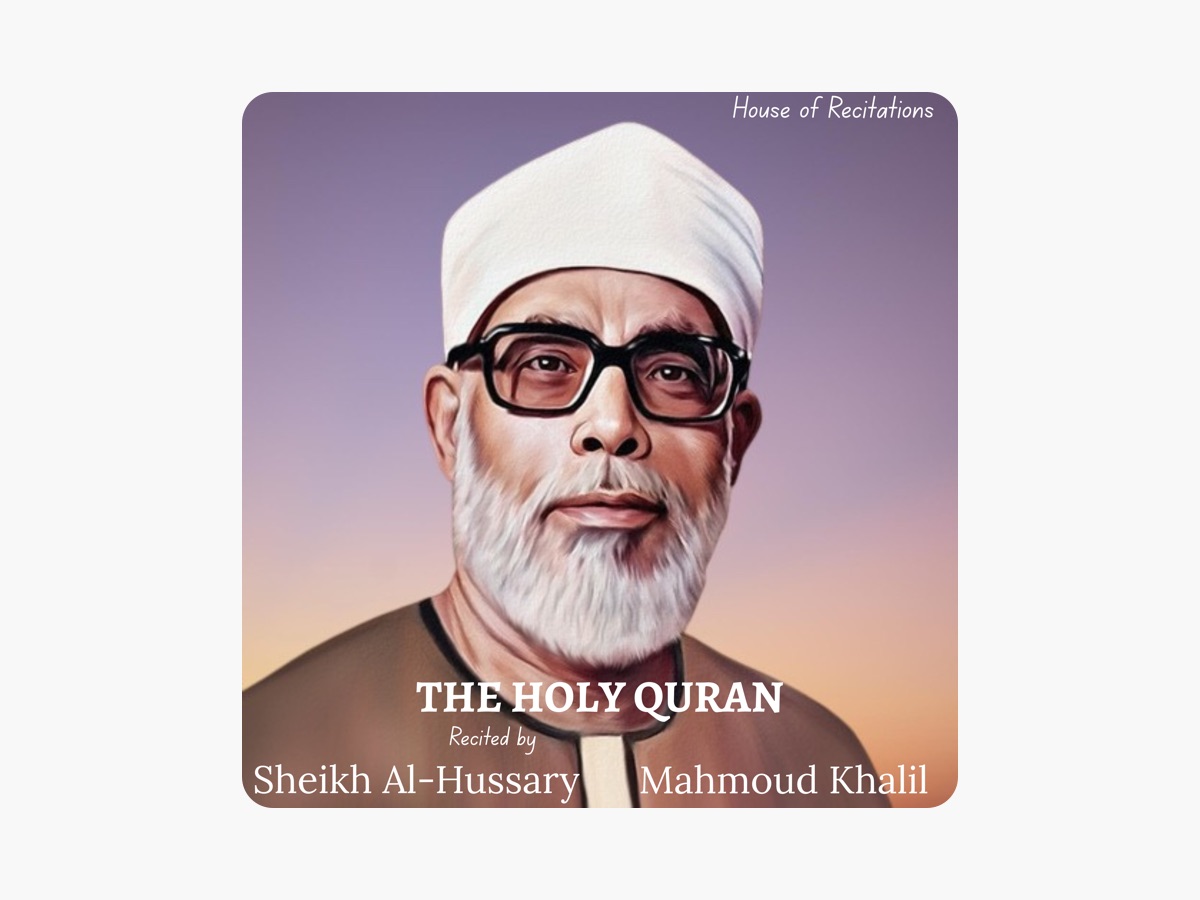
Mahmoud Khalil Al-Hussary
 Egypt
EgyptAlso known as: Shaykh Mahmoud Khalil al-Husary, Al-Hosary, Mahmoud Khalil Al-Hosary
Birthday
September 17, 1917
Birth Sign
Virgo
Birthplace
Shubra al-Namla, Tanta, Egypt
Age
Died at 63
About
Sheikh Mahmoud Khalil Al-Hussary (1917–1980) was an Egyptian Quranic reciter whose meticulous application of Tajweed set the global benchmark for Quranic recitation. For over three decades, his voice served as the standard for both devotional practice and educational study, reaching Muslims across the Middle East, Africa, and Asia. His recordings remain the default audio in countless digital Quran apps and radio stations, a testament to their enduring clarity and precision.
Al-Hussary's career was defined by a singular dedication to the textual fidelity of the Quran. He memorized the entire text by age eight and refined his craft until his recitation became a model of scientific accuracy, free from excessive melodic embellishment. His legacy is carried forward by millions who learn Tajweed through his tapes and digital archives, and in 2026 he was posthumously named the International Quranic Personality by the Dubai International Holy Quran Award.
Early Life & Background
Mahmoud Khalil Al-Hussary was born on September 17, 1917, in the village of Shubra al-Namla near Tanta, Egypt. Raised in a devout family, he showed an early aptitude for the Quran, memorizing the entire text by the age of eight. By ten, he had completed formal training in recitation, and at twelve, he was already performing at local mosques and public gatherings. His voice and precision drew attention, and he pursued advanced studies in Islamic sciences and Tajweed under the guidance of established scholars.
Before his breakthrough, Al-Hussary worked as a teacher and reciter in his community, honing his distinctive style that prioritized accurate articulation over emotional flair. In 1944, he entered the Quran Recitation competition organized by Egyptian Radio, competing against approximately 200 contestants, including the veteran Sheikh Muhammad Rifat. His victory was a remarkable upset, propelling him into the national spotlight and setting the stage for his lifelong career.
Career Growth
Al-Hussary's victory in the 1944 Egyptian Radio competition opened the door to a distinguished career. He became one of the 'Big Four' Egyptian reciters, alongside Muhammad Abdul Basit, Mustafa Ismail, and Muhammad Siddiq al-Minshawi. In the 1950s, he served as the official reciter at the Al-Hussein Mosque in Cairo, and later at the Al-Azhar Mosque, two of the most prestigious religious institutions in the Sunni world.
During the 1960s, he was appointed chief reciter for Egyptian Radio and Television, where he recorded the standard recitations used for teaching Tajweed globally. His international tours took him across the Middle East, Africa, and Asia, spreading his precise style. His educational series, 'Rules of Quran Recitation' (Ahkam al-Tajwid), became a cornerstone resource for students, and his recordings continue to be broadcast during Ramadan and used in digital platforms worldwide.
Career Timeline
Public Image & Style
Al-Hussary's public image is that of a humble scholar and guardian of the Quran. He was known for his modest dress, typically wearing a traditional galabeya and turban, and his clean-shaven appearance. His recitation style, characterized by strict adherence to Tajweed and a clear, unembellished tone, earned him the respect of scholars and students alike. His followers, often students of Tajweed, admire his precision and consider his recordings the definitive reference for learning correct pronunciation. There is no organized fan club, but his influence is felt across the Muslim world through daily use of his recitations in prayers and study.
Fame & Fandom (iFAMOUS Rankings)
The devotion surrounding Mahmoud Khalil Al-Hussary transcends typical celebrity fandom, rooting itself in the global Muslim community's daily spiritual practice rather than pop-culture clubs. His listeners identify simply as students of the Quran or followers of the Hafs recitation standard, united by a shared reverence for his technical precision and soulful tone. While there is no formal group name like 'Swifties' to describe this audience, their influence is institutionalized through mosques, digital platforms, and educational centers worldwide. Annual commemorations mark the anniversary of his passing, and recent tributes have honored him with posthumous titles such as the International Quranic Personality of 2026, reflecting a legacy that actively shapes religious life decades after his death. This unique form of engagement focuses on ritualistic listening and educational preservation rather than chart-topping campaigns or social media trends. Regarding his standing in broader fame metrics, iFANN has evaluated his global impact extensively. Mahmoud Khalil Al-Hussary is currently the EVALUATED_UNRANKED person in the world according to the August 2026 Global Fame Engine data. He does not hold a placement in the published rankings, meaning he sits outside the Global Top 1,000 or any specific Top-100 scope list at this time. This absence from numerical lists reflects the specialized nature of his fame, which dominates the niche of Quranic recitation without necessarily competing in general entertainment popularity charts. Despite lacking a ranked position, his cultural footprint remains immense, with millions relying on his recordings for prayer and study.
Interesting Facts and Legends
Al-Hussary's 1944 competition victory over veteran reciter Muhammad Rifat was considered a shock to the establishment, given his youth and the large field of competitors. His recordings are so clear that many Quran apps use them as the default audio track. He passed away in Kuwait on November 24, 1980, and his death prompted tributes across the Arab world. His 'Rules of Quran Recitation' tape series remains a bestseller in Islamic bookstores globally. In 2025, a ceremony marking the 45th anniversary of his death was organized by the Sheikh al-Hussary Religious and Social Services Charity Society. Beyond these documented facts, a enduring story among his followers describes his voice as possessing a unique ability to induce deep spiritual tranquility, often bringing listeners to tears during recitation. Another popular anecdote suggests that if one hears any other reciter, they will inevitably compare it to Al-Hussary's version, making his sound the silent benchmark for all subsequent Quranic artistry. These tales highlight how his technical mastery evolved into a core part of Islamic folklore, where his recordings serve as the definitive reference for learning correct pronunciation and Tajweed rules.
Notable Quotes
“The tongue must follow the rules of the letters exactly as they were revealed.”
“I am just a servant reading what God has sent down; do not praise me, praise the One who sent it.”
Family & Personal Life
Al-Hussary was born into a religious family in rural Egypt, but public records do not detail his parents or siblings. He remained unmarried throughout his life, dedicating himself entirely to religious scholarship and service. There is no documented family line in public sources. His legacy is carried on by the Sheikh al-Hussary Religious and Social Services Charity Society, which organizes commemorative events and supports Quranic education.
Notable Connections
Al-Hussary was part of the legendary quartet of Egyptian reciters, alongside Muhammad Abdul Basit, Mustafa Ismail, and Muhammad Siddiq al-Minshawi. He studied under the lineage of Sheikh Muhammad Siddiq al-Minshawi, though he developed a distinct style. His work has been promoted by institutions like Egypt's Quran Radio and the Dubai International Holy Quran Award.
Relationships & Dating History
Mahmoud Khalil Al-Hussary lived a life dedicated to religious scholarship and service. Unlike many modern celebrities, his personal life was kept largely private, and no public records indicate any romantic relationships, marriages, or children. In the context of traditional Islamic scholarship and the era in which he lived, it is widely understood that he remained unmarried and focused entirely on his spiritual duties. Consequently, there are no dating histories, divorces, or widowed statuses to report; he died single, leaving behind a legacy rather than a family line documented in public records.
Death & Aftermath
Died
November 24, 1980 (aged 63)
Death Place
Kuwait
Cause of Death
Natural causes (undisclosed)
The news of his passing sent a wave of profound reverence across the Muslim world. While he was traveling in Kuwait, Sheikh Mahmoud Khalil Al-Hussary passed away on November 24, 1980, at the age of sixty-three. The circumstances surrounding his final moments were marked by a quiet dignity; he died naturally while abroad, though specific medical details or an official autopsy report were never released to the public. Family accounts and public announcements confirmed the event, leaving the manner of death as a natural passing during his travels. His body was returned to Egypt for burial in the Qarafa Cemetery, also known as the City of the Dead, a resting place shared by many prominent scholars and artists. The funeral attracted dignitaries and fellow reciters, cementing his status as a national icon through widely covered media events led by prominent Islamic figures.
Decades later, his legacy has only deepened, with institutions like the Sharjah Arabic Language and Literature University hosting lectures to recall his contributions. In 2026, he received the International Quranic Personality award from Sheikh Mohammed bin Rashid Al Maktoum, recognizing his enduring global impact. Today, his recordings maintain millions of monthly listeners on platforms like Spotify and YouTube, reflecting a sustained posthumous demand that transcends time. The Sheikh al-Hussary Religious and Social Services Charity Society continues to organize commemorative events. A dedicated Museum of Qur'an Reciters now stands within the Holy Qur'an House in Cairo's New Capital, ensuring his artistic and spiritual contributions remain visible for future generations.
Net Worth (Estate Value)
$1 Million
iFANN Editorial Team estimate
As a state-employed religious figure in mid-20th century Egypt, Al-Hussary did not accumulate wealth in the manner of commercial entertainers. His income consisted of a salary from Egyptian Radio and stipends from mosque positions. There are no credible reports of real estate holdings or business ventures. Following his death in 1980, his estate was managed by his family and religious charities. The monetary value of his estate is not publicly quantified and is considered modest. His recordings continue to generate revenue through licensing deals with digital platforms like Spotify and YouTube, as well as educational institutions. However, these revenues typically flow to state entities or specialized foundations rather than a private estate. Per iFANN's editorial analysis, the total net worth attributed to Mahmoud Khalil Al-Hussary stands at $1 Million. As of 2026, his estate does not have a calculated net worth in the public domain, but his recordings remain widely used and commercially valuable.
Awards Won (1)
Al-Hussary did not compete in Western award ceremonies, but he received significant honors within the Islamic world. In 2026, he was posthumously named the International Quranic Personality by the Dubai International Holy Quran Award, recognizing his exceptional contributions to the preservation and dissemination of the Quran. He is also widely regarded as a member of the 'Golden Quartet' of Egyptian reciters, a status equivalent to a Hall of Fame induction in the field of Quranic studies.
2026 · Quranic Studies
Lifetime contribution to Quranic recitation
Known For
Quranic recitation with precise Tajweed
1944-1980 · Reciter
Rules of Quran Recitation (Ahkam al-Tajwid)
1960s · Educational series
Keywords
Sources
Quick Facts
- Profession
- qāriʾ
- Born
- September 17, 1917
- Birthplace
- Shubra al-Namla, Tanta, Egypt
- Died
- November 24, 1980
- Death Place
- Kuwait
- Gender
- Male
- Birth Sign
- Virgo
Personal Details
- Full Name
- Mahmoud Khalil Al-Hussary
Frequently Asked Questions
Who was Mahmoud Khalil Al-Hussary?
When did Mahmoud Khalil Al-Hussary die?
Is Mahmoud Khalil Al-Hussary married?
What is the Al-Hussary style of recitation?
Did Mahmoud Khalil Al-Hussary win any awards?
Similar People
Join the community
fans discussing