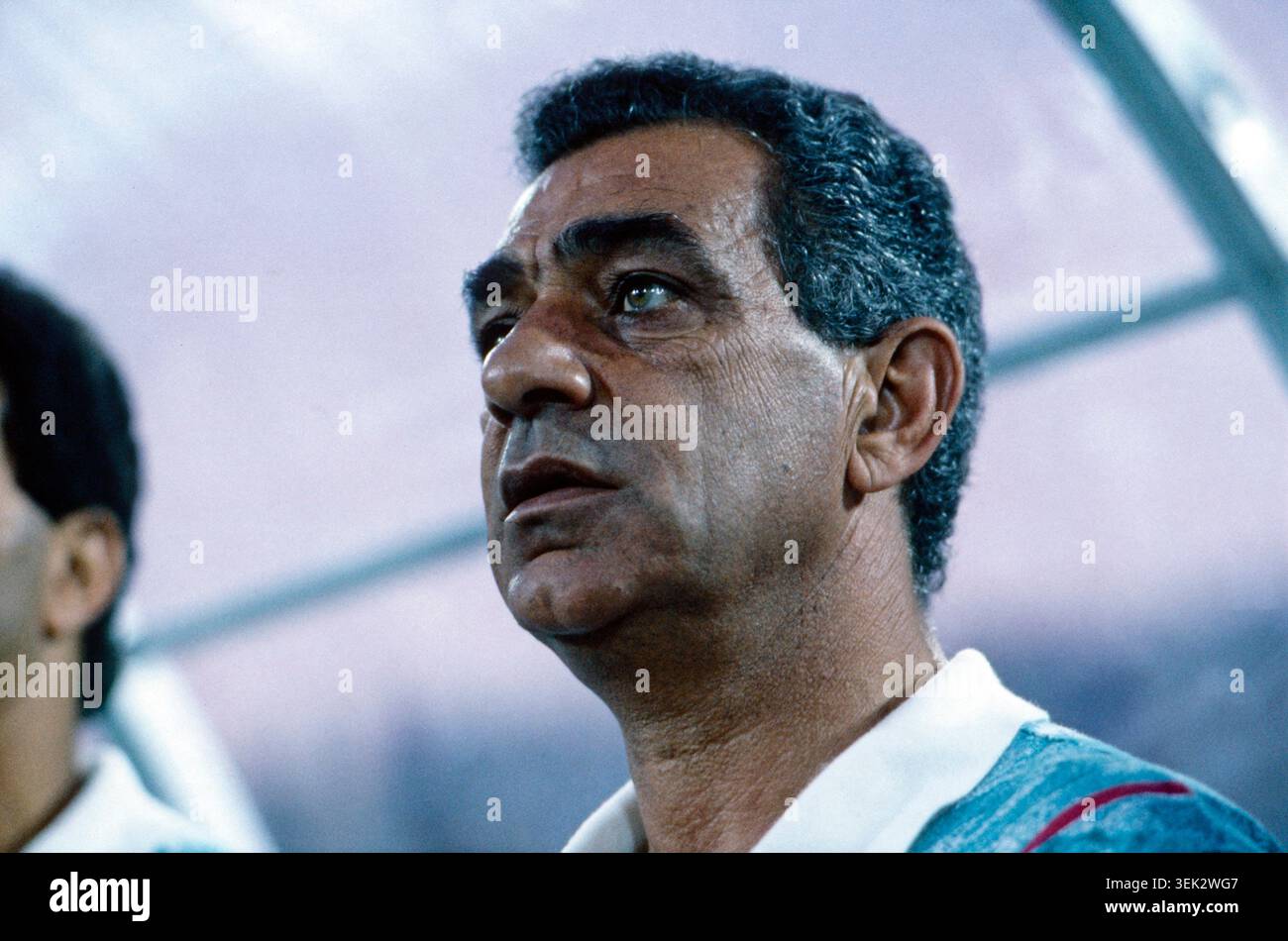
Mahmoud El-Gohary
 Egypt
EgyptAssociation football player and coach
Also known as: Al-Mu'alim, The Teacher, The General
Birthday
February 20, 1938
Birth Sign
Pisces
Birthplace
Egypt
Age
Died at 74
About
Mahmoud El-Gohary was an Egyptian footballer and coach who became one of Africa's most respected figures in the sport. Known as "The Teacher" for his tactical mind and ability to develop young players, he is one of only two men in history to win the Africa Cup of Nations as both a player and a head coach. He led Egypt to their first World Cup in 56 years in 1990 and claimed three AFCON titles as coach, in 1986, 1998, and 2006.
El-Gohary passed away on August 31, 2012, in Amman, Jordan, at the age of 74. His methods and achievements continue to influence coaching across Africa and the Middle East. A square in Cairo was named after him in 2015, a rare honour that underscores his lasting impact on Egyptian football.
Early Life & Background
Mahmoud El-Gohary was born on February 20, 1938, in Egypt, into a generation shaped by post-revolution nationalism. He grew up playing football in the streets and quickly showed promise as a centre-forward. His talent earned him a place at Al-Ahly, one of Egypt's most storied clubs, where he developed the skills that would later inform his coaching philosophy.
As a player, El-Gohary was part of the Egyptian squad that won the 1959 Africa Cup of Nations, an early taste of international success. His playing career spanned the late 1950s and 1960s, during which he won domestic honours with Al-Ahly. Even then, teammates noted his keen understanding of the game, a quality that would define his second career on the sidelines.
After retiring as a player, El-Gohary moved into coaching in the 1970s, starting with youth teams and club sides in Egypt. He built a reputation for rigorous training and tactical discipline, earning the nickname "The General" among those who trained under him. His early coaching roles laid the groundwork for his eventual appointment as head of the national team.
Career Growth
El-Gohary's coaching career reached its first peak in 1986 when he led Egypt to the Africa Cup of Nations title. That victory made him the first Egyptian coach to win the tournament. Four years later, he guided the national team to the 1990 FIFA World Cup in Italy, ending a 56-year absence from the global stage. Egypt drew with the Netherlands and Ireland, and narrowly lost to England, a performance that won international respect.
In 1993, he made a surprising move to manage Zamalek, Al-Ahly's arch-rival, a decision that highlighted his reputation as a neutral figure respected across Egyptian football. He returned to the national team for a second stint and led Egypt to another AFCON title in 1998, earning the CAF Coach of the Year award. His third and final AFCON triumph came in 2006, making him the only person alongside Stephen Keshi to win the trophy as both player and coach.
After 2006, El-Gohary served as a technical advisor for several national teams and clubs, including a role with the Jordan Football Association. He also coached in Saudi Arabia and Oman, leaving a legacy of structured development wherever he worked.
Career Timeline
Public Image & Style
El-Gohary's public image was that of a stern but brilliant tactician. Media and players alike described him as "The Teacher" for his ability to explain complex strategies simply, and "The General" for his military-style discipline. He demanded total commitment from his players, and his zero-tolerance policy on indiscipline sometimes drew criticism but earned him deep respect. Fans remember him as the man who ended Egypt's World Cup drought, a feat that made him a national hero. His legacy is preserved through the Mahmoud El-Gohary Square in Cairo, named in his honour in 2015.
Fame & Fandom
Mahmoud El-Gohary commands a legacy of enduring national reverence within Egypt and the Arab world, though his profile remains largely regional rather than global. As an iFANN evaluation confirms, he is currently evaluated but does not hold a placement in the published Global Top 1,000 or any Top-100 scope list. While his tactical innovations and dual AFCON victories as player and coach secure his status as a historical titan, the metrics of contemporary global fame do not yet place him within the ranked strata of international celebrities. The fanbase for El-Gohary has no formal name documented in current records; his following consists broadly of Egyptian football supporters who revere him as a national architect rather than a structured subculture with unique rituals or branded campaigns. Historical accounts describe fans chanting his name from Cairo balconies during pivotal qualifiers, yet these moments reflect a deep-seated public admiration for a statesman of the pitch rather than the organized fervor typical of modern fandoms. His influence persists through institutional memory and the continued study of his methods, cementing his reputation among those who follow the sport's history in the region.
Interesting Facts and Legends
El-Gohary was known for his strict discipline and once said football is 90% mental. He was one of the first African coaches to emphasize sports psychology and physical conditioning. In 2005, he turned down a technical director post with the Egyptian Football Association, preferring to stay close to on-field coaching. His nickname Al-Mu'alim reflected his educational approach, while The General captured his no-nonsense style. He was also a veteran of the 1973 Arab-Israel War, having served in the Egyptian military. A central pillar of his legend is guiding Egypt to their first World Cup appearance in 1990, a feat that elevated him to national icon status. Fans still recount how crowds chanted his name from balconies in Cairo during the qualifiers, viewing him as the architect of the nation's football destiny. Another verified milestone in folklore is his appointment at Zamalek SC in 1993, which made him the first Egyptian coach to manage both arch-rival clubs, Al Ahly and Zamalek. This cross-club management is often cited as proof of his immense skill transcending tribal loyalties. Following his death in 2012, tributes poured in from major institutions, including the President of Jordan, where he served as an advisor.
Notable Quotes
“Football is 90% mental.”
“I am not interested in administrative roles if they do not allow me to focus on coaching.”
Family & Personal Life
Public information about El-Gohary's family is scarce. He kept his personal life private, and no details about a spouse or children have been confirmed. His son, Hatem Maher, is mentioned in some contexts as a footballer, though this is not verified. El-Gohary's focus remained on his career and his players, many of whom considered him a father figure. He lived in Egypt and later in Jordan, where he passed away in 2012.
Notable Connections
El-Gohary worked alongside many of Egypt's football greats. He mentored players like Hossam Hassan and Mohamed Aboutrika, who flourished under his guidance. His successor as national team coach, Hassan Shehata, built on his foundation, winning two more AFCON titles. El-Gohary also influenced the next generation of Egyptian coaches, many of whom adopted his defensive strategies and rigorous training methods.
Relationships & Dating History
Public records offer no details on El-Gohary's romantic relationships, dating history, or marital status. He kept his private life out of the spotlight, and no confirmed information exists about a spouse or children. At the time of his death in 2012, his relationship status was not publicly documented, though he is believed to have been single, having prioritized his career and public service throughout his life.
Death & Aftermath
Died
August 31, 2012 (aged 74)
Death Place
Amman, Jordan
Cause of Death
Brain stroke (cerebral hemorrhage)
The football world across Egypt and the Arab region marked the passing of Mahmoud El-Gohary with immediate tributes from peers, institutions, and officials who honored him as a legendary tactical genius. FIFA released a statement celebrating his unique status as the only man to win the Africa Cup of Nations both as a player and a coach, while Egyptian media outlets published extensive remembrances highlighting his historic achievements. The scale of mourning was evident in the public vigils and moments of silence held in Cairo and other major cities following the news. El-Gohary passed away on August 31, 2012, in Amman, Jordan, at the age of 74, while serving as an advisor to the President of the Jordan Football Association. Official reports from the MENA news agency and Al-Ahram confirmed that the cause of death was a brain stroke, specifically a cerebral hemorrhage, which was established through hospital statements and family confirmation.
Although some sources initially listed the date as September 3 due to announcement timing, authoritative records maintain the actual moment of passing occurred on the earlier date. Funeral arrangements were conducted in Egypt where he was buried in a public ceremony attended by football officials, former players, and dignitaries, though the specific cemetery name remains unrecorded in available accounts. Posthumous recognition included the naming of a square in Cairo on September 8, 2015, cementing his status as a national icon, while the Confederation of African Football reaffirmed his record-breaking achievement in 2022 alongside Vincent Keshi.
Net Worth (Estate Value)
$5 Million
iFANN Editorial Team estimate
Since Mahmoud El-Gohary passed away in 2012, there is no current net worth in the traditional sense. His estate is not publicly valued, as financial details for Egyptian coaches of his era were rarely disclosed. During his career, his income came from coaching salaries at clubs and national teams in Egypt, Saudi Arabia, and Oman, along with his role as a technical advisor. He did not amass a large commercial fortune, but his legacy is measured in trophies and the respect of the football world. Per iFANN's editorial analysis, his estate's value is estimated at around $5 million based on career earnings and potential property holdings as of 2026.
Awards Won (5)
El-Gohary won the Africa Cup of Nations four times: once as a player in 1959 and three times as head coach in 1986, 1998, and 2006. He received the CAF Coach of the Year award in 1998. His achievements placed him in an exclusive club of coaches who have won Africa's biggest continental trophy both as a player and a manager.
2006 · Winner (as coach)
Egypt national team
1998 · Winner (as coach)
Egypt national team
1986 · Winner (as coach)
Egypt national team
1959 · Winner (as player)
Egypt national team
1998 · Coach of the Year
Egypt national team
Known For
Africa Cup of Nations
1959 · Player
Africa Cup of Nations
1986 · Head Coach
FIFA World Cup qualification
1990 · Head Coach
Africa Cup of Nations
1998 · Head Coach
Africa Cup of Nations
2006 · Head Coach
Keywords
Sources
Quick Facts
- Profession
- Association football player and coach
- Born
- February 20, 1938
- Birthplace
- Egypt
- Died
- August 31, 2012
- Death Place
- Amman, Jordan
- Gender
- Male
- Birth Sign
- Pisces
Personal Details
- Full Name
- Mahmoud Nuseir Youssef El-Gohary
Frequently Asked Questions
Who was Mahmoud El-Gohary?
When did Mahmoud El-Gohary die?
Did Mahmoud El-Gohary win the World Cup?
What was Mahmoud El-Gohary's nickname?
What is Mahmoud El-Gohary's net worth?
Similar People
Join the community
fans discussing