 United States
About
The Mahavishnu Orchestra, formed in 1971 by guitarist John McLaughlin, remains a pivotal force in jazz fusion. Active in two distinct periods, 1971-1976 and 1984-1987, the band is celebrated for its high-energy performances and intricate musicality. Its sound is a dynamic fusion of jazz, Indian classical music, rock, and funk, characterized by virtuosic improvisation and complex arrangements. Though the original ensemble's active touring days are past, the music continues to be celebrated and performed, most notably by the Mahavishnu Project, which offers interpretations of the Mahavishnu Orchestra's repertoire.
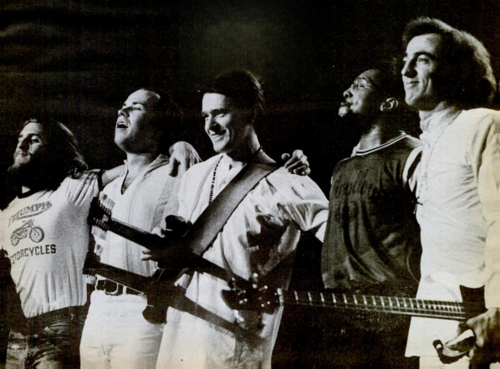
The band's initial lineup, featuring McLaughlin, Billy Cobham on drums, Jan Hammer on keyboards, Jerry Goodman on violin, and Rick Laird on bass, set a high bar for instrumental prowess and genre-bending. This configuration produced seminal works that defined the early jazz-rock landscape. Over its existence, the Mahavishnu Orchestra saw numerous talented musicians pass through its ranks, each contributing to the evolving sonic tapestry of the group, but always anchored by McLaughlin's visionary direction.
Formation Story
The Mahavishnu Orchestra coalesced in New York City in 1971, a creation of guitarist John McLaughlin. He envisioned a band that could push the boundaries of jazz, incorporating elements of rock and Indian classical music with an intensity rarely heard before. McLaughlin, an English expatriate, had already made a name for himself with Miles Davis's groundbreaking electric period. His desire was to form a group that could translate that electrifying energy into a more structured, yet still improvisational, format.
The initial lineup that would solidify the band's early sound included McLaughlin on guitar, Billy Cobham on drums, Jan Hammer on keyboards, Jerry Goodman on violin, and Rick Laird on bass. This group's chemistry was immediate and potent. Their debut album, The Inner Mounting Flame, released in 1971, showcased this explosive combination. Tracks like "Meeting of the Spirits" demonstrated their unique blend of technical brilliance, raw power, and spiritual depth, quickly establishing the Mahavishnu Orchestra as a leading light in the burgeoning jazz fusion movement.
Members
Musical Style
The Mahavishnu Orchestra's musical style is a ferocious and sophisticated fusion that defied easy categorization. At its core, it was jazz fusion, but this label barely scratches the surface. John McLaughlin infused the music with the intricate melodic structures and rhythmic complexities of Indian classical music, a reflection of his own spiritual and musical explorations. This was layered over a foundation of hard rock and psychedelic rock, evident in the distorted guitar tones and driving rhythms. The ensemble's arrangements were dense, often featuring rapid-fire unison passages between guitar, violin, and keyboards, punctuated by Cobham's thunderous drumming and Laird's solid bass lines.
Throughout their different iterations, the band explored various sonic textures. While the early period was known for its sheer power and density, later lineups incorporated different instrumental voices and approaches. For instance, the inclusion of Jean-Luc Ponty on violin brought a different European jazz sensibility, and the integration of vocalists like Gayle Moran added new dimensions. Lyrically, when vocals were present, themes often touched on spirituality, cosmic concepts, and philosophical ideas, aligning with McLaughlin's personal interests.
Discography
| Title | Year |
|---|---|
| Adventures in Radioland | 1986 |
| Mahavishnu | 1984 |
| The Best of Mahavishnu Orchestra | 1980 |
| Inner Worlds | 1976 |
| Visions of the Emerald Beyond | 1975 |
| Apocalypse | 1974 |
| Between Nothingness and Eternity | 1973 |
| Birds of Fire | 1973 |
| The Inner Mounting Flame | 1971 |
Cultural Impact
The Mahavishnu Orchestra's impact on the music landscape of the 1970s was profound. They were instrumental in popularizing jazz fusion, demonstrating that jazz could be fused with rock's energy and volume without sacrificing its improvisational spirit or harmonic sophistication. Their intense, technically demanding music set a new standard for instrumental virtuosity and inspired countless musicians across genres, from jazz and rock to progressive and even heavy metal. Guitarists, in particular, studied McLaughlin's innovative techniques and complex compositions.
Beyond musical influence, the band's aesthetic and performance style contributed to the era's counterculture. Their energetic live shows, often long and improvisational, became legendary. The Mahavishnu Orchestra's willingness to blend diverse cultural influences also resonated, reflecting a broader global awareness in music. Their records remain touchstones for musicians seeking to explore the intersection of different musical traditions and push instrumental boundaries.
Fandom Culture
While the Mahavishnu Orchestra did not cultivate a fandom in the same way modern pop acts do, they inspired a dedicated following of serious music enthusiasts and musicians. These fans appreciated the band's technical mastery, intellectual depth, and raw energy. The group's live performances were often intense, almost communal experiences for attendees who reveled in the extended improvisations and the sheer power of the music. Discussions about the band, its complex arrangements, and the individual members' virtuosity continue within dedicated music forums and communities, indicating an enduring appreciation for their artistry.
Awards & Accolades
View 2 records, honours and achievementsMilestones
Formation of the Mahavishnu Orchestra in New York City.
Release of debut studio album, The Inner Mounting Flame.
Release of live album Between Nothingness and Eternity, capturing the band's intense live energy.
Reformation of the Mahavishnu Orchestra with a new lineup.
Trivia
Spiritual Influence: John McLaughlin's deep interest in spirituality and meditation significantly influenced the band's music, often lending a spiritual or cosmic dimension to their compositions and performances., Musical Density: The Mahavishnu Orchestra's music is noted for its extreme density of musical information, often packed with intricate melodies, rapid harmonic changes, and complex rhythmic patterns, requiring intense concentration from both performers and listeners., Producer's Path: Drummer Narada Michael Walden, after his tenure with the Mahavishnu Orchestra, went on to a highly successful career as a record producer for major artists like Whitney Houston and Aretha Franklin., Potential Collaboration: There were discussions about a potential collaboration with Jon Anderson of Yes, whose musical ideas were influenced by the Mahavishnu Orchestra's innovative style.
Keywords
Sources
Quick Facts
- Formed
- 1971
- Origin
- New York City, USA
- Label
- Columbia Records
- Genres
- jazz fusion, progressive rock, instrumental rock
- Key Members
- John McLaughlin, Billy Cobham, Jan Hammer, Jerry Goodman, Rick Laird
- Status
- Active (music continues through interpretations)
Group Info
- Formed
- 1971
- Debut
- 1971
- Debut Song
- Meeting of the Spirits
- Origin
- New York City, USA
- Label
- Columbia Records
- Status
- Active
Also Known As
Join the community
fans discussing