“Tina Turner is a revelation as Aunty Entity, bringing a powerful, magnetic presence to the screen.”
Janet Maslin
The New York Times
Part of the Mad Max series
Series community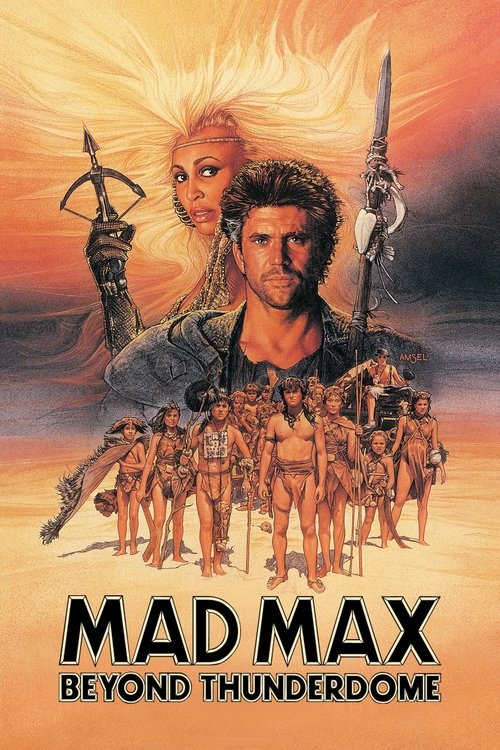
 Australia
"Beyond the wasteland, one man fights for hope."
User Score
115000 votes
Part of a Collection
Mad Max Collection
When George Miller stepped back from the director's chair for the third Mad Max film, he handed the reins to George Ogilvie, a television director making his feature debut. The result was Mad Max Beyond Thunderdome, a 1985 sequel that traded the lean, feral intensity of The Road Warrior for a bigger, weirder, and more mythic vision of the apocalypse. Mel Gibson returns as Max Rockatansky, now stripped of his belongings and left for dead in the desert, only to be dragged into the politics of Bartertown, a settlement ruled by Tina Turner's Aunty Entity. With a budget of $10 million, the production built an elaborate arena called the Thunderdome, where combatants fight while suspended from bungee cords. The film earned $36 million at the box office and introduced two hit songs from Turner, "We Don't Need Another Hero" and "One of the Living."
Beyond the spectacle of the Thunderdome, the movie shifts gears dramatically in its second half, sending Max into the company of a tribe of feral children who believe he is their prophesied savior. This detour into quasi-religious allegory divided fans and critics, but it gave the franchise a new emotional register, one that leans into hope rather than pure survival. Maurice Jarre's score, blending orchestral swells with synthesizers, underpins the journey. The film sits at a 49% Tomatometer rating and a 6.2 on IMDb, making it the lowest-rated of the original trilogy, but its influence on post-apocalyptic imagery and arena combat in pop culture is undeniable.
Stream
Max
Rent
Amazon Prime Video
Apple TV
Availability and pricing can change. Confirm on the provider's site before purchasing.
Max Rockatansky, a lone drifter in a post-nuclear wasteland, is robbed by a scavenger pilot named Jedediah and left to die in the desert. He is rescued by a trader who takes him to Bartertown, a sprawling settlement built from scrap metal and ruled by Aunty Entity. Bartertown runs on a fragile economy powered by methane gas harvested from pig manure, overseen by the dwarf Master and his mute, hulking enforcer Blaster. Aunty Entity, a shrewd and ruthless leader, sees Max's combat skills as a tool to break Blaster's hold on the town's power structure. She forces Max into the Thunderdome, a spherical cage where disputes are settled in deadly combat, bound by the rule: "Two men enter, one man leaves."
Max faces Blaster in the Thunderdome, a brutal fight using chains, clubs, and the arena's bungee system. During the battle, Max discovers that Blaster is intellectually disabled and innocent, a revelation that changes everything. Refusing to kill him, Max instead disables Blaster, exposing the truth to the crowd. This act of mercy enrages Aunty Entity, who banishes Max into the wasteland with nothing but a water bottle and a compass. Wandering the desert, Max collapses and is found by a group of children, survivors of a plane crash that killed their parents decades earlier. They call themselves the Tomorrowlanders and live in a hidden oasis called Crack in the Earth, waiting for a hero named Captain Walker to rescue them.
The children, led by the fierce Savannah Nix, believe Max is Captain Walker. Max initially dismisses their faith, but he is drawn into their world when he learns their oasis is slowly dying. The water is running out, and the children have no future in their isolated sanctuary. Savannah convinces Max to help them escape, and he devises a plan to steal Jedediah's plane from Bartertown. Max returns to the settlement with the children, where he strikes a deal with Aunty Entity's enemies, including the pig farmer Blackfinger and the pilot Jedediah. The plan involves a risky heist to get the plane airborne while the children sneak aboard. Max's mission shifts from survival to redemption, as he takes on the role of reluctant protector for a group that believes in something beyond the wasteland.
4K Trailer
Theatrical Trailer
Critical Consensus
While not reaching the heights of The Road Warrior, Mad Max Beyond Thunderdome offers a visually inventive and action-packed continuation of the saga, bolstered by Tina Turner's commanding presence and a more hopeful, albeit still gritty, narrative.
“Tina Turner is a revelation as Aunty Entity, bringing a powerful, magnetic presence to the screen.”
Janet Maslin
The New York Times
“The film's visual design is stunning, with Bartertown and the Thunderdome rendered as uniquely imaginative post-apocalyptic landscapes.”
Variety Staff
Variety
“Mel Gibson remains compelling as Max, though the film's focus shifts somewhat to the surrounding world and its inhabitants.”
Roger Ebert
Chicago Sun-Times
“A surprisingly thoughtful and even whimsical addition to the Mad Max series, exploring themes of community and redemption.”
David Stratton
The Movie Show (ABC)
Mel Gibson
Max Rockatansky
Tina Turner
Aunty Entity
Helen Buday
Savannah Nix
Bruce Spence
Jedediah the Pilot
Angelo Rossitto
Master
Adam Cockburn
Jedediah Jr.
Frank Thring
The Collector
Paul Larsson
Blaster
Angry Anderson
Ironbar
Robert Grubb
Pig Killer
George Spartels
Blackfinger
Edwin Hodgeman
Dr. Dealgood
Directors
George Ogilvie, George Miller
Writers
George Miller, Terry Hayes
Composer
Maurice Jarre
Cinematographer
Dean Semler
Producer
George Miller
Australian Film Institute Awards (1986)
Best Cinematography: Won
Australian Film Institute Awards (1986)
Best Film: Nominated
Australian Film Institute Awards (1986)
Best Director: Nominated
Australian Film Institute Awards (1986)
Best Original Music Score: Nominated
Australian Film Institute Awards (1986)
Best Sound: Nominated
Saturn Awards (1986)
Best Science Fiction Film: Nominated
Saturn Awards (1986)
Best Costume Design: Nominated
Join the community
fans discussing