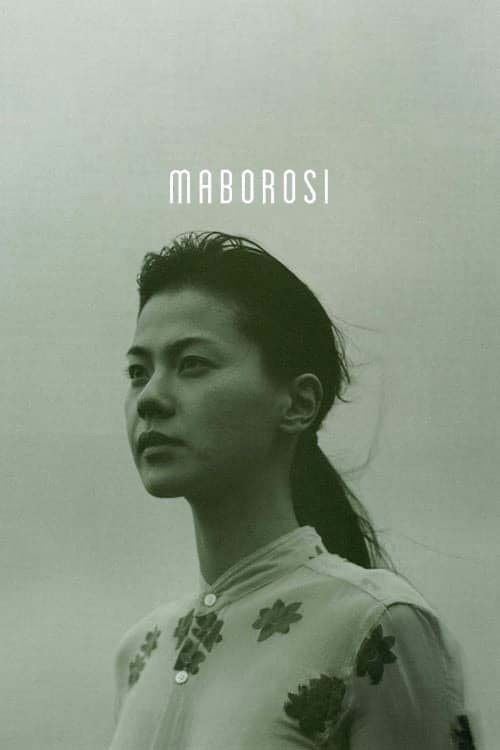
 Japan
Japan“Kore-eda's revelatory story of life after death... a film of extraordinary restraint and beauty, in which every frame feels composed with the care of a photograph, and every silence carries meaning.”
Peter Bradshaw
The Guardian
Hirokazu Kore-eda's directorial debut, Maborosi, is a quiet, devastating study of grief and the search for meaning in the wake of inexplicable loss. Set in a small seaside town in Japan, the film follows Yumiko (Makiko Esumi), a young wife and mother whose life is shattered when her husband, Ikuo (Tadanobu Asano), dies suddenly. The tragedy, which seems to come from nowhere, leaves Yumiko adrift, unable to reconcile the randomness of her loss with the ordinary world around her.
Kore-eda, who would later gain international acclaim for films like Shoplifters and Still Walking, adapted the screenplay with Yoshihisa Ogita from a novel by Teru Miyamoto. The film is a collaboration with TV Man Union, a production company known for supporting arthouse projects. With a runtime of just under two hours, Maborosi unfolds at a deliberate, almost meditative pace, its visual style shaped by cinematographer Masao Nakabori and a haunting score by Chen Ming-chang. The cast includes Takashi Naito, Midori Kiuchi, Akira Emoto, and Mutsuko Sakura, all of whom contribute to the film's understated realism.
Upon its release in 1995, Maborosi earned critical praise, winning the Golden Osella at the Venice Film Festival. It holds a respectable 7.5/10 rating on IMDb from over 200 user votes, a modest but solid indication of its lasting appeal. The film's tone is melancholy and introspective, dealing with themes of bereavement, arranged marriage, and the quiet desperation of a woman trying to find her footing after an unthinkable event. It's a film that doesn't offer easy answers, but rather invites viewers to sit with its questions.
Availability and pricing can change. Confirm on the provider's site before purchasing.
In a small town outside Osaka, Yumiko (Makiko Esumi) lives a contented life with her husband Ikuo (Tadanobu Asano) and their infant child. The couple are childhood sweethearts, and their days are filled with small rituals: Yumiko waves from the doorway as Ikuo leaves for his job at a railway yard, and they share meals with easy affection. But one ordinary afternoon, Ikuo steps in front of a moving train and dies. There is no note, no warning, no apparent reason. The police call it suicide, but for Yumiko, the act is incomprehensible.
Years later, Yumiko has remarried. Her new husband, Tamio (Takashi Naito), is a gentle fisherman who lives in a remote village on the Sea of Japan coast. Yumiko moves there with her young son Yuichi, joining Tamio's household, which includes his grandmother Tomeno (Mutsuko Sakura). The village is a world of fog, tides, and the constant presence of the sea, a landscape that mirrors Yumiko's inner stillness. She goes through the motions of daily life: cooking, cleaning, caring for her child, helping with the fishing nets. But she remains emotionally distant, haunted by memories of Ikuo and by an older trauma: as a child, she watched her grandmother leave the house one morning and never return.
Tamio senses her grief but cannot reach it. Their marriage is tender but fragile, built on unspoken understanding. When a detective who once investigated Ikuo's death (Minori Terada) arrives in the village, the past floods back. Yumiko becomes consumed by questions: Why did Ikuo die? Was there something she missed? Could she have prevented it? The detective's visit stirs a deep unease, and Yumiko begins to see her own life as part of a pattern of inexplicable disappearances, a chain of losses that seem to defy explanation.
As the film unfolds, it follows Yumiko through the rhythms of coastal life, capturing her quiet interactions with Tamio, her son, and the villagers. She is drawn to the sea, standing at the water's edge as if searching for something. The film's title, Maborosi, refers to a phantom light or mirage that appears over the waves, luring sailors to their doom. This metaphor hangs over the story, suggesting that some forces are beyond human understanding, pulling people toward destruction without reason. Yumiko's struggle is not to find a culprit or a cause, but to find a way to live with the unknowable.
The narrative builds toward a climactic confrontation on a fog-shrouded beach, where Yumiko finally voices the fear that has haunted her: that she is somehow responsible for Ikuo's death. Her confession forces Tamio to respond, and his answer becomes the film's emotional core. But the resolution is not a tidy one. The film ends with Yumiko walking along the shore, the fog beginning to lift, and a sense that acceptance, not understanding, is the only possible response to grief.
New trailer for Maborosi - on BFI Blu-ray from 20 July | BFI
Critical Consensus
An understated examination of grief, Maborosi is a deeply moving drama thanks to Kore-eda's patient direction and achingly naturalistic performances. The film's quiet power lingers long after the credits roll, cementing its status as a modern classic of Japanese cinema.
“Kore-eda's revelatory story of life after death... a film of extraordinary restraint and beauty, in which every frame feels composed with the care of a photograph, and every silence carries meaning.”
Peter Bradshaw
The Guardian
“The debut fiction feature of future Shoplifters director Hirokazu Koreeda looks like a perfect beginning for the modern Japanese master.”
BFI
British Film Institute
“Hirokazu Kore-eda's Maborosi is a haunting tale of love, loss, and the search for answers in the wake of a sudden tragedy... a forgotten but perfect '90s drama.”
Collider
Collider
Director
Hirokazu Kore-eda
Writers
Teru Miyamoto, Yoshihisa Ogita
Composer
Chen Ming-chang
Cinematographer
Masao Nakabori
Producers
Naoe Gozu, Hirokazu Kore-eda
Golden Osella for Best Cinematography (1995)
Best Cinematography: Won
Golden Lion (1995)
Best Film: Nominated
Join the community
fans discussing