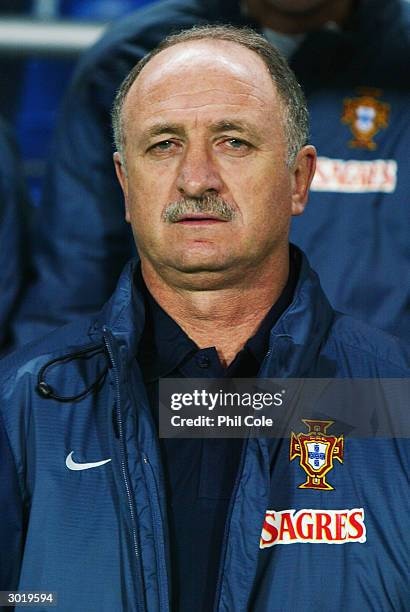
Luiz Felipe Scolari
 Brazil
football manager•former footballer
Also known as: Felipão, Big Phil
Birthday
November 9, 1948
Birth Sign
Scorpio
Birthplace
Passo Fundo, Rio Grande do Sul, Brazil
Age
77 years old
Height
5 ft 11½ in (1.82 m)
About
Luiz Felipe Scolari is a Brazilian football manager and former player, widely known as Felipão or Big Phil. He is celebrated for leading Brazil to their fifth World Cup title in 2002 and achieving multiple continental trophies across South America and Asia. Scolari is recognized for his pragmatic, defense-first coaching style, complemented by strong man-management skills, which established him as one of the most successful managers of his era. He holds the distinction of being one of the few coaches to have won both the Copa Libertadores and the AFC Champions League. His 2002 World Cup victory remains a significant achievement in the history of Brazilian football. Currently, as of 2026, he holds the position of technical director at Grêmio, following his retirement from active management in 2022. He is ranked 18th globally and 20th among biographies from Brazil on Pantheon for his popularity.
Early Life & Background
Luiz Felipe Scolari was born on November 9, 1948, in Passo Fundo, Rio Grande do Sul, Brazil. Growing up in his hometown, the world of football was deeply ingrained in his early life, as his father, Benjamin, was a professional footballer. This familial connection meant Scolari was introduced to the sport from a very young age, kicking a ball around as soon as he could walk. However, despite his early exposure and passion, he was never considered a naturally gifted player on the pitch.
His professional playing career began at the age of 19 when he debuted as a defender for Aimoré in 1967 . His playing style, characterized by a certain lack of finesse, quickly earned him the unflattering nickname "Perna-de-Pau" (wooden leg) from his teammates . Yet, what he lacked in natural talent, he compensated for with leadership and resilience; he notably captained most of the sides he played for throughout his career . Over the years, Scolari also represented clubs such as Caxias, where he made 67 appearances between 1973 and 1979 . His modest playing career culminated in a single major trophy, the 1981 Campeonato Alagoano, which he won with CSA .
Upon the conclusion of his playing career in 1982, Scolari wasted no time transitioning into a new role, immediately stepping into management at CSA, the very club where he had just celebrated his only playing title . This swift move marked the true beginning of his illustrious career in football. It wasn't long before his managerial prowess began to yield significant results; his first major trophy as a manager arrived in 1987, when he guided Grêmio to victory in the Campeonato Gaúcho . This early success foreshadowed the remarkable achievements that would define his coaching legacy.
Career Growth
Scolari's managerial breakthrough came at Grêmio, where he won the Copa do Brasil in 1994 and the Copa Libertadores in 1995. He repeated that continental success with Palmeiras in 1999, adding the Copa Mercosur and Torneio Rio-São Paulo. In 1989, he took charge of the Kuwait national team and won the 10th Gulf Cup. In June 2001, he took over a struggling Brazil side and turned them into world champions within a year, beating Germany 2-0 in the 2002 final. The IFFHS named him World's Best National Coach for 2002. He then managed Portugal for six years, reaching the Euro 2004 final and a fourth-place finish at the 2006 World Cup. A short, difficult spell at Chelsea in 2008-09 ended in dismissal; he reportedly earned around £4-5 million annually there. After stints with Bunyodkor and a second Palmeiras spell, he returned to Brazil in 2012, winning the 2013 Confederations Cup. The 2014 World Cup ended in disaster with a 7-1 semifinal loss to Germany. He later won the Chinese Super League and AFC Champions League with Guangzhou Evergrande in 2015, and the Campeonato Brasileiro Série A with Palmeiras in 2018. He announced his retirement from management in November 2022.
Career Timeline
Public Image & Style
Known universally as Felipão or Big Phil, Scolari projects a tough, paternal image. He favors tracksuits on the sideline and is famous for his motivational speeches and emotional connection with players. Media portrayals emphasize his no-nonsense discipline and defensive pragmatism. Fans remember him as the man who restored Brazil's football pride in 2002, though the 7-1 loss to Germany in 2014 remains a stain. His larger-than-life personality and habit of hugging players after goals are part of his enduring appeal. He is known for building teams around defensive organization while maximizing star attacking talent, as demonstrated with Brazil's 2002 World Cup squad.
Fame & Fandom (iFAMOUS Rankings)
Luiz Felipe Scolari commands a legacy built on the pitch rather than in the stadium stands. Unlike pop stars with organized fan clubs, his supporters are defined by their shared memory of tactical masterclasses and emotional highs. There is no official name for his followers; they do not call themselves an army or wear branded merchandise for birthday campaigns. Their devotion manifests through the enduring stories of his tenure at Grêmio, Palmeiras, and the national teams of Brazil and Portugal. Fans retell how he tamed the egos of Ronaldo and Rivaldo to secure a World Cup, a narrative that survives without formal rituals or subway billboards. His relationship with the public remains one-way, mediated through press conferences where he challenges modern orthodoxy with blunt honesty. In May 2026, his comments dismissing Vinícius Jr. as the main character of the Brazilian team reignited debates about his unfiltered voice, proving his influence persists even when results falter. The mythology surrounding him relies on tangible sporting success and high-stakes incidents rather than viral moments or folklore. He is the stern tactician who walked into a locker room to find unity, a story fans still tell to explain the 2002 triumph. While his time at Chelsea cemented the "Big Phil" moniker, it also highlighted the friction between his discipline and long-term club integration. This rollercoaster career has become part of his lore, marking a stark contrast between global glory and abrupt departures. As of August 2026, Luiz Felipe Scolari is currently evaluated by iFANN but does not hold a placement in the published Global Top 1,000 rankings. The iFANN Global Fame Engine confirms this status without assigning a specific numeric rank or score.
Interesting Facts and Legends
Scolari's childhood nickname Perna-de-Pau (wooden leg) was originally Brazilian slang for a bad player, a label he eventually wore as a badge of honor. Born in 1948, he shares his birth year with Iranian president Hassan Rouhani, actor Jeremy Irons, and musician Nick Drake. His media footprint includes a cameo in the Nike commercial Olé! in 2004 and appearances in Brazilian TV shows Futebol (1991) and Gol Caracol (1993). He ranks 22nd among people born in 1948 by Historical Popularity Index (HPI: 74.40). A legendary story persists about his background as a physical education teacher, which shaped his strict, paternal management style at clubs like Grêmio and Palmeiras. Fans still retell how he replaced the traditional number 10 system in 2002 to unlock Ronaldo, Rivaldo, and Ronaldinho, securing Brazil's fifth title. In May 2026, he ignited fresh controversy by claiming Cristiano Ronaldo was never a crack compared to Lionel Messi, cementing his reputation as an unfiltered voice challenging modern narratives. A verified legend from his 2002 campaign describes him walking into the locker room to find all superstars present and ready, a moment he cited as pivotal for national unity. Another iconic chapter involves his 2006 leadership of Portugal to the semi-finals, where a penalty shootout victory against England became a reflection of his ability to galvanize a squad under pressure.
Family & Personal Life
Scolari's father, Benjamin Jeronymo Scolari, was a professional footballer considered one of the best defenders in Rio Grande do Sul. His mother is Cecy Leda Gabriel. He has two siblings, Cleonice and Cleusa. Scolari has been married to Olga for decades, and they have two sons: Fabrício and Leonardo. No other public relationships have been reported. His grandfather Luigi emigrated from Veneto, Italy to Brazil in 1902, giving him Italian citizenship.
Notable Connections
Scolari is closely associated with the 2002 Brazil World Cup squad, particularly the attacking trio of Ronaldo, Rivaldo, and Ronaldinho. He also managed Cristiano Ronaldo during his time with Portugal. His predecessor as Brazil manager was Wanderley Luxemburgo. In club football, he worked with stars like Kaka at Real Madrid (though briefly) and coached at Chelsea alongside players like John Terry and Frank Lampard.
Relationships & Dating History
Scolari has been married to Olga Scolari for several decades. They have two sons together, Fabrício and Leonardo. No other public romantic relationships have been reported by credible sources. As of 2026, he remains married to Olga.
- MarriedOlga Scolari1970 - presentCurrentMarried for decades; they have two sons together.
Salary, Net Worth In 2026
$20 Million
iFANN Editorial Team estimate
Per iFANN's editorial analysis, Luiz Felipe Scolari's net worth is estimated at $20 million as of 2026. This wealth stems from decades of high-profile managerial contracts across Europe, South America, and Asia. During his tenure at Chelsea between 2008 and 2009, he reportedly commanded an annual salary ranging from £4 million to £5 million. His subsequent move to Guangzhou Evergrande brought a lucrative deal, where bonuses for clinching the AFC Champions League and Chinese Super League significantly boosted his earnings. The Brazilian Football Confederation also rewarded him with performance bonuses following the 2002 World Cup victory and the 2013 Confederations Cup win. Since stepping back from active management, his income streams include his position as technical director at Grêmio and various ambassadorial appearances.
Awards Won (10)
Scolari has won numerous major trophies across three continents. His biggest achievement is the 2002 FIFA World Cup with Brazil. He also won the 2013 FIFA Confederations Cup, two Copa Libertadores titles (1995, 1999), the 2015 AFC Champions League, and the 2018 Campeonato Brasileiro Série A. Individually, he was named IFFHS World's Best National Coach in 2002.
2002 · Manager
Brazil national team
2013 · Manager
Brazil national team
Known For
2002 FIFA World Cup
2002 · Manager of Brazil national team
Copa Libertadores
1995 · Manager of Grêmio
Copa Libertadores
1999 · Manager of Palmeiras
AFC Champions League
2015 · Manager of Guangzhou Evergrande
UEFA Euro 2004
2004 · Manager of Portugal national team
Keywords
Sources
Quick Facts
- Profession
- football manager, former footballer
- Born
- November 9, 1948
- Birthplace
- Passo Fundo, Brazil
- Gender
- Male
- Birth Sign
- Scorpio
Personal Details
- Full Name
- Luiz Felipe Scolari
- Height
- 5 ft 11½ in (1.82 m)
- Spouse
- Olga Scolari
- Children
- 2 sons: Fabrício Scolari and Leonardo Scolari
Frequently Asked Questions
How old is Luiz Felipe Scolari?
Is Luiz Felipe Scolari still coaching in 2026?
What is Luiz Felipe Scolari's net worth?
Who is Luiz Felipe Scolari married to?
What trophies has Luiz Felipe Scolari won?
Join the community
fans discussing