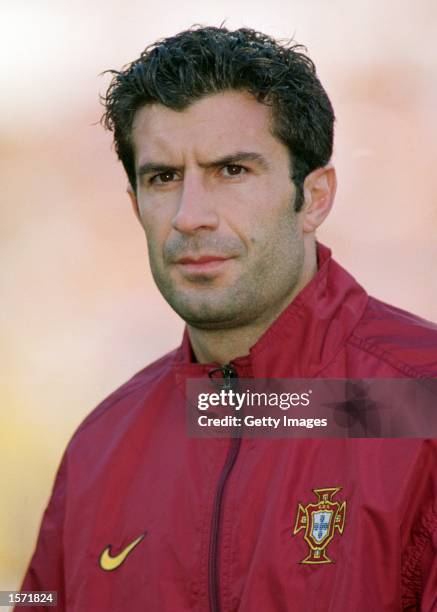
Luís Figo
 Portugal
Birthday
November 4, 1972
Birth Sign
Scorpio
Birthplace
Almada, Portugal
Age
53 years old
Height
5 ft 11 in (180 cm)
About
Luís Filipe Madeira Caeiro Figo is a Portuguese former professional footballer widely regarded as one of the greatest wingers in the history of the sport. Over a career spanning two decades, he played for Sporting CP, Barcelona, Real Madrid, and Inter Milan, winning major trophies at every club. Figo won the Ballon d'Or in 2000 and was named FIFA World Player of the Year in 2001. He earned 127 caps for Portugal, a national record at the time, scoring 32 goals and leading his country to the final of Euro 2004. Known for his elegant dribbling, pinpoint crossing, and tactical intelligence, Figo was a creative force on the right wing. His controversial transfer from Barcelona to Real Madrid in 2000 set a world record fee of €62 million and became one of football's most talked-about moments. Today, Figo works as a football advisor for UEFA and serves as a Goodwill Ambassador for the Stop Tuberculosis Partnership, staying active in the sport he helped define. He is also a leading figure in UEFA's ambassador programme.
Early Life & Background
Figo was born on 4 November 1972 in Almada, Portugal. He grew up in the Lisbon suburb and joined Sporting CP's youth academy as a boy. He was part of Portugal's celebrated Golden Generation, winning the U-16 and U-20 European Championships alongside future stars Rui Costa and João Pinto. His professional debut for Sporting CP came in 1989, and he quickly established himself as a dynamic winger. By 1995, he had helped the club win the Portuguese Cup. Off the pitch, Figo completed only 11 years of formal schooling before turning fully to football. He later finished secondary school (12th grade) at age 38 in 2011 through a special skills certification programme, showing his dedication to education. He also studied business management through a nine-month course at IESE in Madrid.
Career Growth
Figo's breakout came after his 1995 transfer to Barcelona, where he won the UEFA Cup Winners' Cup in 1997 and back-to-back La Liga titles in 1998 and 1999. His dazzling performances earned him the Ballon d'Or in 2000 while still at Barcelona. That summer, his shock move to arch-rivals Real Madrid for a world-record €62 million made global headlines. At Real Madrid, he won two La Liga titles (2001, 2003), the UEFA Champions League in 2002, and the Intercontinental Cup in 2002, playing alongside Zinedine Zidane, Ronaldo, and David Beckham in the Galactico era. He was named FIFA World Player of the Year in 2001. In 2005, Figo moved to Inter Milan, where he won four consecutive Serie A titles (2006–2009), an Italian Cup in 2006, and three Italian Super Cups (2006, 2007, 2009). He retired on May 31, 2009, after a trophy-laden career. For Portugal, he captained the team to the Euro 2004 final and the 2006 World Cup semi-finals.
Career Timeline
Public Image & Style
Figo's public image is defined by elegance and technical brilliance on the pitch. He was known for his quickness, close ball control, and ability to beat defenders one-on-one. Off the field, he is seen as a calm, business-savvy figure. His transfer to Real Madrid made him a villain in Catalonia, where he was famously jeered and had a pig's head thrown at him during a match at Camp Nou. Despite the controversy, Figo's legacy as one of football's greatest wingers remains intact. He is admired for his vision and creativity, and fans remember him as a key figure in two of Europe's biggest clubs. In 2004, he was named by Pelé in the FIFA 100 list of the world's greatest living players.
Fame & Fandom
Luís Figo's legacy is not built on a singular, organized fan club with specific rituals or a branded name. Instead, his audience spans the globe as a collective of football enthusiasts who revere his technical mastery and the drama of his career. While he commands millions of followers on social media platforms like Instagram, these connections remain standard for a sports icon rather than evolving into the elaborate, ceremonial culture seen in music or entertainment. There are no documented fan-funded subway ads, dedicated birthday billboards, or internal jokes that define a unified movement around him. His mythology rests firmly on the pitch: the elegance of his dribbling, the historic 2000 transfer to Real Madrid that turned fans against him in Catalonia, and his recent role as a sharp critic of football governance. The story of the pig's head thrown at him during a match remains the defining moment of his polarizing status, cementing a narrative where he was simultaneously a hero and a villain. This complex history has kept him relevant long after retirement, transitioning him from a player to a business mogul and outspoken voice in the sport's administration. Despite the lack of a formal fandom name, his influence persists through his continued presence in high-profile business ventures and public statements regarding FIFA leadership. According to the latest data from the iFANN Global Fame Rankings, Luís Figo is currently the 14th most famous person in Portugal and stands as the 8th most famous person from Portugal, holding steady positions in the global consciousness.
Interesting Facts and Legends
Luís Figo is one of the few players in history to have represented both Barcelona and Real Madrid, clubs that share an intense rivalry. His controversial move between them involved a massive transfer clause with Florentino Pérez, which included a penalty of 5 billion pesetas if he refused to leave Barcelona. Beyond the pitch, Figo has built a diverse empire, founding Network90, a private networking site for football professionals, and owning businesses across hotels, fashion, catering, mining, and wine sectors. In 2010, he launched Damash Assets, a mining company, while also co-owning an upscale bar in Vilamoura and a hotel in Carvoeiro within Portugal's Algarve region. Standing at 1.80 meters tall, his physical stature belied his agility and tactical intelligence. A legendary chapter of his life involves the infamous incident at Camp Nou, where angry Barcelona supporters threw a pig's head at him following his switch to their arch-rivals. This event became a symbol of the fierce divide in Spanish football. More recently, in August 2026, Figo entered new territory by publicly attacking FIFA President Gianni Infantino, calling for his resignation and labeling him deceitful. These actions highlight his evolution from a celebrated athlete to a formidable critic of modern football administration.
Family & Personal Life
Figo married Swedish model Helen Svedin in 2000. The couple has three daughters: Daniela (born 1999), Martina (born 2002), and Stella (born 2004). The family resides primarily in Madrid and Lisbon. Figo's parents were not publicly prominent, and he has rarely discussed them in interviews. He is known to value family privacy, but his wife and daughters occasionally appear at public events. Figo's full name includes the honorific OIH, indicating he was awarded the Order of Prince Henry.
Notable Connections
Relationships & Dating History
Figo's only known serious relationship is with Swedish model Helen Svedin. The couple began dating in the late 1990s and married in 2000. They have three daughters together: Daniela (born 1999), Martina (2002), and Stella (2004). The marriage has remained stable, with the family living between Madrid and Lisbon. As of 2026, Figo is still married to Svedin, and no other public relationships have been reported.
- MarriedHelen Svedin2000 - presentCurrentSwedish model; married in 2000, three daughters together.
Salary, Net Worth In 2026
$60 Million
iFANN Editorial Team estimate
Per iFANN's editorial analysis, Luís Figo's net worth is estimated at $60 million as of 2026. This substantial fortune accumulated primarily through his illustrious football career, playing for top clubs such as Sporting CP, Barcelona, Real Madrid, and Inter Milan. His transfer from Barcelona to Real Madrid in 2000 set a world record at the time, marking a pivotal financial moment in his trajectory. Beyond base salaries, he earned significant income from endorsement deals with global brands like Nike and Pepsi. Post-retirement, Figo has diversified his wealth through strategic investments in real estate and various business ventures, including a hotel chain in Portugal. He serves as a brand ambassador for multiple companies, further bolstering his financial standing. While his social media presence generates some revenue, it remains a minor contributor compared to his established business portfolio and past earnings.
Awards Won (22)
Figo won the Ballon d'Or in 2000 and was named FIFA World Player of the Year in 2001. He also won multiple league titles: four La Liga titles (two with Barcelona, two with Real Madrid) and four Serie A titles with Inter Milan. In European competition, he won the UEFA Champions League in 2002 and the UEFA Cup Winners' Cup in 1997. Domestically, he won the Portuguese Cup in 1995, the Spanish Cup twice, and the Italian Cup once. He also won the Intercontinental Cup in 2002 and several Super Cups.
2000 · Best Player
FC Barcelona
2001 · Best Player
Real Madrid
Known For
Ballon d'Or Winner
2000 · Player
FIFA World Player of the Year
2001 · Player
UEFA Champions League Winner
2002 · Player
Real Madrid Galactico
2000-2005 · Winger
Keywords
Sources
Quick Facts
- Profession
- association football player
- Born
- November 4, 1972
- Birthplace
- Almada, Portugal
- Gender
- Male
- Spouse
- Helen Svedin
- Birth Sign
- Scorpio
- Height
- 5 ft 11 in (180 cm)
- National Team Caps
- 127
Personal Details
- Full Name
- Luís Filipe Madeira Caeiro Figo
- Height
- 5 ft 11 in (180 cm)
- Spouse
- Helen Svedin
- Children
- Three daughters: Daniela (born 1999), Martina (born 2002), Stella (born 2004)
- Education
- 11th grade; completed secondary school (12th grade) in 2011 via a special skills certification programme
Frequently Asked Questions
How old is Luís Figo?
What is Luís Figo's net worth in 2026?
Is Luís Figo still involved in football?
Why is Luís Figo famous?
How many children does Luís Figo have?

Join the community
fans discussing