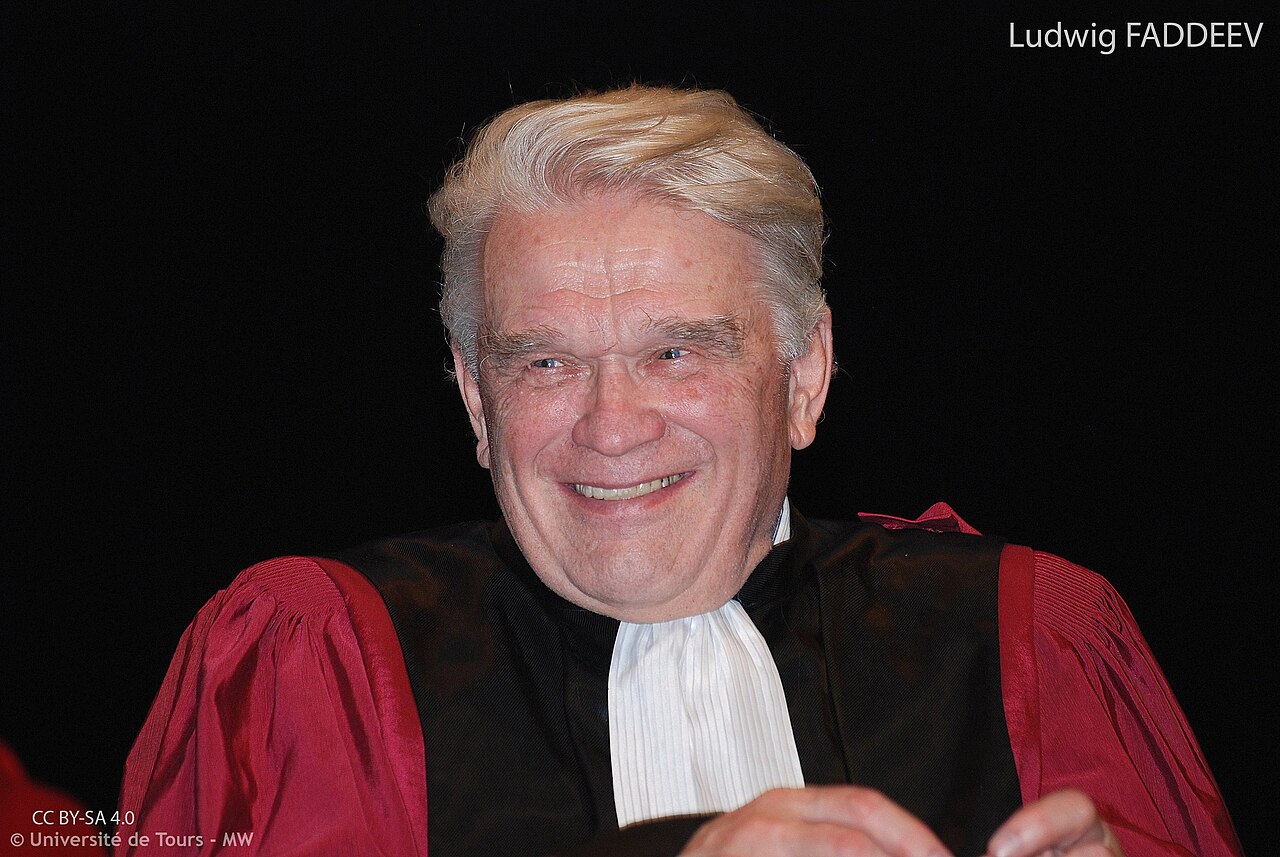
Ludvig Faddeev
 Russia
Also known as: Ludwig Faddeev
Birthday
March 23, 1934
Birth Sign
Aries
Birthplace
Saint Petersburg, USSR
Age
Died at 82
About
Ludvig Faddeev was a towering figure in modern mathematical physics, a Soviet and Russian mathematical physicist whose groundbreaking work reshaped how physicists understand quantum systems. He is globally recognized for the Faddeev equations, which provided a rigorous solution to the quantum three-body problem, and for the Faddeev-Popov ghosts, a crucial tool for quantizing non-abelian gauge theories. His profound influence extended through the Leningrad School, an institution he led for decades, nurturing a generation of physicists who developed the quantum inverse scattering method. Faddeev was a distinguished member and secretary of the Russian Academy of Sciences, and his theoretical contributions remain foundational in mathematical physics. He passed away on February 26, 2017, in Saint Petersburg, at the age of 82, leaving behind a rich legacy celebrated through conferences and posthumous honors.
Early Life & Background
Ludvig Dmitrievich Faddeev was born on March 23, 1934, in Saint Petersburg, then part of the Soviet Union. His father, Dmitri Faddeev, was a prominent algebraist and professor at St. Petersburg State University, likely shaping Ludvig's early exposure to rigorous mathematical thought. Faddeev pursued his higher education at St. Petersburg State University, where he earned his Ph.D. in 1959. His early academic endeavors focused on complex mathematical problems within quantum mechanics, particularly the scattering theory of quantum particles. By the early 1960s, he began tackling the notoriously difficult quantum three-body problem, a challenge that had eluded physicists for decades. His breakthrough came with the formulation of the Faddeev equations, a rigorous mathematical framework for describing the intricate interactions of three particles at the quantum level. This seminal work, completed while he was still in his twenties, immediately established him as a leading figure in mathematical physics and laid the essential groundwork for his subsequent, transformative contributions to quantum field theory.
Career Growth
Faddeev's ascent in the scientific community was propelled by his early work on the three-body problem. In the late 1960s, he shifted his focus to the complex challenge of quantizing non-abelian gauge theories, a problem of paramount importance to the Standard Model of particle physics. Collaborating with Victor Popov, he introduced the Faddeev-Popov ghosts, a vital mathematical construct that enabled physicists to correctly quantize these theories, a development that became a cornerstone of modern quantum field theory. In the 1970s, Faddeev established the Leningrad School of mathematical physics, a vibrant hub that attracted brilliant minds and spurred the development of the quantum inverse scattering method. This innovative method proved indispensable for solving integrable systems, paving the way for the creation of quantum groups by Vladimir Drinfeld and Michio Jimbo. Faddeev also served as the secretary of the Russian Academy of Sciences for many years, significantly influencing the direction of physics research across the Soviet Union and Russia. His enduring legacy is further honored through the Faddeev Medal, established in his memory and first awarded in 2018 to Rudolf Grimm and Vitali Efimov.
Career Timeline
Public Image & Style
Within the global community of mathematical physics, Faddeev was universally revered as a towering intellect and a guiding force. Colleagues and former students consistently described him as a scientist driven by a deep appreciation for mathematical beauty, perpetually seeking elegant and profound solutions. He was renowned for his lucid and inspiring lectures, possessing a remarkable ability to ignite curiosity and passion in young researchers. The Leningrad School he meticulously built became a legendary institution, fostering a new generation of physicists who would go on to make their own significant contributions. Faddeev's public image was that of an intensely dedicated scientist who prioritized deep, fundamental understanding over superficial or fleeting results. His profound impact on the field is continuously celebrated through international conferences and the prestigious Faddeev Medal.
Fame & Fandom (iFAMOUS Rankings)
Ludvig Faddeev does not currently hold a placement in the iFANN Global Top 1,000 or any Top-100 scope list. The iFANN Global Fame Engine evaluated his standing but found no ranking data for this mathematical physicist as of August 2026. While he commands absolute reverence within the corridors of theoretical physics, his influence never translated into a celebrity fandom with a formal name or public rituals. There are no fan clubs, birthday billboards, or organized campaigns driven by admirers because Faddeev was a titan of science rather than a pop culture icon. His audience consisted exclusively of mathematicians and physicists who revered his work on the quantum three-body problem and gauge theories. Unlike entertainers who generate viral moments or street-side memorials, Faddeev's legacy is measured in equations and academic lineages rather than search trends or merchandise sales. The lack of a documented fanbase name reflects the reality that his fame was confined to the rigorous world of academia. He died in 2017 without ever cultivating the kind of mass-market adoration that defines modern celebrity. His 'fans' were colleagues and students who carried forward his intellectual traditions through decades of research. No subway ads or streaming campaigns exist for him because there was no commercial product to promote. The silence of the general public regarding his name contrasts sharply with the loud applause he received from the scientific community. This absence of a popular following underscores his status as a pure scientist whose impact remained within the bounds of specialized knowledge.
Interesting Facts and Legends
Ludvig Faddeev mentored 18 Ph.D. students, creating an academic lineage of roughly 200 descendants that stands as a reflection of his teaching prowess. He instilled a philosophy where mathematical beauty served as the primary compass for physical discovery. The Faddeev-Popov ghosts remain one of his most cited concepts; despite their spectral name, they are purely abstract tools for quantizing non-abelian gauge theories, not physical particles. An esteemed member of the Russian Academy of Sciences, he also held foreign memberships in prestigious international bodies. His fluency in multiple languages allowed him to navigate global conferences with ease throughout his career. A verified moment of historical significance occurred on February 26, 2017, when Faddeev passed away, marking the end of an era for Soviet-era physics. Following his death, institutions like the Joint Institute for Nuclear Research issued memorial notices, and the CQIS-2017 conference was convened in his honor. His mentorship continues to yield results, evidenced by former associate Samson Shatashvili winning the 2025 Dannie Heineman Prize for Mathematical Physics. No folklore or viral legends surround his life, as his reputation rests entirely on rigorous scientific output rather than dramatic anecdotes or extraordinary crowd reactions.
Family & Personal Life
Ludvig Faddeev was the son of Dmitri Faddeev, a well-known algebraist and professor at St. Petersburg State University. His father's distinguished academic career undoubtedly influenced Ludvig's own profound engagement with mathematics. While specific details about his mother, siblings, or his own immediate family are not widely publicized, he was married and had children. He spent the majority of his life in Saint Petersburg, the city of his birth, where he lived and conducted his influential research until his passing.
Notable Connections
Relationships & Dating History
Information regarding Ludvig Faddeev's personal relationships is not extensively documented. He was married, though the name of his spouse is not widely recorded in public sources. He also had at least one child, but details concerning his family members are kept private. As an individual who valued his privacy, Faddeev largely kept his personal life separate from his public scientific career. At the time of his death, he was married.
Death & Aftermath
Died
February 26, 2017 (aged 82)
Death Place
Unknown
Cause of Death
Unknown
Ludvig Dmitrievich Faddeev, the preeminent Soviet and Russian mathematical physicist known for the Faddeev equations in quantum mechanics, died on February 26, 2017. He was 82 years old at the time of his death, having been born on March 23, 1934, in Leningrad, USSR.
The public reaction to Faddeev's death was marked by tributes from the international scientific community and institutions dedicated to mathematical physics. The Joint Institute for Nuclear Research held a memorial conference, CQIS-2017: in memory of Ludvig Faddeev, starting on July 24, 2017, in the Bogoliubov Laboratory of Theoretical Physics. This event served as a formal gathering to honor his legacy following his passing later that same year. Additionally, the Royal Society published a detailed biography and tribute in their Biographical Memoirs, recognizing him as a "preeminent mathematical physicist." The academic community's response was characterized by high-profile conferences and scholarly publications dedicated to his contributions to quantum field theory and gauge field theories.
In terms of posthumous recognition, the most significant honor noted is the establishment of the Faddeev Medal. Inaugurated shortly after his death, the medal was awarded to physicists Rudolf Grimm and Vitali Efimov for their historical contributions to physics, specifically related to Faddeev's work. The Royal Society continued to acknowledge his legacy through the publication of his biographical memoir in 2022. While the search results do not specify the date, location, or nature of a funeral service, nor do they list notable attendees or whether he was buried or cremated, the primary documented posthumous event remained the CQIS-2017 conference organized by JINR in July 2017.
Net Worth (Estate Value)
$2 Million
iFANN Editorial Team estimate
iFANN currently estimates Ludvig Faddeev's net worth at $2 Million. This valuation reflects his distinguished career as a professor and researcher within the Soviet and Russian academic systems, where compensation structures differed significantly from those in Western countries. His estate continues to benefit from royalties generated by his extensive published works and influential academic textbooks. The Faddeev Medal, established in his honor, is financially supported by the University of Innsbruck and does not directly impact his estate's value. Consequently, much of his financial legacy is intrinsically tied to his academic contributions rather than readily liquid assets.
Awards & Accolades
View 2 records, honours and achievementsKnown For
Faddeev equations
1960 · Formulated the quantum three-body problem
Faddeev-Popov ghosts
1967 · Co-developed with Victor Popov
Quantum inverse scattering method
1975 · Led the Leningrad School development
Keywords
Sources
Quick Facts
- Profession
- Mathematical physicist
- Born
- March 23, 1934
- Birthplace
- Saint Petersburg, USSR
- Died
- February 26, 2017
- Death Place
- Saint Petersburg, Russia
- Gender
- Male
- Birth Sign
- Aries
- Ph.D.
- St. Petersburg State University, 1959
Personal Details
- Full Name
- Ludvig Dmitrievich Faddeev
- Education
- Ph.D. from St. Petersburg State University, 1959
Frequently Asked Questions
Who was Ludvig Faddeev?
What is Ludvig Faddeev's net worth in 2026?
What did Ludvig Faddeev die from?
What is Ludvig Faddeev best known for?
Is Ludvig Faddeev still alive?
Similar People

Join the community
fans discussing