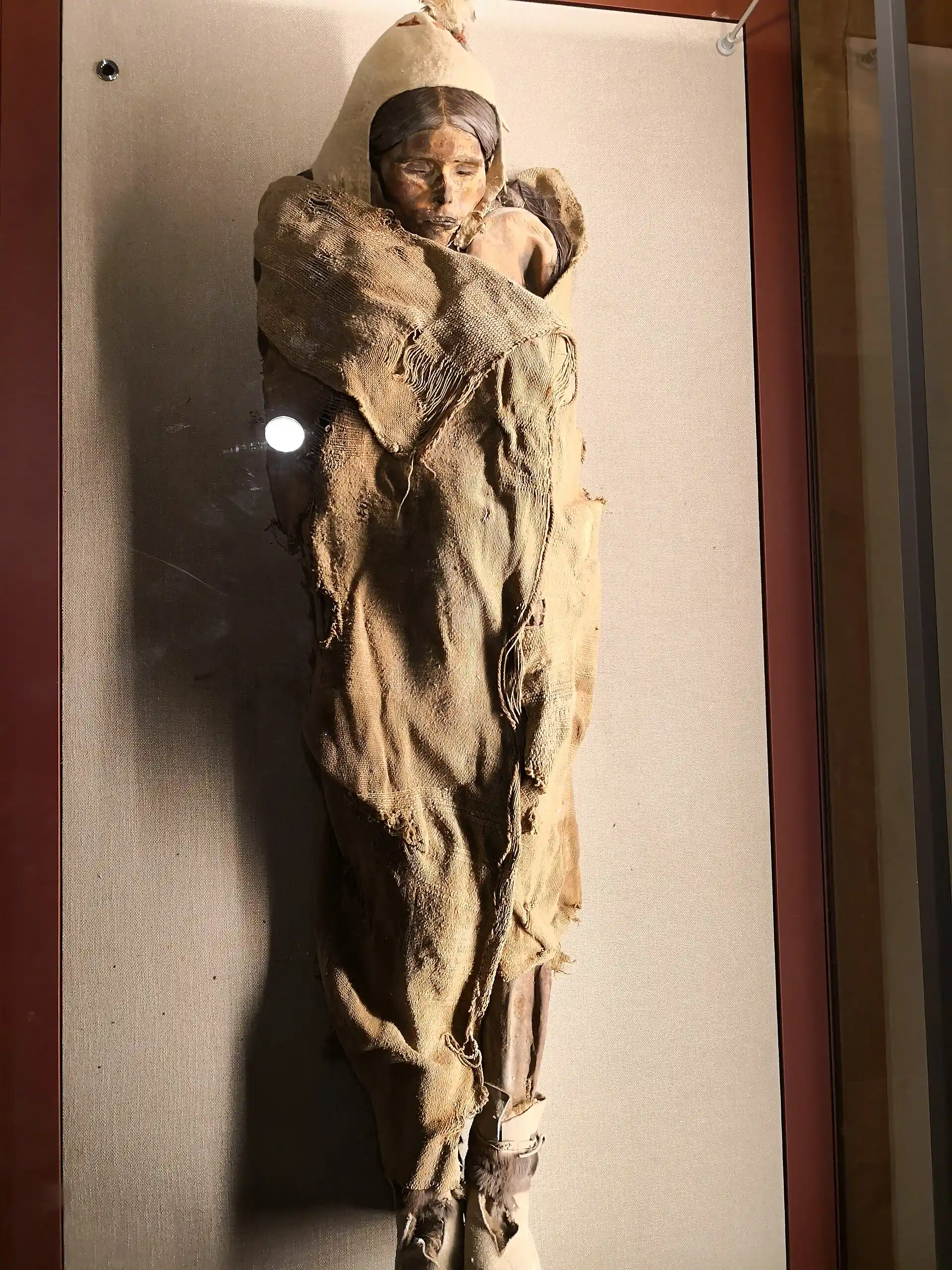
Loulan Beauty
 China
Also known as: Beauty of Krorän, Loulan Beauty
Birthday
-1900
Birth Sign
Capricorn
Birthplace
Tarim Basin, Ruoqiang County, Xinjiang, China
Age
Unknown
Height
5 ft 2 in (158 cm)
About
The Beauty of Loulan was the preserved corpse of a woman who lived during the Bronze Age in what is now the Ruoqiang County of Xinjiang, China. She dates back to approximately 1800 BC and stands as one of the most exceptionally well-preserved mummies ever discovered. Unlike Egyptian mummies created through intentional embalming rituals, this body was naturally desiccated by the extreme aridity of the Taklamakan Desert. Her discovery challenged long-held assumptions about the ethnic composition of ancient East Asian populations due to her distinct Caucasian features and reddish-brown hair.
Found in 1980, the mummy has become a focal point for archaeological research into the migration patterns of Indo-European peoples into Central Asia. Genetic testing conducted in 1993 and later confirmed by Chinese researchers in 2007 and 2009 revealed a mix of Western and Eastern Eurasian ancestry. The remains are currently housed in the Xinjiang Uygur Autonomous Region Museum in Urumqi, where they remain a protected cultural relic.
Early Life & Background
The woman known today as the Loulan Beauty lived in the Tarim Basin roughly between 1900 BC and 1800 BC, a time when written history had not yet recorded individual lives. She was a member of the indigenous population of the region, likely part of the Tocharian people or a related Indo-European group. Her upbringing took place in the harsh environment of the Taklamakan Desert, near the ancient city of Loulan, which served as a crucial stop on the Silk Road. Life here required adaptation to extreme temperatures and scarce water sources.
Her existence remained unknown to the modern world until April 1, 1980, when Chinese archaeologist Mu Shunying discovered her body while excavating near the dried-up Lop Nur lake bed. The desert conditions had naturally mummified her tissues, preserving her skin, hair, and facial features in remarkable detail without any human intervention. She was buried alongside other individuals, including infants and children, suggesting a communal burial site used by her community. This discovery occurred nearly four thousand years after her death, marking the beginning of her journey from a forgotten Bronze Age resident to a globally recognized archaeological specimen.
Career Growth
As an ancient mummy, the Loulan Beauty did not pursue a career in the traditional sense, nor did she hold professional roles or artistic projects during her lifetime. Her significance lies entirely in her contribution to the fields of archaeology and anthropology. Her primary achievement is serving as one of the most famous and best-preserved Tarim mummies ever found, providing critical data for understanding the genetic diversity and migration patterns of the region during the Bronze Age.
Since her discovery in 1980, her legacy has grown through scientific study rather than professional output. In 1993, DNA samples were smuggled out of China for testing, revealing her European ancestry and sparking intense academic debate. Further studies by Chinese researchers in 2007 and 2009 corroborated these findings. A facial reconstruction created in 2004 based on skeletal analysis generated widespread media coverage, bringing her image to the public eye. Today, she continues to be the subject of documentaries, news reports, and online exhibitions, cementing her status as a pivotal figure in the study of ancient Central Asian history.
Career Timeline
Public Image & Style
Her public image is that of a mysterious, ancient artifact representing the enigmatic past of Central Asia. Media portrayals focus on her striking appearance, her sleeping state, and the scientific secrets she holds. She is often depicted in documentaries and educational materials as a window into the Bronze Age. The contrast between her Caucasian features and her location in China has made her a subject of enduring fascination and debate regarding the ethnic history of the region.
Fame & Fandom (iFAMOUS Rankings)
iFANN has not yet collected fame data for the Loulan Beauty, so she is not currently ranked in the Global Fame Rankings. She is not on the September 2026 iFAMOUS Rankings flagship list. While she attracts significant interest from history enthusiasts, archaeology students, and general audiences, this does not constitute a fandom in the pop culture sense. Fans do not engage in streaming pushes, birthday billboards, or charity drives for her. Instead, her audience consists of those interested in ancient history and archaeology who follow updates on the Tarim Basin mummies through museums and academic publications.
Interesting Facts and Legends
The Loulan Beauty is often called the Sleeping Beauty of Loulan because her uncanny preservation allows viewers to see her facial features and hair as they appeared over three millennia ago. Unlike the intentional mummification of ancient Egypt, her body was preserved almost entirely by accident due to the unique environmental conditions of the Taklamakan Desert. Her DNA analysis revealed a mix of Western Eurasian and Eastern Eurasian ancestry, challenging the long-held belief that the region was exclusively populated by East Asians during the Bronze Age.
She lived in the vicinity of the ancient Kingdom of Loulan, a vital hub on the Silk Road, though it is unclear if she was a local resident or a traveler. While she does not appear to have visible tattoos like some other Tarim mummies, her discovery helped pave the way for the study of tattooed mummies found in the same region. A notable moment in her lore occurred in 2008 when a New York Times article highlighted the tension between her scientific findings of European ancestry and the Chinese government's preference for narratives emphasizing a unified, indigenous Han identity.
Family & Personal Life
There is no information regarding the Loulan Beauty's parents, siblings, or extended family members. As a Bronze Age individual whose life predates written records, her kinship ties remain unknown. She died of undetermined natural causes, likely due to illness or complications associated with her time period, though the exact cause remains unconfirmed. There is no evidence of spouses, children, or romantic partners, and any speculation regarding her marital status or offspring is purely hypothetical and unsupported by archaeological evidence. She was interred in a coffin made of cowhide and wood, wrapped in woolen fabrics, consistent with the burial practices of the era.
Notable Connections
Mu Shunying, Xinjiang Uygur Autonomous Region Museum, Tocharian people, Tarim Basin mummies
Relationships & Dating History
The Loulan Beauty has no recorded personal life, family, or relationships. There is no information regarding parents, siblings, spouses, children, or romantic partners. Consequently, there is no dating history, marriage, divorce, or widowhood to report. Any speculation regarding her marital status or offspring is purely hypothetical and unsupported by archaeological evidence. She died of undetermined natural causes, likely due to illness or complications associated with her time period, though the exact cause remains unconfirmed.
Death & Aftermath
Died
-1800
Death Place
Ruoqiang County, Xinjiang, China
Cause of Death
Undetermined natural causes
The Loulan Beauty died in the Bronze Age, approximately three thousand eight hundred years ago, within the arid expanse of the Taklamakan Desert near the ancient Kingdom of Loulan. Her body was preserved naturally by the dry climate, which desiccated her tissues before decomposition could occur, leaving her in an exceptional state of conservation for millennia. No records exist regarding her final days, last public appearance, or the specific circumstances surrounding her passing, as these events predate written history and formal medical examination by thousands of years. Archaeological investigation following her discovery in 1980 revealed she was a Caucasian woman with reddish-brown hair, likely a member of the Tocharian people or related Indo-European groups living along the Silk Road, though her exact status as a local resident, traveler, or sacrifice remains unconfirmed.
The discovery of the mummy initiated scientific study rather than legal proceedings or police investigations, with researchers utilizing radiocarbon dating and DNA analysis to determine her age and genetic lineage. These studies confirmed her European ancestry, challenging previous historical narratives about early populations in East Asia and sparking significant international discussion among scholars regarding the origins of peoples in the Tarim Basin. Public reaction has been limited to academic fascination and global interest in ancient history, with the figure featured in numerous documentaries and news reports since her recovery. No formal funeral service was held at the time of her death, as burial practices of the era involved interment in a coffin made of cowhide and wood wrapped in woolen fabrics.
Following her rediscovery, the Chinese state assumed ownership of the remains as a cultural relic, housing the Loulan Beauty in the Xinjiang Uygur Autonomous Region Museum in Urumqi where she serves as a permanent exhibit for preservation and display.
Net Worth (Estate Value)
$0
iFANN Editorial Team estimate
The Loulan Beauty has no net worth, salary, business ventures, or real estate holdings. As a human remains classified as a national cultural relic, she cannot be owned, bought, or sold. The Chinese state maintains ownership of the remains. Any financial figures associated with her are related to museum ticket sales, research grants, or tourism revenue generated by the museum housing her, none of which constitute personal wealth. The iFANN Editorial Team estimates her value as a cultural asset at $0, as she is property of the state and not a commercial entity.
Awards & Accolades
View 3 records, honours and achievementsKnown For
Beauty of Loulan
1980 · Mummy Discovery
Keywords
Sources
Quick Facts
- Born
- -1900
- Died
- -1800
- Gender
- Female
- Discovery Date
- April 1, 1980
- Height
- 5 ft 2 in (158 cm)
- Hair Color
- Reddish-brown
Personal Details
- Height
- 5 ft 2 in (158 cm)
- Children
Frequently Asked Questions
What ethnicity were the Loulan Beauty?
How old is the Loulan Beauty?
Where was the Loulan Beauty found?
Why is the Loulan Beauty famous?
Is the Loulan Beauty still on display?
Similar People
Join the community
fans discussing