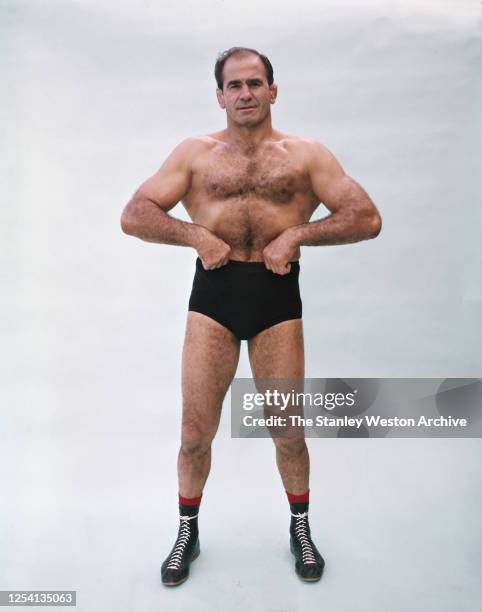
Lou Thesz
 United States
Also known as: Aloysius Martin Thesz, Tetsujin, God of Wrestling
Birthday
April 24, 1916
Birth Sign
Taurus
Birthplace
Banat, Michigan, USA
Age
Died at 86
Height
6 ft 0 in (183 cm)
About
Lou Thesz was an American professional wrestler and coach, widely regarded as one of the greatest wrestlers in history and the last globally accepted world champion. Born Aloysius Martin Thesz on April 24, 1916, in Banat, Michigan, he dominated the sport for decades with a technical, submission-based style rooted in catch wrestling. Thesz won the NWA World Heavyweight Championship three times, holding it for a combined 3,749 days — longer than anyone else. Known as a true "shooter," he could legitimately defeat opponents if a match turned real. In Japan, he was revered as the "God of Wrestling" and "Tetsujin" (Ironman) for his conditioning and skill. Thesz also trained generations of Japanese wrestlers and mixed martial artists alongside Karl Gotch and Billy Robinson. He was inducted into multiple halls of fame, including the inaugural class of the George Tragos/Lou Thesz Professional Wrestling Hall of Fame, which he helped establish. Fans and historians alike celebrate him as the gold standard of professional wrestling.
Early Life & Background
Lou Thesz grew up in St. Louis, Missouri, where his father Martin, a German immigrant and former competitive wrestler, began training him at age six. Martin was strict and disciplined, believing wrestling was a path to a better life. Lou attended St. Louis public schools but left formal education early to focus on wrestling. As a teenager, he won the YMCA amateur wrestling championship and, at 16, claimed the Missouri State Amateur Wrestling Championship in the 175-pound division. That victory caught the attention of promoters. He then trained at the St. Louis Wrestling Club under Tom Packs, learning the craft of professional wrestling and honing his skills as a legitimate shooter.
Career Growth
Lou Thesz made his professional debut at age 16 in St. Louis in 1932. He won his first major title, the Missouri State Heavyweight Championship, in 1934. In 1936, he captured the AWA World Heavyweight Championship, his first world title. A year later, he won the NWA World Heavyweight Championship, beginning his first reign. Thesz's second NWA reign began in 1948 when he defeated Orville Brown in a unification match that consolidated multiple world titles. He held the belt continuously for 7 years, 8 months — one of the longest reigns in history. In 1952, he defended the title against Japanese legend Rikidozan in Tokyo, a match that helped popularize professional wrestling in Japan. Thesz regained the NWA title for a third and final time in 1957, holding it until 1963 when he lost to Buddy Rogers. He continued wrestling internationally into the 1970s, particularly in Japan, where he became a cultural icon. He later served as head coach at the CACC Snake Pit Japan, training a new generation of wrestlers in catch wrestling.
Career Timeline
Public Image & Style
Lou Thesz was known for his clean-cut, athletic look and serious, no-nonsense demeanor. He wore classic wrestling trunks and boots, contrasting with the flamboyant characters that emerged later. Media and fans universally portray him as a "shooter" — a legitimate wrestler who could actually fight. His matches were technical, submission-based, and methodical, emphasizing real grappling skills over entertainment. In Japan, he was revered as the "God of Wrestling" and "Tetsujin" (Ironman). Fans of Thesz often study his matches for technical knowledge, and he is celebrated in catch wrestling communities. His legacy accounts on social media post historical photos, match clips, and quotes from his autobiography, keeping his memory alive among wrestling historians.
Fame & Fandom (iFAMOUS Rankings)
Lou Thesz remains the bedrock of professional wrestling history, a figure whose legacy is preserved not through viral social media campaigns or organized fan clubs, but through the enduring institutions he helped build. The wrestling community itself serves as his primary fandom, treating him as the ultimate standard of technical excellence and integrity. This reverence is institutionalized in the George Tragos/Lou Thesz Pro Wrestling Hall of Fame, established specifically to honor his name and induct new generations of talent, and the annual Lou Thesz Award presented by the Cauliflower Alley Club, which recognizes individuals who embody his character. From local honors in Waterloo, Iowa, to global recognition in the WWE Hall of Fame, his influence permeates every era of the sport. Fans do not chant his name with a specific slogan or gather for digital billboards; instead, they revere him as the last globally accepted world champion and the man who refused to compromise his legitimacy for entertainment. His story is one of quiet dominance, where the legend of being the only man who could legitimately defeat anyone in the ring cemented his status as the "God of Wrestling" in Japan and the gold standard in America. While modern stars chase fame, Thesz built a foundation that still supports the industry today. According to iFANN's Global Fame Engine evaluation conducted in August 2026, Lou Thesz does not currently hold a placement in the published rankings, including the Global Top 1,000 or any Top-100 scope list. Consequently, no specific ordinal rank or score is assigned to his current global standing.
Interesting Facts and Legends
The signature move known as the "Thesz Press," a running knee drop to a prone opponent, was named by fans rather than the wrestler himself. A strict teetotaler and non-smoker, Thesz maintained his legendary physique through daily training and once turned down lucrative offers to throw matches, preserving his integrity as a legitimate competitor. He wrestled his final match at age 74 in 1990, defeating a much younger opponent, and authored the classic autobiography "Hooker: An Authentic Wrestler's Adventures Inside the Bizarre World of Professional Wrestling." Beyond the ring, he helped train early mixed martial artists, including members of the original UFC and Pancrase organizations. A widely retold story from his career highlights his reputation as the undisputed "real" world heavyweight champion; legends claim that if Thesz felt disrespected, he would actually attack opponents, a narrative verified by his background as an amateur wrestler and his refusal to work matches unless necessary. Another persistent tale from his 1937 title win against Everett Marshall describes the moment he launched a career defined by dominance, often referenced as the beginning of the "Thesz Era." These stories are not mere folklore but historical facts that underscore his status as the greatest technician to ever grace the ring.
Notable Quotes
“I never threw a match in my life. If I was supposed to lose, I'd make the other guy earn it.”
“Wrestling is not a fake sport. It's a simulated sport. There's a difference. The moves are real. The athleticism is real. The only thing that's predetermined is the winner.”
“Thesz Press was just a knee drop. I didn't name it. The fans did. I just did what worked.”
“I trained every day of my life. When other wrestlers were drinking and carousing, I was in the gym. That's why I lasted so long.”
“The business changed. It became about entertainment, not wrestling. That's fine, but don't call it what I did.”
Family & Personal Life
Lou Thesz was born to Martin Thesz, a German immigrant and shoemaker who had been a competitive wrestler in Germany, and his wife. The family moved to St. Louis when Lou was a child. He married Dorothy Thesz in 1949, and they remained together until his death in 2002. They had two children: a son and a daughter. Dorothy managed many aspects of his career and helped preserve his legacy. Thesz was known for his discipline and rigorous training regimen, values instilled by his father. He had no other siblings mentioned in public records.
Notable Connections
Lou Thesz trained and worked with many legendary figures. Karl Gotch and Billy Robinson were his training partners and fellow shooters, together establishing catch wrestling in Japan. He faced Rikidozan in a historic 1952 match that made him a legend in Japan. Thesz defeated Orville Brown in a 1948 unification match and lost the NWA title to Buddy Rogers in 1963. He mentored Antonio Inoki and Yoshiaki Fujiwara, who became Japanese wrestling icons. His early promoter was Tom Packs.
Relationships & Dating History
Lou Thesz was married three times. His first marriage, around 1940, ended in divorce around 1948; little is publicly known about this relationship, and no children were recorded. In 1949, he married Dorothy Thesz, who became his lifelong partner. They remained together until his death in 2002. Dorothy was his constant companion throughout his career and later years, managing many aspects of his professional life and helping preserve his legacy. They had two children: a son and a daughter. Thesz was famously private about his personal life, and no other high-profile relationships, engagements, or rumored pairings are confirmed by credible sources. As of 2026, Thesz is deceased, and at the time of his death, he was married to Dorothy.
- MarriedUnknown1940 - 1948First marriage; little is publicly known. Ended in divorce.
- MarriedDorothy Thesz1949 - 2002Longest relationship; married until his death. Had two children together. Dorothy managed his career and legacy.
Death & Aftermath
Died
April 28, 2002 (aged 86)
Death Place
St. Joseph, Missouri, USA
Cause of Death
Natural causes due to old age
The wrestling world's reverence for Lou Thesz remains vivid, anchored by the annual Lou Thesz Award presented by the Cauliflower Alley Club and the ongoing inductions into the George Tragos/Lou Thesz Pro Wrestling Hall of Fame in Waterloo, Iowa. Recent tributes continue to highlight his impact, with Bret Hart scheduled to receive the award in June 2026, while lost footage of his legendary matches resurfaced in 2025 to remind new generations of his technical mastery. These honors cemented a legacy that outlasted his physical presence, ensuring his name remained central to discussions on professional wrestling history. Thesz passed away on April 28, 2002, at the age of 86 in St. Joseph, Missouri, the city where he had lived for much of his life and maintained significant influence over the sport.
While specific details about his immediate last public appearance or the medical events leading up to April 28 remain unreported, the community accepted the event without dispute. Public reaction was characterized by deep respect from peers and institutions alike, solidifying his status as one of the sport's most influential figures. The family kept funeral proceedings private, though his widow, Charlie Thesz, remained active in sharing his story well into the 2020s, noting their long marriage in interviews years after his passing. Posthumously, Thesz received numerous honors including inductions into the WWE Hall of Fame and the National Wrestling Hall of Fame, preserving his contributions for future athletes.
Net Worth (Estate Value)
$2 Million
iFANN Editorial Team estimate
Updated for 2026, iFANN currently estimates Lou Thesz's estate value at $2 Million. During his career, he was one of the highest-paid wrestlers of his era, earning an estimated $100,000 to $200,000 annually at his peak in the 1950s, equivalent to $1-2 million today. His income came from match fees, promotional appearances, exhibitions, and training fees as head coach at the CACC Snake Pit Japan. Since his death in 2002, the estate has earned ongoing revenue from royalties on DVD releases and streaming of classic matches, licensing of his name and likeness for wrestling video games (such as the WWE 2K series), and merchandise like T-shirts and posters. The estate also earns from documentary and interview licensing. Thesz's intellectual property rights are managed by his children. The estate's income is modest but steady, driven by the nostalgia market for classic wrestling.
Awards Won (5)
Lou Thesz was inducted into multiple halls of fame, including the inaugural class of the George Tragos/Lou Thesz Professional Wrestling Hall of Fame in 1979, which he helped establish. He was also inducted into the WCW Hall of Fame (1993), Wrestling Observer Newsletter Hall of Fame (1996), Professional Wrestling Hall of Fame and Museum (2002), and the WWE Hall of Fame Legacy Wing (2016). He received honors from the Cauliflower Alley Club for lifetime contributions to wrestling.
1979 · Induction
Career
1993 · Induction
Career
Known For
NWA World Heavyweight Championship
1937 · Champion
NWA World Heavyweight Championship
1948 · Champion
NWA World Heavyweight Championship
1957 · Champion
Keywords
Quick Facts
Personal Details
- Full Name
- Aloysius Martin Thesz
- Height
- 6 ft 0 in (183 cm)
- Spouse
- Dorothy Thesz
- Children
- Two (son and daughter)
Frequently Asked Questions
What was Lou Thesz's net worth?
How old was Lou Thesz when he died?
Was Lou Thesz a real fighter?
Did Lou Thesz have children?
Who did Lou Thesz lose his title to?
Similar People
Join the community
fans discussing