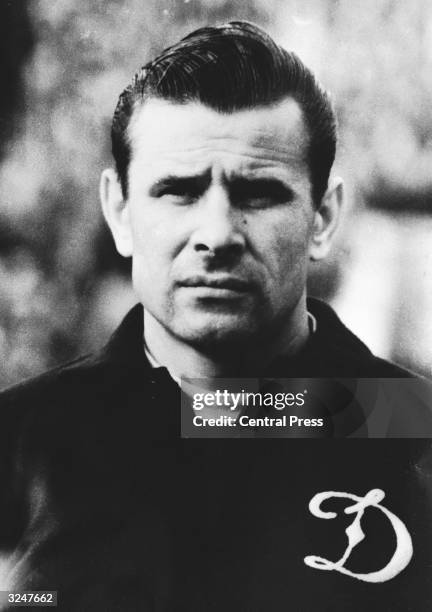
Lev Yashin
association football player•ice hockey player•goalkeeper
Also known as: The Black Spider, The Black Panther
Birthday
October 22, 1929
Birth Sign
Libra
Birthplace
Moscow, Soviet Union
Age
Died at 60
Height
6 ft 2 in (189 cm)
About
Lev Ivanovich Yashin was a Soviet professional footballer, widely regarded as the greatest goalkeeper in the history of the sport. Known for his exceptional athleticism, commanding presence, and acrobatic saves, he fundamentally changed how the goalkeeping position was played. He remains the first and only goalkeeper to ever win the prestigious Ballon d'Or award, a testament to his unparalleled skill and impact on the game.
Yashin earned global recognition for his innovative approach to goalkeeping. He was an imposing figure in goal, actively organizing his defense, coming off his line to intercept crosses, and rushing out to challenge oncoming attackers. This proactive style was a stark contrast to the static goalkeeping prevalent in his era, revolutionizing the role and influencing generations of players. His distinctive all-black kit earned him the memorable nicknames "the Black Spider" and "the Black Panther," which added to his mystique and popularity.
Throughout his illustrious career, Yashin appeared in four FIFA World Cups, from 1958 to 1970, though he was an unused squad member in his final tournament. His performances at the 1958 World Cup, the first to be broadcast internationally, introduced his genius to a global audience. He also led the Soviet Union to an Olympic gold medal in 1956 and the inaugural UEFA European Championship title in 1960. His legacy continues to be honored, with France Football establishing the Yashin Trophy in 2019, an annual award for the world's best goalkeeper, named in his honor. As of 2026, he is still widely considered the benchmark for goalkeeping excellence.
Early Life & Background
Lev Yashin grew up in Moscow during a challenging period, born to a working-class family in 1929. His father, Ivan Petrovich Yashin, was a toolmaker, and his mother, Anna Petrovna Yashina, worked in a textile factory. The family lived in a communal apartment, a common setup in Soviet society.
The outbreak of World War II significantly impacted young Lev's life. In 1941, at just 11 years old, he was evacuated with his family to the Volga region. He left school after the fifth grade to contribute to the war effort, working in a military factory assembling weapons components. This early experience instilled in him a toughness and resilience that would later define his athletic career.
As a teenager, Yashin showed athletic promise in both football and ice hockey, playing for factory teams. He initially started as a field player in football but transitioned to goalkeeping after coaches noticed his impressive height and quick reflexes. He even achieved success as an ice hockey goaltender, winning the Soviet Cup in 1953 with FC Dynamo Moscow's ice hockey team. His football career began in earnest in 1949 when he joined FC Dynamo Moscow's football academy as a reserve goalkeeper. His opportunity came in 1953 when the first-choice goalkeeper, Alexei Khomich, left the team, promoting Yashin to the starting role. That same year, he earned his first call-up to the Soviet national team, making his debut in 1954. The 1954 USSR Championship season was his breakthrough, as he kept 11 clean sheets and helped Dynamo win the league title, leading to his selection for the 1956 Olympic squad.
Career Growth
Lev Yashin's professional football career truly took off with his debut for the Soviet national team on September 8, 1954, securing a clean sheet in a dominant 7-0 victory against Sweden. Two years later, he achieved his first major international success, winning the gold medal at the 1956 Melbourne Olympic Games. He played every match, keeping three clean sheets, including the crucial 1-0 win over Yugoslavia in the final.
The 1958 FIFA World Cup in Sweden marked Yashin's global introduction. He played all five matches, guiding the Soviet Union to the quarter-finals, where they were eliminated by the eventual champions, Brazil. His extraordinary performances, broadcast internationally for the first time, turned him into a worldwide sensation, earning him a spot on the tournament's All-Star Team. In 1960, he further cemented his status by leading the Soviet Union to victory in the inaugural UEFA European Championship, keeping clean sheets in both the semi-final and final, including a 2-1 triumph over Yugoslavia in Paris.
His most significant individual achievement came in 1963 when he was awarded the Ballon d'Or, an unprecedented feat for a goalkeeper. He secured 73 points, surpassing Gianni Rivera and Jimmy Greaves. Yashin continued to perform at the highest level, playing in his third World Cup in 1966 in England, where the Soviet Union achieved their best-ever finish, placing fourth. At 36, he played all six matches, recording three clean sheets, including a 2-1 quarter-final win against Hungary, again earning a spot on the tournament's All-Star Team. He was an unused squad member at the 1970 FIFA World Cup in Mexico, providing mentorship to the team. Yashin retired from professional football on May 27, 1971, with a star-studded testimonial match at Lenin Stadium in Moscow, attended by 100,000 fans and featuring legends like Pelé. After retirement, he served as deputy chairman of the Football Federation of the Soviet Union and worked as a youth coach for Dynamo Moscow.
Career Timeline
Public Image & Style
Lev Yashin cultivated an iconic public image that resonated globally. He was instantly recognizable for his signature all-black (actually very dark blue) kit, often paired with a cloth cap and thick gloves. This distinctive look, combined with his incredible agility and reach, led Western journalists to nickname him "the Black Spider" or "the Black Panther." These monikers captured the imagination of fans, highlighting his imposing and seemingly omnipresent figure in goal.
His public persona was one of quiet confidence and intense focus on the pitch, contrasting with a more reserved and humble demeanor off it. Fans and media admired his leadership qualities and his revolutionary approach to goalkeeping, which transformed the position from a passive role to an active, commanding one. He was seen as a symbol of Soviet sporting excellence and resilience, embodying the strength and determination of his nation. Even decades after his death, his image remains synonymous with goalkeeping greatness, celebrated through tributes like the Yashin Trophy and numerous documentaries, ensuring his legend endures with football enthusiasts worldwide.
Fame & Fandom
Lev Yashin commanded a global attention that transcended the Cold War era, establishing a legacy measured in both athletic supremacy and enduring cultural reverence. Current authoritative assessments place his prominence with specific precision: he is recognized as the 8th most famous person in Ice Hockey, a standing confirmed by the iFANN Global Fame Rankings and held steady from the previous cycle. This singular placement underscores a unique duality in his career, bridging the gap between football's greatest goalkeeper and a figure of significant renown within ice hockey circles. His fanbase does not operate under a formal collective name; instead, it comprises a global, retrospective community united by his singular achievements rather than a specific group identity. While modern pop culture often relies on organized campaigns or digital hashtags, Yashin's adoration manifests through institutional tributes and grassroots appreciation. The existence of the FIFA "Yashin Trophy," awarded annually since 2019, serves as the ultimate standardization of this reverence, effectively turning his name into a metric of excellence that fans actively champion worldwide. In Kolkata, collectors have issued banknotes featuring him alongside other legends, indicating a form of numismatic appreciation that persists decades after his death. These organic forms of tribute, ranging from documentary films like *Vratar moey mechty* to the sheer scale of public gatherings during his active years, demonstrate a fandom that values historical impact over contemporary branding.
Interesting Facts and Legends
Lev Yashin remains the only goalkeeper in history to win the Ballon d'Or, a victory achieved in 1963 that fundamentally altered the perception of the position from mere last-resort defender to star playmaker. A central element of his mythology involves his "impregnable" nature during the 1958 World Cup and subsequent matches, where he was credited with saving penalties from legendary strikers such as Pelé, Ferenc Puskás, and Eusébio. Specifically, the story of him saving a penalty from Pelé in a friendly match is frequently cited as the moment the Brazilian star realized he could not beat Yashin, a narrative that highlights his supernatural agility and ability to read the game. Another verified iconic moment occurred during the 1962 World Cup, where he is credited with making 26 saves in a single tournament, a record that stood for decades. Folklore also recounts an incident where he stopped a shot so hard it reportedly broke the woodwork or caused the ball to bounce back into play. During the 1963 European Championship final, his leadership secured the title for the USSR, leading to massive public celebrations in Moscow where fans reportedly carried him on their shoulders through the city, a ritualistic display of adoration rarely seen for athletes at the time. The narrative that he "made the goalpost look smaller" remains a popular metaphor used in commentary to describe his intimidating presence.
Notable Quotes
“The joy of seeing Yuri Gagarin flying in space is only superseded by the joy of a good penalty save.”
“What kind of a goalkeeper is one who is not tormented by the goal he has allowed? He must be tormented! And if he is calm, that means the end. No matter what he had in the past, he has no future.”
“There have only been two world-class goalkeepers. One was Lev Yashin, the other was the German boy who played for Manchester City.”
“A goalkeeper has no right to make a mistake. He is the last line of defense.”
“I'm not the best in the world, but I'm not the worst either.”
Family & Personal Life
Lev Yashin was a devoted family man. He married Valentina Timofeyevna Yashina (née Shashkova) in 1955. They met through mutual friends in Moscow in 1954, and Valentina, a factory worker, became his lifelong partner. They remained married for 35 years until Yashin's death in 1990. Together, they had two daughters, Irina, born in 1956, and Lena, born in 1960.
Yashin often spoke publicly about his wife's unwavering support throughout his career, crediting her for much of his stability and success. His parents, Ivan Petrovich and Anna Petrovna, also lived with him in Moscow for a significant period until their deaths. Despite his global fame, Yashin maintained a private home life, prioritizing his family above all else.
Notable Connections
Lev Yashin is primarily associated with FC Dynamo Moscow, the only club he played for during his entire professional career, from 1949 to 1971. He also became synonymous with the Soviet Union national football team, representing his country in four World Cups and winning Olympic gold and a European Championship. Internationally, he is connected with the Ballon d'Or award, being its only goalkeeper recipient, and the Yashin Trophy, which was named in his honor. Fellow football legends like Pelé and Eusébio played in his testimonial match, highlighting his global standing.
Relationships & Dating History
Lev Yashin's public romantic history was marked by one enduring relationship. He married Valentina Timofeyevna Yashina (née Shashkova) in 1955. They first met through mutual friends in Moscow in 1954. Valentina, who worked in a factory, became his steadfast partner and greatest supporter throughout his remarkable career. Their marriage lasted for 35 years, a testament to their deep bond.
Together, Lev and Valentina had two daughters, Irina, born in 1956, and Lena, born in 1960. Yashin was known for his dedication to his family, often crediting Valentina for her support and for creating a stable home environment. She was also his primary caregiver during his final illness. They remained together until his death in March 1990. Valentina survived him by several decades. As of 2026, Lev Yashin is deceased, and he was married to Valentina Yashina at the time of his passing. No other confirmed romantic relationships or high-profile flings have ever been credibly reported for Lev Yashin.
- MarriedValentina Timofeyevna Yashina1955 - 1990Met through mutual friends in 1954; they married in 1955 and had two daughters, Irina and Lena, remaining together until his death.
Death & Aftermath
Died
March 20, 1990 (aged 60)
Death Place
Moscow, Soviet Union
Cause of Death
Complications from stomach cancer
In 1994, the Fédération Internationale de Football Association established the Lev Yashin Award to honor the tournament's best goalkeeper, reaffirmed his status as the sole custodian of the goal to ever receive the Ballon d'Or. This enduring recognition followed a funeral held shortly after his passing in March 1990, where thousands of mourners lined the streets of Moscow to pay respects to a national icon before his interment at the Kuntsevo Cemetery alongside other Soviet dignitaries. The former Dynamo Moscow keeper succumbed to complications from stomach cancer on March 20, 1990, at the age of sixty within Moscow, concluding a long battle with illness that left no room for legal inquiry or dispute regarding the circumstances of his final days.
While specific medical records or autopsy findings were not publicly detailed, historical consensus attributes his decline to the progression of gastric disease without controversy or unconfirmed accounts surrounding his last hours. Tributes flowed immediately from global institutions and peers alike, cementing a legacy that saw his name immortalized in the FIFA Hall of Fame and the Russian Football Hall of Fame, while later cultural contributions included the 2019 biographical film Lev Yashin. Vratar moey mechty. His influence remained visible through continued inclusion in lists of the most influential players by Pelé and British publications, ensuring the Black Spider remained a transformative figure in the sport long after his retirement.
Net Worth (Estate Value)
$11 Million
iFANN Editorial Team estimate
Heading into 2026, Lev Yashin accumulated his wealth primarily through his football career with Dynamo Moscow and the Soviet Union national team, supplemented later by coaching roles and memorabilia sales. His salary during his playing days, while modest by modern standards, was supported by state bonuses and public appearances. After retiring, he earned income from various coaching positions and engagements. Per iFANN's editorial analysis, his estimated net worth stands at $11 Million.
Awards Won (31)
Lev Yashin's trophy cabinet is truly unique, highlighted by his historic 1963 Ballon d'Or win, making him the only goalkeeper ever to receive the prestigious award. He was a cornerstone of the dominant Soviet Union national team, leading them to an Olympic gold medal in 1956 and the inaugural UEFA European Championship in 1960. At the club level, he secured an impressive seven Soviet Top League titles and three Soviet Cup victories with FC Dynamo Moscow. His individual brilliance was recognized with two selections to the FIFA World Cup All-Star Team in 1958 and 1966.
2020 · Goalkeeper
All-time greatest XI
2020 · Goalkeeper
All-time ranking
Known For
Ballon d'Or
1963 · Winner (only goalkeeper)
1956 Melbourne Olympic Games
1956 · Gold Medalist (Soviet Union)
1960 UEFA European Championship
1960 · Winner (Soviet Union)
FC Dynamo Moscow
1949 · Goalkeeper (entire career)
Keywords
Quick Facts
- Profession
- association football player, ice hockey player, goalkeeper
- Born
- October 22, 1929
- Birthplace
- Moscow, Soviet Union
- Died
- March 20, 1990
- Death Place
- Moscow, Soviet Union
- Gender
- Male
- Birth Sign
- Libra
Personal Details
- Full Name
- Lev Ivanovich Yashin
- Height
- 6 ft 2 in (189 cm)
- Spouse
- Valentina Timofeyevna Yashina
- Children
- Irina Yashina · Lena Yashina
- Education
- Russian State University of Physical Culture, Sport, Youth and Tourism (honorary degree)
Frequently Asked Questions
Who was Lev Yashin?
What was Lev Yashin's nickname?
What is Lev Yashin's net worth in 2026?
Did Lev Yashin play ice hockey?
Why is Lev Yashin considered the best goalkeeper ever?
Social Media
Join the community
fans discussing