“Eastwood has made a film that is both a tribute to the courage of the Japanese soldiers and a condemnation of the war that forced them to fight.”
A.O. Scott
The New York Times
 United States
"The other side of Iwo Jima, told by the men who held the caves."
Part of a Collection
Clint Eastwood's Iwo Jima Collection
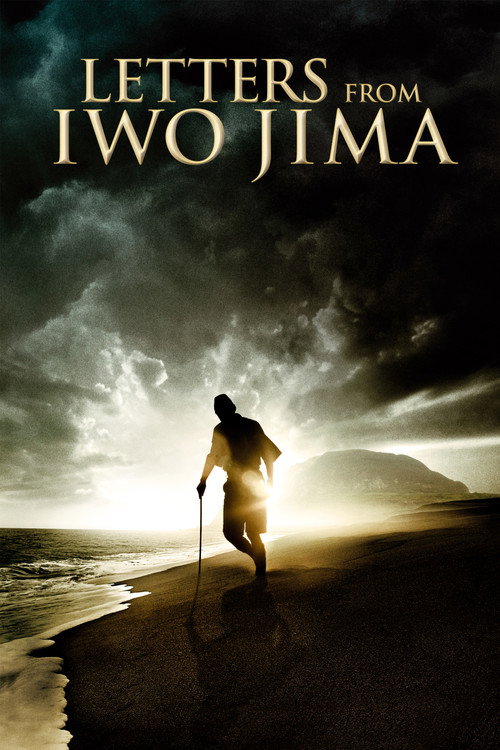
Clint Eastwood spent 2006 looking at the same battle from two directions. Flags of Our Fathers told the American story of Iwo Jima; Letters from Iwo Jima, released that December, flips the camera around and stays with the Japanese defenders in their tunnels and pillboxes. The film is in Japanese with English subtitles, a choice that startled distributors and turned out to be the point: the men digging in on the island are not villains but soldiers with families, orders, and nowhere to retreat.
Ken Watanabe plays General Tadamichi Kuribayashi, the commander who arrives on Iwo Jima knowing the island cannot be held and reorganizes the defense anyway. Kazunari Ninomiya is Private Saigo, a baker conscripted away from his wife and infant daughter, and the film's emotional center. Tsuyoshi Ihara, Ryo Kase, and Shidou Nakamura fill out a cast of officers and grunts whose loyalties pull in different directions. Eastwood shot from a script by Iris Yamashita and Paul Haggis, with Steven Spielberg producing through Amblin and DreamWorks alongside Warner Bros. and Eastwood's Malpaso.
Availability and pricing can change. Confirm on the provider's site before purchasing.
In February 1945, the Imperial Japanese Army prepares for a desperate defense of Iwo Jima, a small volcanic island in the Pacific Ocean that serves as a critical strategic point for the United States military. The narrative opens by introducing General Tadamichi Kuribayashi (Ken Watanabe), a man of immense intellect and compassion who has been appointed to command the defense of the island. Unlike his predecessors, Kuribayashi understands that holding the beach is impossible against the overwhelming firepower of the American Navy and Air Force. He realizes that the only way to inflict maximum casualties on the enemy is to abandon traditional open-field tactics and instead construct an intricate network of underground tunnels, pillboxes, and fortifications deep within the island's volcanic ash and lava tubes. His goal is not to win a victory, but to prolong the battle and make the cost of taking the island so high that it might influence the war's outcome or at least honor the sacrifice of his men.
The story weaves together the lives of various soldiers under Kuribayashi's command, humanizing the "enemy" through their personal struggles and fears. We meet Private Saigo (Kazunari Ninomiya), a gentle baker from Tokyo who was conscripted into the army just days before his wedding. Saigo is haunted by thoughts of his wife and infant daughter back home, carrying a photograph of them as his only comfort. He represents the common soldier's desire for peace and survival rather than glory. Another key figure is Colonel Baron Nishi (Tsuyoshi Ihara), a former Olympic gold medalist in fencing who is now a rigid, traditional officer struggling with the shift in warfare and the loss of the old samurai spirit. He clashes with Kuribayashi over tactical decisions, believing in a suicidal charge to the death, while Kuribayashi insists on a defensive strategy that prioritizes the lives of his men.
As the American forces begin their bombardment and subsequent invasion, the film shifts focus to the brutal reality of life inside the tunnels. The soldiers face starvation, dehydration, and the constant threat of suffocation as they are cut off from supplies. The psychological toll is immense; many men are driven to madness or despair. The film explores the complex relationship between the officers and the enlisted men, highlighting moments of camaraderie, fear, and the absurdity of war. A young idealistic soldier named Shimizu (Ryo Kase) struggles with the morality of fighting a war he knows is unwinnable, while others cling to their beliefs in the Emperor and the divine nature of Japan.
Throughout the siege, the film uses the motif of letters written by the soldiers to their families as a framing device. These letters, often never sent due to the chaos of battle, provide intimate glimpses into the hearts of the men. They reveal their love for their families, their confusion about the war, and their hopes for a future that will likely never come. The tension builds as the American troops push deeper into the island, systematically dismantling the Japanese defenses. The soldiers are forced to fight in close quarters, using grenades and bayonets in the claustrophobic tunnels. The conflict is not just against the Americans but also against the inevitable decay of their bodies and minds.
The story moves toward the final days of the battle, where the remaining defenders are pushed to their absolute limits. Kuribayashi continues to lead from the front, maintaining order and morale even as the situation becomes hopeless. The film captures the tragedy of a group of men who are doing exactly what they were told to do, yet know they are marching toward their deaths. It portrays the universal experience of war: the loss of innocence, the breaking of spirits, and the enduring bond between comrades in the face of annihilation. As the American forces close in, the Japanese soldiers prepare for their final stand, knowing that there is no retreat and no escape. The film ends on a note of profound sorrow and respect for the humanity of those who fought, leaving the audience to reflect on the futility and cost of conflict without revealing the specific fate of every character or the immediate aftermath of the battle.
Official Trailer
Teaser Trailer
Critical Consensus
Eastwood's Letters from Iwo Jima offers a haunting, empathetic look at the Japanese perspective of the Battle of Iwo Jima. Ken Watanabe delivers a commanding performance in a film that strips away propaganda to reveal the shared humanity of soldiers on both sides. The movie stands as a powerful anti-war statement that honors the sacrifices made by all combatants without glorifying the conflict itself.
“Eastwood has made a film that is both a tribute to the courage of the Japanese soldiers and a condemnation of the war that forced them to fight.”
A.O. Scott
The New York Times
“This is a movie that does not glorify war, but rather shows its horror and its futility. It is a masterpiece of empathy and understanding.”
Roger Ebert
Chicago Sun-Times
“Eastwood has created a film that is both a historical document and a work of art. It is a testament to the power of cinema to bridge cultural divides.”
Peter Travers
Rolling Stone
Ken Watanabe
General Tadamichi Kuribayashi
Kazunari Ninomiya
Private Saigo
Tsuyoshi Ihara
Colonel Baron Nishi
Ryo Kase
Private Shimizu
Shidou Nakamura
Lieutenant Ito
Hiroshi Watanabe
Lieutenant Fujita
Director
Clint Eastwood
Writers
Iris Yamashita, Paul Haggis
Composer
Kyle Eastwood
Cinematographer
Tom Stern
Producers
Robert Lorenz, Steven Spielberg, Paul Haggis, Clint Eastwood
Academy Awards (2007)
Best Foreign Language Film: Nominated
Golden Globe Awards (2007)
Best Motion Picture - Drama: Nominated
BAFTA Awards (2007)
Best Film Not in the English Language: Won
Screen Actors Guild Awards (2007)
Outstanding Performance by a Male Actor in a Leading Role: Nominated
Join the community
fans discussing