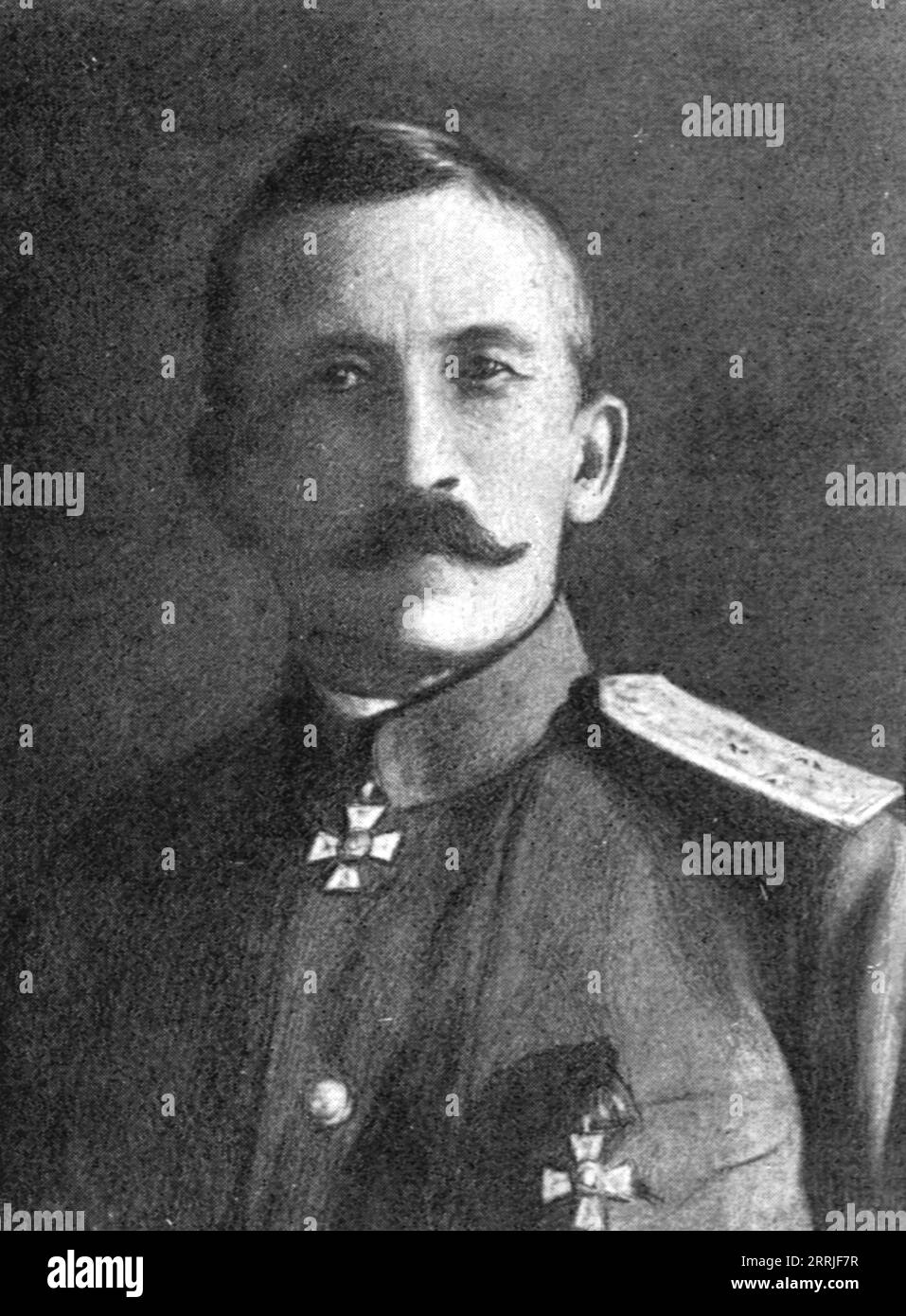
Lavr Kornilov
 Russia
military officer•explorer•diplomat
Also known as: Lavr Georgiyevich Kornilov
Birthday
August 18, 1870
Birth Sign
Leo
Birthplace
Ust-Kamenogorsk, Semirechye Oblast, Russian Turkestan (modern Oskemen, Kazakhstan)
Age
Died at 47
About
Lavr Georgiyevich Kornilov was a Russian military commander, explorer, and diplomat. He rose to prominence as a general in the Imperial Russian Army, earning fame for his daring escape from Austrian captivity during World War I. In 1917, he became Commander-in-Chief of the Russian Army, but his attempt to stop the revolution led to the infamous Kornilov Affair, a failed coup that inadvertently strengthened the Bolsheviks. After the October Revolution, he co-founded the White Volunteer Army and fought against the Red Army in the Russian Civil War until his death in 1918.
Kornilov is remembered as a complex and controversial figure. To some, he was a patriot who tried to save Russia from chaos; to others, he was a counter-revolutionary whose actions hastened the Bolshevik takeover. His legacy endures in historical debates and even in popular culture, where he appears in alternate-history narratives.
Early Life & Background
Born in 1870 in Ust-Kamenogorsk, a remote town in Russian Turkestan, Kornilov grew up in a family of Siberian Cossack heritage. His father, Georgy, was a Cossack officer who later worked as an interpreter at a border post on the Chinese frontier. His mother, of Kazakh descent, gave him distinctly Asian features that contemporaries often noted. The family moved to Zaisan, a military outpost, where young Lavr developed a fascination with military service and languages.
With no formal schooling available at the border post, Kornilov was largely self-taught, except for mathematics, which a border officer tutored him in. He dreamed of entering the Cadet Corps in Omsk. After the family relocated, he enrolled and excelled, graduating at the top of his class in 1889. That achievement earned him the right to choose any military college, and he selected the Nikolaevsky Artillery School in St. Petersburg. To support himself, he gave math lessons and wrote articles on zoogeography, even sending money home to his parents.
He later graduated from the General Staff Academy, setting the stage for a distinguished military career.
Career Growth
Kornilov's military career took off during the Russo-Japanese War (1904–1905), where he distinguished himself in combat. From 1907 to 1911, he served as a military attaché in Qing China, learning Chinese and traveling extensively. During this period, he met Chiang Kai-shek, who would later become China's president. In 1911, he took command of a Russian army unit.
When World War I broke out, Kornilov led the 48th Infantry Division in Galicia and the Carpathians. He was promoted to major general in 1915, but in April of that year, he was captured by Austrian forces. His daring escape from captivity in July 1916 made him a celebrated hero on the Eastern Front.
In 1917, amid the Russian Revolution, Kornilov was appointed commander of the Petrograd Military District in March, then Commander-in-Chief of the Russian Army in July. His attempt to impose order led to the Kornilov Affair in August, a failed coup that ended with his arrest. After escaping prison in November, he joined the White movement and co-founded the Volunteer Army in southern Russia. He fought against the Red Army until his death in 1918.
Career Timeline
Public Image & Style
Kornilov cut a striking figure, with Asiatic features that set him apart from many of his contemporaries. He was seen as a determined, sometimes ruthless commander who believed in strong military authority. His daring escape from captivity and his role in the Kornilov Affair made him a polarizing figure. To White supporters, he was a martyr for the cause; to Bolsheviks, he was a reactionary threat. In historical memory, he symbolizes the counter-revolutionary movement and the tragedy of the Russian Civil War.
Fame & Fandom (iFAMOUS Rankings)
Lavr Kornilov does not possess a modern fandom in the sense of organized fanbases, unofficial nicknames, or digital campaigns. His legacy is defined by political and military history rather than entertainment, with admirers existing primarily as ideological followers or historical students. Groups like the Kornilovtsy emerged during the Civil War and later among right-wing militants, while monarchists and nationalists revere him as a symbol of order. In the alternate-history mod Kaiserreich for Hearts of Iron IV, players engage with his survival narrative, yet this represents a game community rather than a dedicated fanbase for the historical figure himself. There are no formal rituals, birthday billboards, or streaming pushes associated with his name. The cultural mythology surrounding him remains strictly rooted in verified historical events, most notably the failed 1917 coup that bears his name and the retrospective parallels drawn between his actions and the 2023 Wagner Group mutiny. These stories serve as cautionary tales about the fragility of democracy and the dangers of military intervention. While he remains a polarizing figure in Russian historical memory, the concept of a consumer-based fandom simply does not apply to a man who died over a century ago. Lavr Kornilov is currently evaluated by iFANN but holds no placement in the Global Top 1,000 rankings.
Interesting Facts and Legends
Kornilov's mother's ethnicity has long been debated, with sources suggesting Kazakh, Kalmyk, Don Cossack, Polish, or Altai ancestry. He was known for an abrupt and aggressive personality that sometimes alienated allies, yet he was also a talented linguist speaking several languages including Chinese. During his student years, he authored scientific articles on zoogeography. In the Kaiserreich alternate-history universe, Kornilov survives the civil war and becomes War Minister of the Russian Republic. His escape from Austrian captivity became a popular legend among Russian troops. The Kornilov Affair of August 1917 stands as his most iconic moment; this attempted coup against the Provisional Government failed spectacularly, inadvertently strengthening the Bolsheviks and accelerating the collapse of the old regime. A modern legend has emerged linking the June 2023 Wagner mutiny directly to Kornilov's 1917 advance, with analysts comparing Prigozhin's march on Moscow to Kornilov's push toward Petrograd. This retrospective comparison has become a dominant narrative in understanding recent Russian political dynamics.
Family & Personal Life
Kornilov's father, Georgy Kornilov, was a Cossack officer and later an interpreter at the Zaisan border post. His mother, whose name is not recorded, was of Kazakh descent. The family was friends with Grigory Potanin, a prominent explorer and supporter of Siberian autonomy. Kornilov married Taisiya Vladimirovna Markovina, and they had at least one child. Little is known about his family life, as his career and the turbulent times overshadowed personal details.
Notable Connections
Kornilov's career intersected with several key figures: Alexander Kerensky, who appointed and then dismissed him; Anton Denikin, Pyotr Wrangel, and Mikhail Drozdovsky, fellow White Army leaders; Grigory Potanin, a family friend and explorer; and Chiang Kai-shek, whom he met during his service in China.
Relationships & Dating History
Kornilov married Taisiya Vladimirovna Markovina, and the couple had at least one child. Details of their courtship and marriage are not well-documented, as Kornilov's public life overshadowed his personal affairs. He remained married to Taisiya at the time of his death in 1918.
- MarriedTaisiya Vladimirovna Markovina? - 1918Married; had at least one child.
Death & Aftermath
Died
April 13, 1918 (aged 47)
Death Place
Ekaterinodar (now Krasnodar), Russia
Cause of Death
Reportedly killed in action by shell fragment or bullet
Lavr Georgiyevich Kornilov spent his final days commanding the Volunteer Army in the North Caucasus, leading forces against Bolshevik troops in the besieged city of Ekaterinodar. On April 13, 1918, while directing operations during the Battle of Ekaterinodar, he fell to a shell fragment or bullet sustained during active combat. His death transformed him instantly into a central symbol of the White resistance, with tributes pouring in from fellow generals and political figures who viewed him as the founding figure of the anti-communist movement.
Anton Denikin attended the military procession and service held immediately after the battle before interring Kornilov in the city cemetery, though the exact grave site has likely been lost to subsequent turmoil and Soviet reorganization. In the decades that followed, state narratives vilified him during the Soviet era while exiles and later post-Soviet conservatives revered him as a martyr. Modern interest has resurged around historical anniversaries and contemporary parallels, sparking academic debates about his role as a counter-revolutionary leader.
His death did not trigger judicial proceedings or police investigations connected to the circumstances of his passing. The family's property and assets were confiscated by the Bolsheviks following the Red capture of the region. Posthumously, Kornilov has been the subject of numerous books, films, and academic studies focusing on the Russian Civil War. He has been inducted into various historical narratives within Russian nationalist and monarchist organizations, though not in official Soviet or modern Russian state institutions which initially suppressed his image.
Net Worth (Estate Value)
$5 Million
iFANN Editorial Team estimate
iFANN currently estimates Lavr Kornilov's net worth at $5 Million based on his military salary, estate, and posthumous recognition. As a general in the Imperial Russian Army, he would have earned a substantial officer's salary, though records remain sparse. His estate, managed by descendants, has benefited from historical interest, book royalties, and commemorative items. In 2026, the estate continues to generate modest income from these sources, though the exact figures remain private.
Awards Won (3)
Kornilov received the Order of St. George twice, the Order of Saint Anna, and the Order of Saint Stanislaus for his military service. He also held the rank of General of the Infantry.
Military
Russo-Japanese War and World War I
Military
Military service
Known For
Kornilov Affair
1917 · Leader of the attempted coup
Volunteer Army
1918 · Co-founder and commander
World War I
1914-1916 · Commander of 48th Infantry Division
Keywords
Sources
Quick Facts
- Profession
- military officer, explorer, diplomat
- Born
- August 18, 1870
- Birthplace
- Ust-Kamenogorsk, Russian Turkestan
- Died
- April 13, 1918
- Death Place
- Yekaterinodar (Krasnodar)
- Gender
- Male
- Birth Sign
- Leo
- Spouse
- Taisiya Vladimirovna Markovina
- Children
- At least one
Personal Details
- Full Name
- Lavr Georgiyevich Kornilov
- Spouse
- Taisiya Vladimirovna Markovina
- Children
- At least one
- Education
- Cadet Corps School in Omsk; Nikolaevsky Artillery School in St. Petersburg; General Staff Academy
Frequently Asked Questions
What was the Kornilov Affair?
How did Lavr Kornilov die?
Was Lavr Kornilov married?
What was Kornilov's ethnicity?
What is Kornilov's legacy in Russian history?
Similar People
Join the community
fans discussing