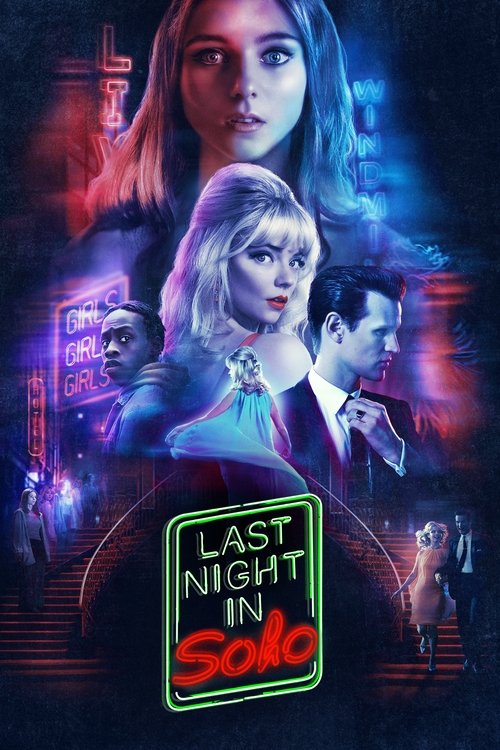
Edgar Wright steps away from comedy for a stylish, unsettling horror with Last Night in Soho. The film follows Eloise Turner (Thomasin McKenzie), a shy fashion student from rural Cornwall who moves to London for college. Bullied by her trendy roommate and overwhelmed by the city, Eloise retreats into a vivid fantasy: she dreams of Sandie (Anya Taylor-Joy), a glamorous aspiring singer in 1960s Soho. As Eloise slips deeper into the past, the line between admiration and possession blurs. The movie cost $43 million to make and earned just under $23 million worldwide, a modest return for a film that critics praised for its visual flair while noting its tonal shifts. Wright co-wrote the script with Krysty Wilson-Cairns, and the cinematography comes from Chung Chung-hoon, known for his work on Park Chan-wook's films. The result is a neon-drenched nightmare about nostalgia, ambition, and the dark side of London's swinging sixties.
Availability and pricing can change. Confirm on the provider's site before purchasing.
PlotSpoiler-free
Eloise Turner, a shy young woman from Cornwall, has always felt out of step with her peers. She lives with her grandmother Peggy, who warns her that London can be a dangerous place. Ellie, as she is called, dreams of becoming a fashion designer and is obsessed with the style and music of the 1960s. When she is accepted to the London College of Fashion, she eagerly moves to the capital, despite her grandmother's concerns.
London immediately overwhelms Ellie. The noise, the crowds, and the cruelty of her new roommate Jocasta and her clique make her feel isolated. Jocasta mocks Ellie's vintage clothes and naive demeanor. Unable to cope, Ellie moves out of the dormitory and rents a small bedsit in a charming old townhouse owned by the stern but protective Ms. Collins. The room is decorated with 1960s memorabilia, and Ellie feels an immediate connection to it.
That night, Ellie dreams vividly. She is transported to 1960s Soho, where she observes a stunning young woman named Sandie. Sandie is confident, glamorous, and ambitious, she wants to become a famous singer. In these dreams, Ellie experiences Sandie's world through her eyes, feeling her emotions and seeing her life unfold in dazzling neon detail. Ellie begins to live for these dreams, using them as inspiration for her fashion designs and as an escape from her miserable waking life.
But the dreams take a dark turn. Sandie meets Jack, a charming man who promises to help her career. Jack introduces Sandie to the seedy underbelly of Soho's nightlife, where she is coerced into working as a prostitute for a network of abusive men. Ellie witnesses Sandie's dreams shatter as she is exploited, beaten, and trapped. The glamorous 1960s fantasy becomes a nightmare of misogyny and violence. Ellie's dreams grow increasingly violent and intrusive, bleeding into her waking hours. She begins to see ghostly, grotesque male figures pursuing her, and the line between past and present blurs dangerously.
Desperate for answers, Ellie investigates the real history of Sandie and the men who destroyed her. She learns that Sandie was a real person who died under mysterious circumstances in the 1960s. Ellie becomes convinced that Sandie's ghost is reaching out to her for justice, and that the killer is still alive. With the help of John, a kind fellow student who has a crush on her, Ellie tries to uncover the truth before the nightmare consumes her entirely. The central conflict becomes Ellie's struggle to maintain her sanity while being pulled deeper into a vengeful ghost's traumatic past.
Last Night in Soho is a visually dazzling and ambitious psychological horror that showcases Edgar Wright's stylistic flair and strong lead performances, but its uneven tone and muddled third act prevent it from fully realizing its potential. The film's technical craft and emotional ambition are widely praised, while its narrative execution divides critics.
 China
China