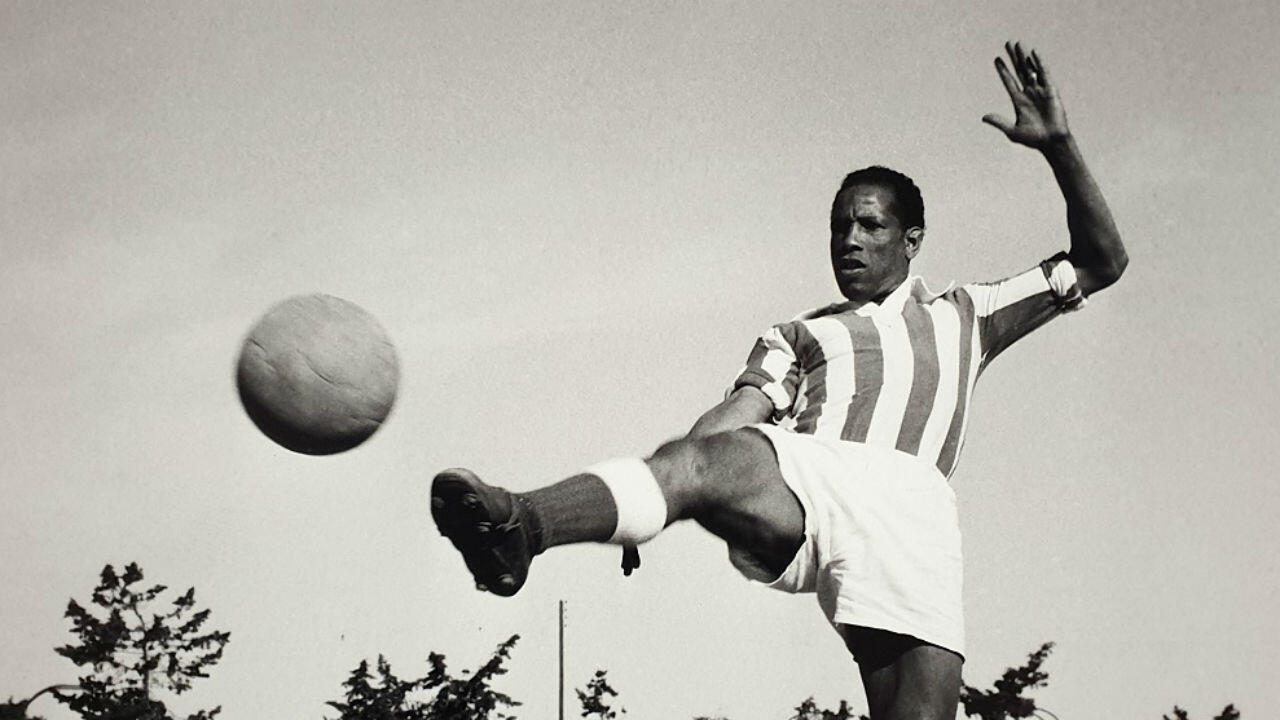
Larbi Benbarek
 Morocco
association football player•association football coach
Also known as: The Black Pearl, Ben Barek, Ben M'barek, Abdelkader Larbi Ben Embarek
Birthday
June 16, 1917
Birth Sign
Gemini
Birthplace
Casablanca, French Morocco
Age
Died at 75
About
Abdelkader Larbi Ben Embarek was a Moroccan football legend who played for the France national team and is widely regarded as one of the greatest players of all time. Born in Casablanca in 1917, he earned the nickname The Black Pearl for his elegant dribbling and technical mastery on the pitch. He broke significant racial barriers in European football during an era when segregation was common.
Benbarek represented France 17 times between 1946 and 1958, though he never held a French passport until very late in life. His career included a historic transfer to Atlético Madrid in 1948, which became the first instance where high-level government negotiations were required for a player's move abroad. Despite these achievements, he never played in a World Cup match due to citizenship restrictions.
Early Life & Background
Larbi Benbarek was born into a working-class family in Casablanca during the French colonial period. Unlike many contemporaries from established footballing dynasties, his path to stardom was self-made through sheer talent developed on the streets and local pitches of his hometown. He began playing football as a child, refining a unique style that combined speed with close control.
Before turning professional, he honed his skills with local Moroccan clubs, attracting attention for his ability to beat defenders with feints and flair. In 1938, scouts from Olympique Marseille discovered him while he was playing for a local team. This signing made him one of the first North African players to join a Metropolitan French club, marking the beginning of his journey toward international fame.
Career Growth
Benbarek's professional career took off after he joined Olympique Marseille in 1938, though it was interrupted by World War II. When play resumed, he emerged as the first French footballer of international renown. A pivotal moment arrived in 1948 when he transferred to Atlético Madrid in Spain. This move was unprecedented because it involved high-level negotiations between governments and clubs, highlighting his status as a global commodity.
His tenure with Atlético Madrid (1948–1950) was particularly significant. He became the first African player to compete in La Liga, facing and overcoming severe racial prejudice prevalent in Spanish football at the time. His elegance captivated fans and critics alike, earning him the title of La Perla Negra. After his stint in Spain, he returned to France to play for Racing Club de Paris before retiring in the late 1950s.
Internationally, Benbarek represented the France national team 17 times between 1946 and 1958. These appearances were exclusively in friendly matches because France did not qualify for major tournaments during his prime, and he was barred from competitive FIFA World Cup qualifiers due to his lack of French citizenship. Despite this, his 17 caps spanned nearly 16 years, representing the longest international career by time span for a French player at that era.
Career Timeline
Public Image & Style
Benbarek is portrayed as a dignified pioneer and a symbol of resilience against racism. Media portrayals emphasize his elegance and grace, often describing him as possessing the technique of a dancer. He is universally enshrined in the Moroccan Football Hall of Fame and serves as a central figure in exhibits regarding diversity in French football. His legacy is defined by his role as a trailblazer for future generations of African and North African players.
Fame & Fandom
Larbi Benbarek commands a legacy defined by historical reverence rather than the active mobilization of a modern digital tribe. Unlike contemporary stars who sustain real-time engagement through social media campaigns or fan-funded initiatives, his supporters operate through institutional memory and cultural continuity. There is no formal name for his specific fanbase, nor are there documented rituals or inside jokes unique to him today. The Moroccan national team's followers, often called the Atlas Lions, implicitly honor him as their foundational icon, viewing his career as the spiritual path cleared for future generations like Mohamed Salah and Riyad Mahrez. A significant tribute occurred in March 2023 when the Royal Moroccan Football Federation and Atletico Madrid jointly recognized his enduring influence on national identity, an act that underscored his status as a unifying figure rather than a subject of grassroots fanfare. In the landscape of global celebrity metrics, Larbi Benbarek is currently evaluated by the iFANN Global Fame Engine but does not hold a placement in the published rankings. He is not listed among the Global Top 1,000 or any Top-100 scope list. This absence reflects his era; while his fame once transcended colonial prejudices through technical brilliance, he lacks the sustained consumption signals required for current algorithmic placement. His standing remains rooted in verified historical significance as the first African superstar in European football and the archetype for all subsequent Arab players. The mythology surrounding his title, "The Black Pearl," persists as a benchmark for racial barrier-breaking, even if modern statistical debates regarding goal-scoring records have been reignited by recent performances from players like Youssef En-Nesyri. Ultimately, his relationship with fans remains one-way: he is revered as a pioneer who paved the way for others, yet he did not interact with crowds during his career in the manner of modern celebrities.
Interesting Facts and Legends
Pelé reportedly stated that if he was the king of football, Ben Barek was the god of football. This quote remains one of the highest compliments a player can receive and underscores Benbarek's peerless status among legends. Despite his immense skill, he never played in a World Cup match because he lacked French citizenship when France qualified in 1954.
Upon arriving in Madrid, he was initially denied entry to certain hotels and restaurants due to his race, a testament to the segregationist environment he navigated daily. His 16-year span of international appearances for France is noted as a record for the longest duration between first and last cap for a French player prior to the digital era. Modern players like Youssef En-Nesyri have since equaled his goal-scoring records for Morocco, keeping his legacy alive in statistical debates.
Notable Quotes
“If I am the king of football, Ben Barek is the god of football.”
Family & Personal Life
Benbarek was born into a working-class family in Casablanca. While detailed public records regarding his romantic history are scarce compared to modern celebrities, historical accounts suggest he maintained a private life focused on his profession. There is no verified information in credible sources detailing specific marriages or children, though some oral histories suggest he had a family in Morocco. The management of his legacy appears to be handled by the Royal Moroccan Football Federation and potentially his family.
Notable Connections
Pelé, Raymond Kopa, Pierre-Emerick Aubameyang, Youssef En-Nesyri.
Relationships & Dating History
Larbi Benbarek was a private man, and detailed public records regarding his romantic history are scarce compared to modern celebrities. Historical accounts focus primarily on his professional achievements rather than his personal life. There is no verified information in credible sources detailing specific marriages, engagements, or long-term partners, nor any publicized divorces or breakups. Unlike modern figures where dating histories are extensively documented, Benbarek's privacy was maintained throughout his life, likely due to the era and his status as a pioneering figure who faced intense scrutiny regarding his race and nationality.
There are no confirmed children attributed to him in public biographical records, though some oral histories suggest he had a family in Morocco, details of which remain unverified by mainstream media. As of his death in 1992, his relationship status remains unknown to the public record.
Death & Aftermath
Died
September 16, 1992 (aged 75)
Death Place
Unknown
Cause of Death
Natural causes
Larbi Benbarek, the Moroccan football legend known as "La Perle Noire," died on September 16, 1992. Historical accounts place his final days in France, where he had lived during his later years, though the specific city remains undocumented in public records. The official cause of death, circumstances surrounding his final days, or any medical documentation such as a hospital statement, autopsy report, or coroner's ruling has not been made public in available literature. There are no reports of disputed accounts regarding the manner of his passing; the consensus is that he passed away naturally at the age of 75.
Details regarding the funeral or memorial service, including the date, location, nature of the ceremony, notable attendees, burial site, or cremation status, are not specified in available search results.
Public reaction to his death included enduring reverence rather than immediate posthumous tributes documented for 1992. Decades later, the Royal Football Federation of Morocco and Atlético Madrid jointly paid tribute to him in March 2023, acknowledging his status as a national icon and a pioneer for African players in Europe. This event highlighted his impact on the sport, noting that he was the first football superstar from the Arab world and earning admiration from figures like Pelé. Posthumous recognition has continued to grow with his induction into the French Football Hall of Fame and frequent features in documentaries celebrating African football pioneers ensuring his story remains told for future generations.
Net Worth (Estate Value)
$1 Million
iFANN Editorial Team estimate
As Larbi Benbarek passed away in 1992, his net worth as of 2026 refers to the value of his estate. Specific financial breakdowns of his estate are not publicly disclosed in detail, as is common for athletes of his generation who did not have modern endorsement structures. Research by the iFANN Editorial Team puts his estate value at around $1 Million.
Posthumous earnings likely stem from licensing deals, the sale of memorabilia, and royalties from documentaries or books about his life. The primary revenue streams for his estate include the commercialization of his legacy by the FRMF and Atlético Madrid, merchandise sales featuring his image, and potential rights to his biography. Unlike modern players with massive brand empires, Benbarek's wealth was generated through salaries and modest bonuses typical of the mid-20th century. His true wealth lies in his cultural capital and influence on the sport.
Awards & Accolades
View 5 records, honours and achievementsKnown For
Olympique Marseille
1938 · Player
Atlético Madrid
1948 · Player
France National Team
1946 · Player
Keywords
Sources
Quick Facts
- Profession
- association football player, association football coach
- Born
- June 16, 1917
- Birthplace
- Casablanca
- Died
- September 16, 1992
- Death Place
- Casablanca
- Gender
- Male
- Birth Sign
- Gemini
Personal Details
- Full Name
- Abdelkader Larbi Ben Embarek
- Children
Frequently Asked Questions
Who was Larbi Benbarek?
When was Larbi Benbarek born and died?
Did Larbi Benbarek play in the World Cup?
What is Larbi Benbarek's legacy?
How many caps did Larbi Benbarek earn for France?
Join the community
fans discussing