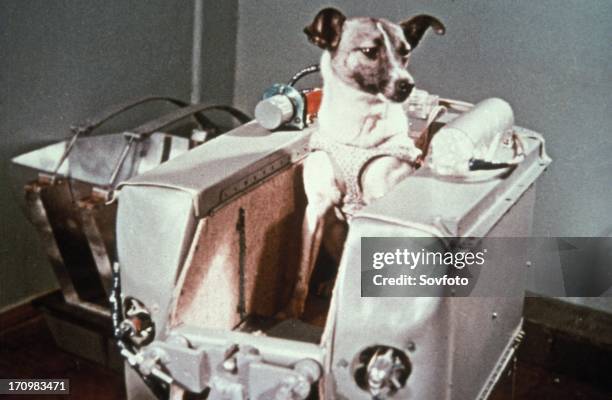
Laika
 Russia
Also known as: Laika the Space Dog
Birthday
1954
Birth Sign
Capricorn
Birthplace
Moscow, Russia
Age
Died at 3
About
Laika (LY-kə; Russian: Лáйка; c. 1954 – 3 November 1957) was a Soviet space dog who became the first living creature to orbit Earth. A stray mongrel from the streets of Moscow, she was selected for the Sputnik 2 mission, launched on 3 November 1957. Her flight proved that a living organism could survive launch and the conditions of orbit, paving the way for human spaceflight. The technology to return a spacecraft from orbit had not yet been developed, so Laika's survival was never expected. She died from overheating and stress within hours of launch, a fact that was not disclosed until 2002. Laika's sacrifice sparked global debate about animal testing in space and turned her into a tragic icon of the Space Age. Monuments in Moscow and Star City honor her contribution, and her story continues to be told in books, songs, and documentaries.
Early Life & Background
Laika was born around 1954 as a stray on the streets of Moscow, surviving harsh winters and food scarcity alongside other homeless dogs. In 1957, Soviet scientists captured her and several other strays for the space program, believing street dogs were tougher and more adaptable than purebreds. She was taken to the Institute of Aviation Medicine, where she underwent training that included confinement in progressively smaller cages, centrifuge tests to simulate launch G-forces, and learning to eat a special gelatinous space food. Her calm temperament and tolerance of confinement made her the ideal candidate. The backup dog, Albina, had already flown on a suborbital test flight. Laika weighed about 5 kilograms and was described by her trainer, Dr. Vladimir Yazdovsky, as quiet and charming.
Career Growth
On 3 November 1957, Laika launched aboard Sputnik 2 from the Baikonur Cosmodrome in Kazakhstan. The spacecraft carried her in a pressurized cabin with life-support systems, oxygen generator, temperature control, and food dispensers. Sensors monitored her heartbeat, respiration, and blood pressure, transmitting data back to Earth. The mission achieved its primary goal: proving a living being could survive launch and orbit. However, due to a design flaw, thermal insulation tore loose during launch, causing the cabin temperature to rise rapidly. Laika died from overheating and stress approximately 5–7 hours into the flight, on the fourth orbit. Sputnik 2 continued orbiting for 162 days before burning up in the atmosphere on 14 April 1958. The Soviet government initially claimed she was euthanized after a week, a story maintained for 45 years until Dr. Dimitri Malashenkov revealed the truth in 2002.
Career Timeline
Public Image & Style
Laika is remembered as a tragic hero of the Space Age, an innocent animal sacrificed for scientific progress. Media portrayals emphasize the ethical questions surrounding animal testing, and her story has inspired songs, books, and documentaries. She has no official fandom name, but is widely called "the space dog." Fan culture includes memorial events on the anniversary of her flight and educational projects about space history. Social media accounts run by fans focus on commemoration and advocacy for animal welfare in research.
Fame & Fandom
Laika holds the distinction of being the first living creature to orbit Earth, a historical milestone that has secured her place in global memory rather than contemporary celebrity charts. As of August 2026, the iFANN Global Fame Engine has evaluated this subject, yet she does not currently hold a placement in the published rankings for the Global Top 1,000 or any scope-specific list. Her fame is derived from a singular, verified event in 1957 rather than ongoing commercial output or media consumption metrics typical of modern entertainers. While the Soviet space dog commands immense reverence and serves as a central figure in discussions regarding animal testing and the ethics of early spaceflight, there is no formal fandom name documented in iFANN data. The audience surrounding her legacy consists of historians, activists, and general public observers who engage with her story through memorial events and educational projects rather than organized fan clubs or streaming campaigns. Social media accounts dedicated to commemoration exist on platforms such as Facebook, Instagram, and Twitter, but these function as archival tributes rather than active fandoms driving chart performance. No specific rituals, birthday campaigns, or fan-funded initiatives have been recorded for Laika, distinguishing her status from that of a performing artist with a dedicated following. Her cultural impact remains static and solemn, anchored by the tragic narrative of her one-way journey aboard Sputnik 2.
Interesting Facts and Legends
The name Laika translates to "Barker" in Russian, a moniker applied despite her reputation as a quiet stray from Moscow streets. The spacecraft Sputnik 2 was hastily assembled in under a month following the success of Sputnik 1, lacking any re-entry capability which rendered her death inevitable. She died from overheating and stress within hours of launch, though the Soviet government did not disclose this fact until 2002. Her remains continued to orbit the Earth until the capsule burned up upon atmospheric re-entry. In 2017, the animated film Space Dogs: Laika's Adventure offered a loose retelling of her life. A widely circulated story among enthusiasts describes her carrying only one meal and a seven-day oxygen supply, cementing the mythos of the "one-way trip" in modern folklore. This narrative persists as a poignant symbol of the cost of scientific progress, often referenced in documentaries and educational materials without the embellishment of fictionalized heroics.
Notable Quotes
“The more time passes, the more I'm sorry about it. We didn't learn enough from the mission to justify the death of the dog.”
“She was quiet and charming. I wanted to take her home with me.”
“The dog was to be sacrificed. There was no way to bring her back.”
Family & Personal Life
Laika was born to unknown parents on the streets of Moscow. She lived with a pack of stray dogs before being captured. She had no known offspring. After her capture, she was cared for by scientists and veterinarians at the Institute of Aviation Medicine, who became her de facto family. Dr. Vladimir Yazdovsky, her primary trainer, later wrote that he wanted to take her home.
Notable Connections
Dr. Vladimir Yazdovsky was the lead scientist who trained Laika and oversaw the biological experiments. Dr. Dimitri Malashenkov revealed the true cause of Laika's death in 2002. Sergei Korolev was the chief Soviet rocket engineer who designed Sputnik 2. Nikita Khrushchev approved the mission for propaganda purposes.
Relationships & Dating History
Laika had no documented romantic relationships. As a stray dog before her capture and a test subject afterward, she was not known to have mated or produced offspring. Her relationships were limited to her handlers and the scientists who trained her. As of 2026, Laika is deceased.
Death & Aftermath
Died
November 3, 1957 (aged 3)
Death Place
Unknown
Cause of Death
Unknown
Laika remained aboard the Sputnik 2 spacecraft as it ascended into orbit, where a design flaw caused thermal insulation to tear loose during the launch sequence. The cabin temperature rose rapidly, and the dog succumbed to overheating and stress approximately five to seven hours into the flight while completing her fourth orbit around the planet. Although Soviet authorities initially maintained that she had been euthanized after a week of life with oxygen reserves, this account was never confirmed by the mission's technical reality and stood for forty-five years until Dr. Dimitri Malashenkov revealed the true cause in 2002.
Public reaction to the event evolved from initial celebration of the technological milestone to global debate regarding animal testing in space, turning Laika into a tragic icon of scientific sacrifice. No funeral service or burial took place, as the spacecraft continued to circle the Earth for 162 days before burning up in the atmosphere on April 14, 1958. Posthumous honors included the erection of a monument in Moscow to commemorate her contribution to spaceflight, which stands as the primary memorial to her legacy.
Net Worth (Estate Value)
$0
iFANN Editorial Team estimate
Per iFANN's editorial analysis, Laika is deceased and possessed no personal wealth during her lifetime. Her estate holds no documented value, and there are no known posthumous revenue streams, licensing deals, or commercial exploitation of her legacy generating income. Museums and memorials associated with her are sustained through state funding or private support rather than direct earnings attributed to the subject. As of 2026, iFANN estimates her net worth at $0.
Awards & Accolades
View 6 records, honours and achievementsKnown For
Sputnik 2
1957 · First animal to orbit Earth
Keywords
Quick Facts
- Profession
- astronaut
- Born
- 1954
- Birthplace
- Moscow, Russia
- Died
- November 3, 1957
- Death Place
- low Earth orbit
Frequently Asked Questions
How did Laika die?
Was Laika a stray dog?
Did Laika have puppies?
How old was Laika when she died?
Where is Laika buried?
Similar People
Join the community
fans discussing