 France
About
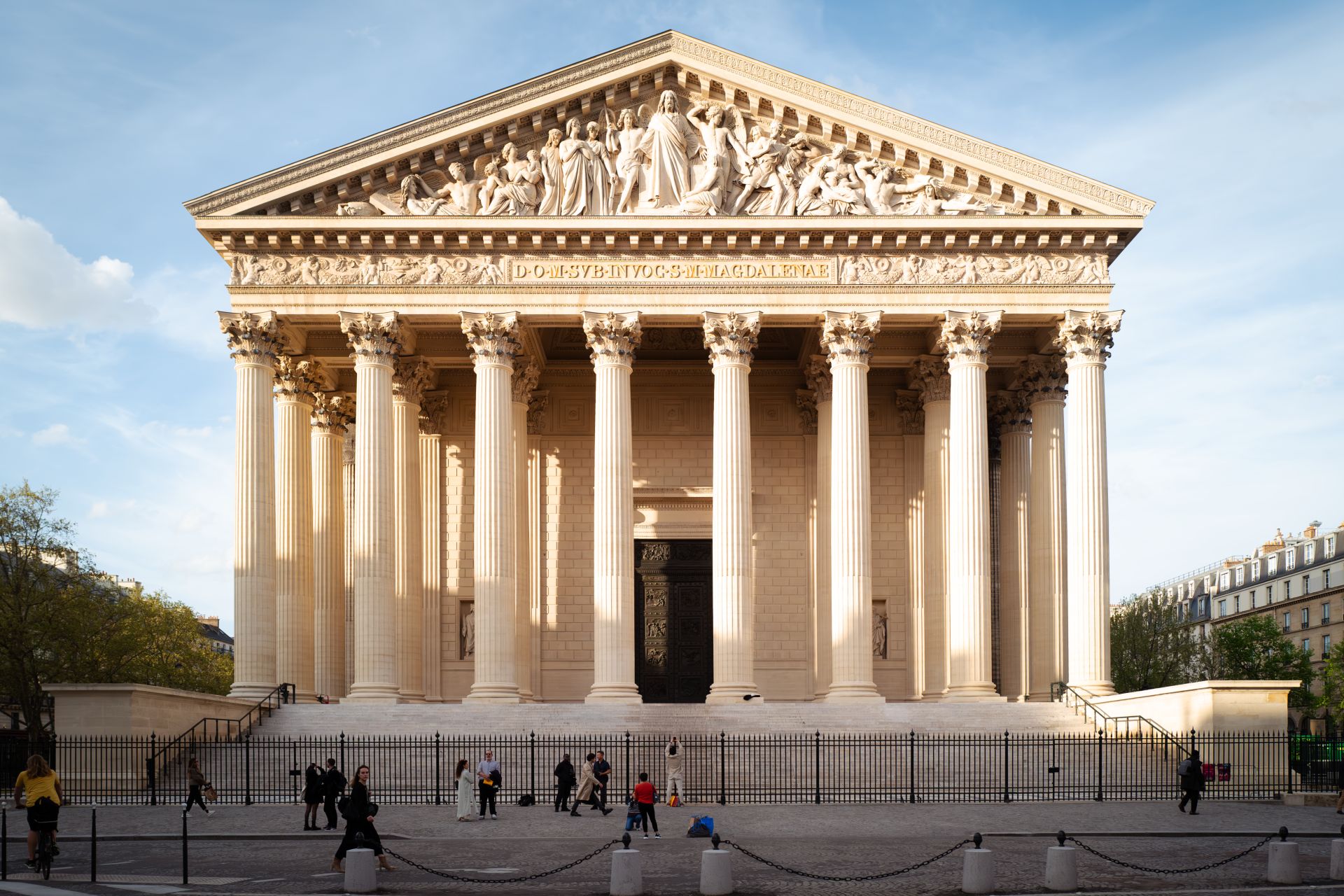
La Madeleine, formally the Church of Saint Mary Magdalene, stands as a striking neoclassical monument at the heart of Paris's 8th arrondissement. Designed to anchor the grand perspective of Rue Royale leading to Place de la Concorde, its construction began under Louis XV in 1764 but was interrupted by the French Revolution. Napoleon later repurposed the unfinished structure as a Temple of Glory, a monument to his Grande Armée, before it was finally consecrated as a Catholic church in 1842. The building's exterior, with its massive Corinthian columns, resembles a Roman temple more than a traditional church, making it one of the city's most distinctive landmarks.
Directed by architect Pierre-Alexandre Vignon, who won the commission in 1806, the church took over three decades to complete, a testament to the political upheavals of the era. Its interior features a single nave with three shallow domes, adorned with sculptures and frescoes that blend classical and Christian motifs. While not a major box office draw, the church has appeared in numerous films and novels, including the 2006 adaptation of The Da Vinci Code, which brought it international attention. Today, it remains an active parish, hosting concerts and services, and is a popular stop for tourists drawn to its architectural splendor and its role in French history.
Mission
La Madeleine serves as an active Roman Catholic parish, providing daily masses, sacraments, and pastoral care to its congregation. Beyond worship, it functions as a cultural venue, hosting concerts and art exhibitions, and welcomes thousands of visitors each year who come to admire its unique architecture. The church aims to balance its religious mission with its role as a public heritage site, opening its doors to all while maintaining the sanctity of its sacred spaces.
History
The story of La Madeleine begins in 1764, when King Louis XV personally dedicated the site and laid the foundation stone. The original plan called for a traditional church, but work stalled during the French Revolution. In 1806, Napoleon Bonaparte took over the project, commissioning architect Pierre-Alexandre Vignon to redesign the unfinished building as a neoclassical Temple of Glory, a monument to his Grande Armée. Vignon's design, with its massive Corinthian colonnade and pediment, gave the structure the appearance of a Greco-Roman temple, a striking departure from typical church architecture.
After Napoleon's fall, the building was finally consecrated as a Catholic church in 1842, and the parish was formally established in 1845. Over the following decades, the church became a beloved Parisian landmark, known for its unique design and its location at the end of Rue Royale. In the 20th century, it gained further fame through appearances in literature and film, most notably in the 2006 adaptation of The Da Vinci Code. In June 2024, the church received a significant boost for its preservation when Marie-Amélie Daout bequeathed more than $5 million for restoration work. More recently, in June 2026, the crypt opened a free street art exhibition called 'La Caverne,' featuring about fifty immersive works, demonstrating the church's ongoing engagement with contemporary culture.
Subdivisions
Religious Services
Daily masses, sacraments, and pastoral care
Cultural Programming
Concerts and musical performances hosted within the church
Tourism and Visitor Services
Welcoming tourists and providing information about the church's history and architecture
Crypt and Underground Spaces
Hosts temporary exhibitions, such as the 'La Caverne' street art show
Notable People
Pierre-Alexandre Vignon
Architect · 1806–1828
Designed the neoclassical temple facade and oversaw construction for over two decades
King Louis XV
Founder · 1764
Dedicated the site and laid the foundation stone
Napoleon Bonaparte
Patron · 1806
Repurposed the structure as a Temple of Glory for his Grande Armée
Marie-Amélie Daout
Benefactor · 2024
Bequeathed over $5 million for the church's restoration
Milestones
1764
King Louis XV dedicates the site and lays the foundation stone
1806
Napoleon commissions Pierre-Alexandre Vignon to redesign the structure as a Temple of Glory
1842
The building is consecrated as a Catholic church
1845
Formal establishment of the religious institution
2006
Appears in the film adaptation of The Da Vinci Code
2024
Marie-Amélie Daout's $5+ million bequest announced for restoration
2026
La Caverne street art exhibition opens in the crypt
Sources
Organization Info
- Founded
- 1845
- Headquarters
- Place de la Madeleine, 75008 Paris, France
- Country
- France
- Parent
- Archdiocese of Paris
- Type
- Religious
Official Website
lamadeleineparis.fr/
Join the community
fans discussing