 France
“A stunning, incendiary work... Mr. Kassovitz has made a film of tremendous immediacy and power, one that captures the fury of a disenfranchised generation with shocking clarity.”
Janet Maslin
The New York Times
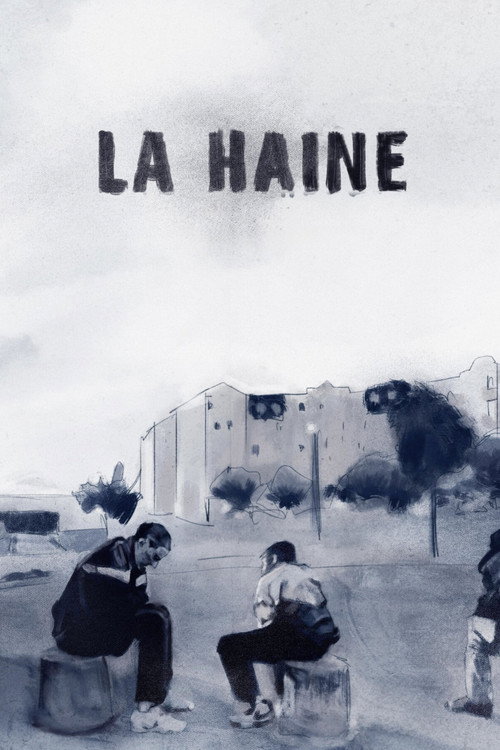
Mathieu Kassovitz's 1995 film La Haine drops you straight into the concrete labyrinth of the Parisian banlieues, a world that mainstream French cinema had mostly ignored. The story kicks off after a night of brutal police violence leaves a young man named Abdel in a coma. Over the next 24 hours, we follow three friends: Vinz, a hotheaded Jewish kid who idolizes Travis Bickle; Hubert, a thoughtful Black boxer and aspiring artist; and Saïd, a quick-witted Arab who keeps the peace. They wander through a landscape of housing projects, graffiti, and simmering rage, carrying a stolen police revolver that becomes a ticking time bomb.
Shot in stark black-and-white on a budget of $2.6 million, the film feels like a documentary from another dimension. Vincent Cassel, Hubert Koundé, and Saïd Taghmaoui were all relatively unknown at the time, but their performances crackle with authenticity. Kassovitz, who grew up in these suburbs, drew directly from the 1993 death of Makomé M'Bowolé, a teenager shot by police. The result is a film that grossed over $15 million worldwide, won the Best Director prize at Cannes, and launched a thousand debates about race, class, and police brutality in France. It's a movie that doesn't just show you anger, it makes you feel it in your bones.
Stream
Availability and pricing can change. Confirm on the provider's site before purchasing.
The film opens with news footage of real riots in the Parisian suburbs, followed by a quote from Jean Genet: "It's the story of a man who falls from a skyscraper. As he falls, he keeps repeating to himself, 'So far so good... so far so good.' It's not the fall that matters, it's the landing." This sets the tone for a story that's less about plot mechanics and more about the inevitability of tragedy in a system designed to fail its citizens.
The story begins in the aftermath of a massive riot in Chanteloup-les-Vignes, triggered by the brutal police beating of a young Arab man named Abdel Ichaha. During the chaos, a police officer loses his service revolver. The film follows three friends over the next 24 hours: Vinz (Vincent Cassel), a hotheaded Jewish youth who idolizes Robert De Niro's Travis Bickle; Hubert (Hubert Koundé), a thoughtful Black boxer and aspiring artist who dreams of escaping the projects; and Saïd (Saïd Taghmaoui), a quick-witted Arab who serves as the group's mediator and comic relief.
The central conflict emerges when Vinz reveals that he has found the missing police gun. He vows to kill a cop if Abdel dies from his injuries. This loaded weapon becomes the film's ticking clock, representing the thin line between anger and destruction. Hubert tries to restrain Vinz's violent impulses, while Saïd attempts to keep the peace between his two friends.
The three friends roam the concrete wasteland of their neighborhood, encountering a gallery of characters: a menacing skinhead who philosophizes about hate, a group of wealthy art gallery patrons who treat them like exotic specimens, and a series of police officers ranging from casually racist to openly hostile. They attempt to visit Abdel in the hospital but are turned away. They try to raise money, get involved in a drug deal gone wrong, and find themselves increasingly trapped in a cycle of humiliation and rage.
A key subplot involves the group's attempt to retrieve a stolen jacket from a local gangster, which leads them into dangerous territory. Throughout the day, Vinz practices his "cop-killing" routine in the mirror, a direct homage to Taxi Driver, while Hubert tries to convince him that violence will only perpetuate their suffering. The film's black-and-white cinematography emphasizes the moral starkness of their world, while the hip-hop soundtrack grounds the story in 1990s French youth culture.
The narrative builds toward a final confrontation at the police station, where the three friends must decide whether to escalate the conflict or find another way forward. The film deliberately avoids easy resolutions, maintaining a documentary-like realism that refuses to sentimentalize its characters' struggles.
Restoration Trailer
Critical Consensus
La Haine is a raw, visceral masterpiece that captures the anger and desperation of marginalized youth in the Parisian suburbs. Mathieu Kassovitz's black-and-white direction and Vincent Cassel's explosive performance create a film that remains urgently relevant decades after its release, a powerful indictment of police brutality and social inequality.
“A stunning, incendiary work... Mr. Kassovitz has made a film of tremendous immediacy and power, one that captures the fury of a disenfranchised generation with shocking clarity.”
Janet Maslin
The New York Times
“Kassovitz shoots the film in black and white, giving it the look of a newsreel from hell. The performances are electrifying, especially Cassel's Vinz, a powder keg of a character who could explode at any moment.”
Peter Travers
Rolling Stone
“This is not a movie about stereotypes, but about individuals. The three young men are not symbols, but people. And their tragedy is that they live in a world where the symbols are more important than the people.”
Roger Ebert
Chicago Sun-Times
“A film of extraordinary force and conviction... Kassovitz's use of black and white strips away the glamour of the banlieue, leaving only the raw concrete and the raw emotions.”
Jonathan Romney
The Guardian
“An emotionally charged, technically accomplished feature that announces the arrival of a major new talent. Kassovitz demonstrates a sure hand with actors and a keen eye for the telling visual detail.”
Todd McCarthy
Variety
Director
Mathieu Kassovitz
Writer
Mathieu Kassovitz
Cinematographer
Pierre Aïm
Producer
Christophe Rossignon
Cannes Film Festival (1995)
Best Director: Won
Cannes Film Festival (1995)
Palme d'Or: Nominated
César Awards (1996)
Best Film: Won
César Awards (1996)
Best Director: Nominated
César Awards (1996)
Best Actor (Vincent Cassel): Nominated
César Awards (1996)
Best Editing: Won
César Awards (1996)
Best Producer: Won
César Awards (1996)
Most Promising Actor (Vincent Cassel): Won
César Awards (1996)
Most Promising Actor (Hubert Koundé): Nominated
César Awards (1996)
Most Promising Actor (Saïd Taghmaoui): Nominated
European Film Awards (1996)
Best Film: Nominated
European Film Awards (1996)
Best Young Film: Won
Lumière Awards (1996)
Best Film: Won
Lumière Awards (1996)
Best Director: Won
BAFTA Awards (1997)
Best Film Not in the English Language: Nominated
Independent Spirit Awards (1997)
Best Foreign Film: Nominated
French Syndicate of Cinema Critics (1996)
Best Film: Won
Join the community
fans discussing